

Chances are, if you’re looking up ‘what is tree lopping’, you’ve got a problem with a tree that’s getting too big, blocking your view, or just looks unsafe. It’s a term we hear a lot across the Central Coast and Newcastle, often used as a catch-all for any kind of tree cutting. But from a qualified arborist's perspective, lopping is a harmful, outdated practice we actively avoid.
Your Guide to Safe and Healthy Tree Care
This guide is here to clear things up. We’ll explain what lopping really is, the lasting damage it does, and walk you through the safer, professional alternative: proper pruning. With over 25 years of hands-on experience in suburbs from Gosford to Lake Macquarie, we've seen firsthand what works for our unique local environment and what doesn't.
Our goal is to give you the information you need to protect your property and keep your trees healthy, all while staying on the right side of council regulations. We’ll even cover the best times to prune trees in Australia for the best results. Think of this as a chat with a local expert, giving you the confidence to make a safe, informed choice for your home or business.
Understanding Tree Lopping and Its Hidden Dangers
So, what exactly is tree lopping? You’ve probably heard the term thrown around. At its heart, it’s the indiscriminate cutting of branches or even a tree's main trunk, done with zero regard for its natural structure or biology. Often called 'topping', this aggressive method involves hacking off large limbs, leaving ugly, flat-topped stubs.
Imagine you've got a large gum tree in Terrigal dropping branches onto your driveway. A 'lopper' might suggest just cutting the whole top off. While it might look like a quick fix, this approach is one of the worst things you can do for the tree. It’s like performing surgery with a sledgehammer instead of a scalpel—the damage is immediate, severe, and often irreversible.
Why Lopping Is So Harmful
The huge, open wounds left by lopping are simply too big for a tree to seal over properly. This makes them wide-open invitations for pests, fungal decay, and diseases that rot the tree from the inside out. In response to this trauma, the tree panics. It goes into survival mode, frantically pushing out a dense cloud of weak, fast-growing shoots called epicormic growth.
These new branches aren't anchored securely like the originals. They’re poorly attached and far more likely to snap off in the next big coastal storm that rolls through Newcastle or the Central Coast. So, instead of making the tree safer, lopping actually creates a ticking time bomb. It’s a cheap, short-term fix that guarantees long-term danger and instability.
To help you visualise the right and wrong way to handle an overgrown tree, take a look at this quick guide.
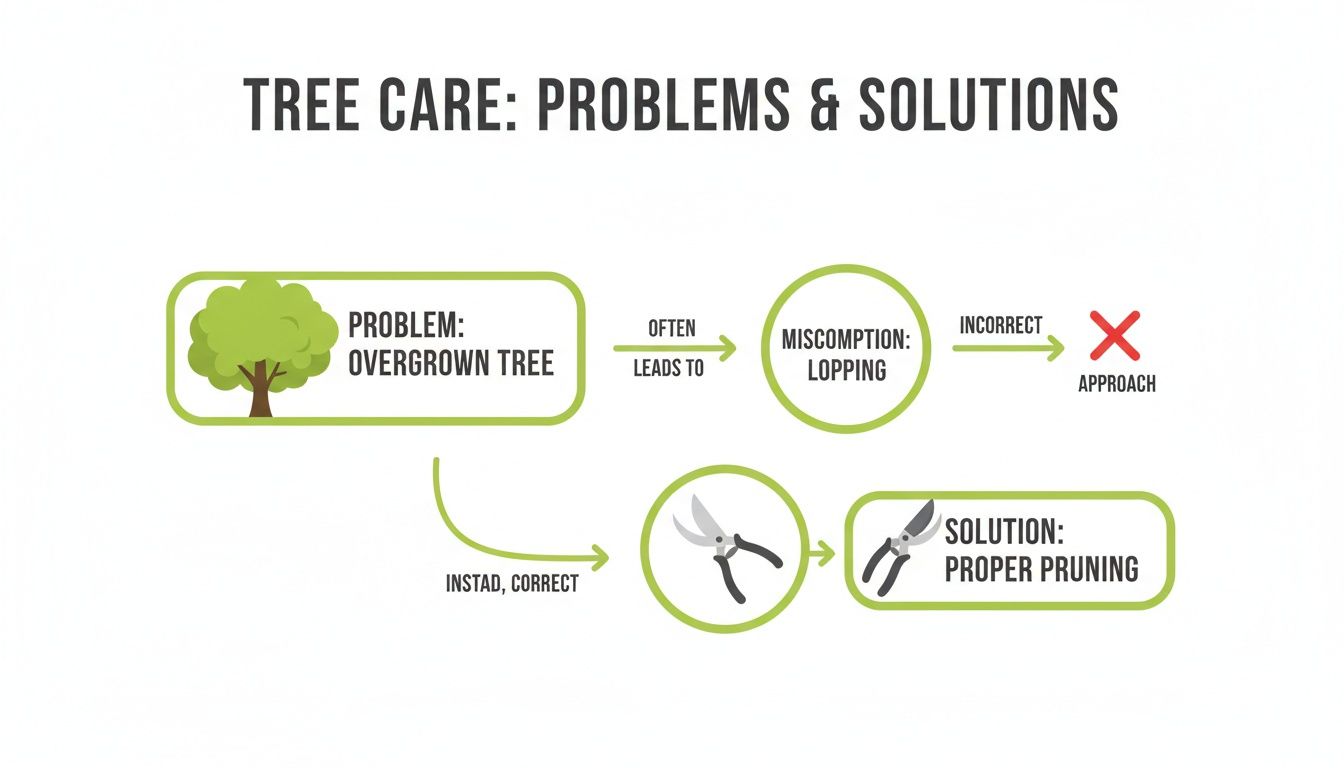
As you can see, the problem—an overgrown tree—is real, but choosing lopping leads to a dangerous outcome. Professional pruning, on the other hand, provides a safe, healthy, and sustainable solution.
Tree Lopping vs Professional Pruning: A Quick Comparison
It's easy to get confused by the terminology, but the difference in outcomes is massive. Here’s a simple breakdown to help you understand why one is a harmful practice and the other is a vital part of tree care.
| Aspect | Tree Lopping (Incorrect Method) | Professional Pruning (Correct Method) |
|---|---|---|
| Technique | Indiscriminate cutting, 'topping' main stems, leaving large stubs. | Selective removal of branches at growth points or collars to promote healing. |
| Tree Health | Causes stress, decay, disease, and weak regrowth. | Improves structure, encourages strong growth, and removes dead or diseased wood. |
| Safety | Creates unstable, weakly attached branches prone to failure. | Makes the tree safer by removing hazardous limbs and improving overall stability. |
| Appearance | Leaves a disfigured, unnatural shape that ruins the tree's aesthetic. | Enhances the tree's natural form and beauty. |
| Long-Term Cost | Requires frequent, costly re-cutting and often leads to premature tree removal. | A smart investment in the long-term health and safety of your tree, reducing future costs. |
Ultimately, choosing professional pruning over lopping is about investing in the health, safety, and beauty of your property for years to come.
The Risks Go Beyond Tree Health
The dangers of lopping aren’t just confined to the tree itself. While this heavy-handed trimming has been common in New South Wales for years, the safety data paints a grim picture. National statistics show that a shocking 20% of all tree work casualties happen during lopping or trimming operations. This highlights just how risky the practice is, especially when untrained and unqualified operators are involved. You can discover more insights about Australian tree work safety to understand the full scope of the problem.
On top of the safety risks, there are legal ones. Many councils across the Central Coast, Lake Macquarie, and Newcastle have strict tree preservation orders in place. Illegally lopping a protected tree can land both the property owner and the person who did the work with hefty fines. This is exactly why understanding safer, council-compliant alternatives is so critical.
The Professional Alternative That Protects Your Trees
Now that we’ve seen the damage lopping can cause, let’s look at how a qualified arborist approaches tree care. We practice arboricultural pruning, a skilled discipline guided by strict Australian Standards (specifically AS 4373-2007). This isn't about hacking away at branches; it's a science. We make precise, selective cuts to improve a tree’s health, structure, and safety for the long haul.
Imagine you have a beautiful angophora in your Lake Macquarie garden, and its branches are starting to creep a little too close to your roof. An unqualified operator might just lop it back harshly. In contrast, our team would assess the tree, understand its growth patterns, and recommend a specific pruning strategy that works with the tree, not against it.
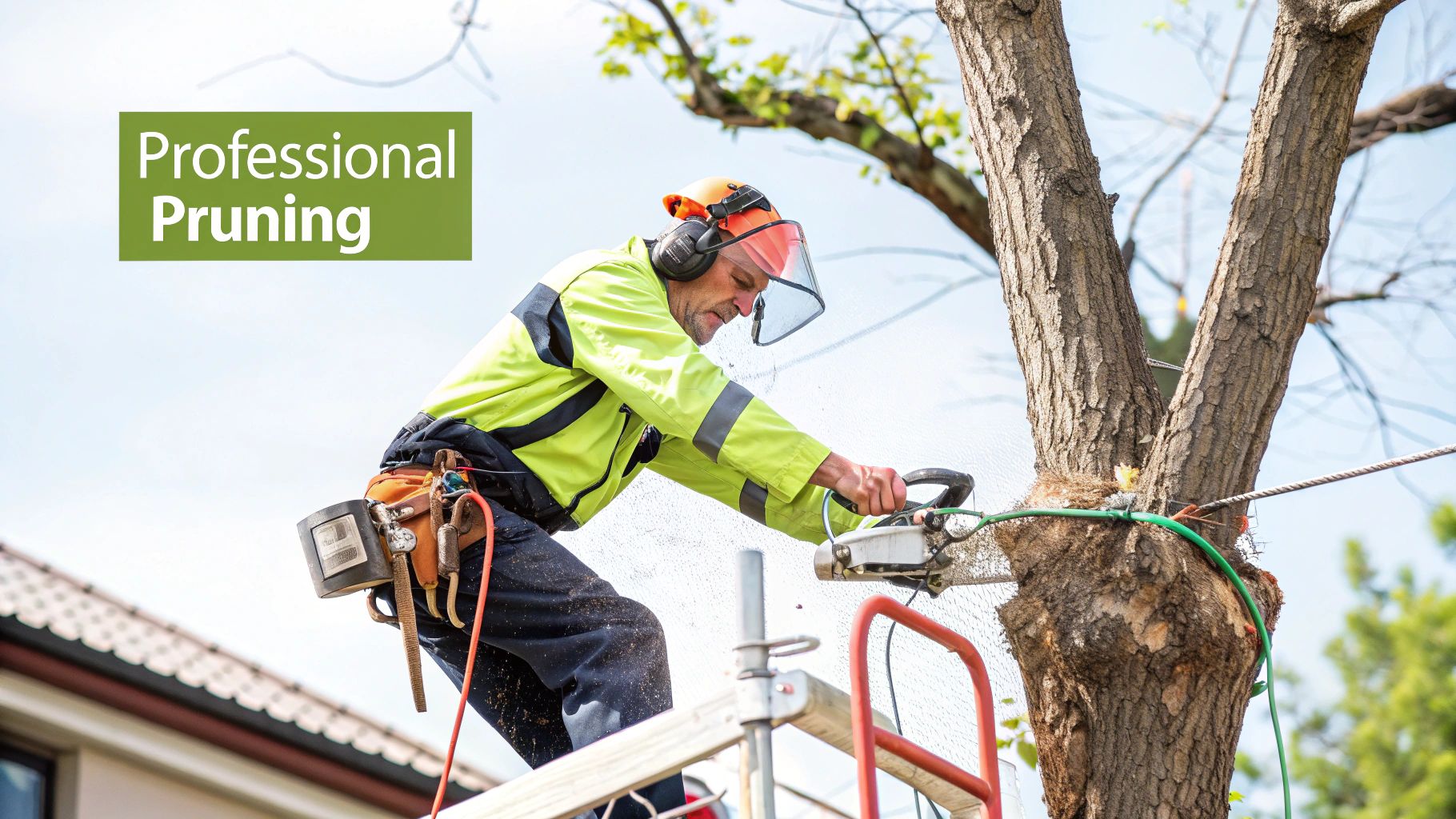
Common Pruning Techniques We Use
Instead of causing damage, we use proven methods to solve common problems for homeowners across the Central Coast and Newcastle. Each technique has a clear purpose, designed to fix the issue without harming the tree's health or stability.
Here are a few examples of professional pruning techniques:
- Crown Thinning: This involves carefully removing smaller branches from inside the canopy. The idea is to let more sunlight and air flow through, which reduces disease risk and strengthens the tree's overall structure without actually changing its size or shape.
- Crown Lifting: Need more clearance for a driveway, footpath, or under your house in a suburb like Gosford? We can remove the lowest branches, lifting the entire canopy upwards. This creates usable space underneath while leaving the bulk of the tree untouched.
- Selective Pruning: When a branch gets too long or heavy, we don't just chop it off. We trace it back to a strong side-branch—a suitable lateral—and prune it there. This encourages regrowth in a better direction and avoids leaving a big, ugly wound that won’t heal.
These methods are designed to be subtle. The goal is to leave the tree looking natural, balanced, and even healthier than when we arrived. To see how these different methods work in practice, you can learn more about our professional tree pruning on the Central Coast and see how we apply them.
The key difference is foresight. Lopping focuses on a quick, aggressive cut for today. Professional pruning considers the tree’s health, safety, and growth for the next ten years and beyond, protecting your property's most valuable green assets.
By working with the tree's biology instead of against it, we ensure it heals properly and continues to thrive for many years to come.
Knowing When Tree Removal Is the Safest Option
Sometimes, even the most careful and professional pruning isn't enough to save a tree. This is especially true for trees that have been slowly weakened over many years by storms, disease, or the irreversible damage caused by reckless lopping. When a tree's structural integrity is compromised beyond repair, professional tree removal becomes the only responsible and safe path forward.
While we always prefer to preserve a healthy tree, your safety has to be the top priority. A dying or structurally unsound tree is a ticking time bomb, posing a huge risk to your home, your family, and the public. With over 25 years of hands-on experience, we’ve learned exactly how to spot a tree that has tipped over from being an asset into a liability.
Key Warning Signs to Look For
It can be tough for the untrained eye to tell a healthy tree from a hazardous one. But there are a few clear red flags that suggest removal might be on the cards. Keeping an eye out for these signs can help you take action before a dangerous situation unfolds.
You should call us for a professional assessment if you spot any of these:
- Large, dead branches in the upper canopy that are completely bare of leaves.
- Deep cracks or splits visible in the main trunk, especially if they look like they go deep into the wood.
- Fungal growth, like mushrooms or shelf-like conks, sprouting on the trunk or around the base.
- A significant lean that has appeared suddenly or is getting worse over time.
Imagine you have a massive Ironbark in your Warners Bay yard that’s constantly dropping limbs and has huge sections of dead wood. It’s more than just a nuisance. That's the tree's way of telling you its health is failing and its structure could give way at any moment.
Navigating Council Permits and Insurance
Deciding a tree needs to go is just the first step. The next part, dealing with council permits, can feel like a maze. Regulations are different across the Central Coast, Newcastle, and Lake Macquarie council areas, and they can be complex. For example, getting approval to remove a native species is often much harder than for an invasive one.
To make things easier, we've put together a detailed guide on council approval for tree removal that breaks down the whole process.
Better yet, our team can handle all of this for you. We manage everything from the initial hazard assessment and arborist report right through to lodging the application with your local council. Your peace of mind is what matters most, which is why all our tree removal work is backed by our $20 million public liability insurance. This guarantees your property is fully protected from start to finish, so you can have complete confidence the job is being done safely and by the book.
How to Choose a Qualified Arborist on the Central Coast
Your trees are one of the most valuable assets on your property, so finding the right professional to look after them is a big deal. The trouble is, the industry is full of unqualified operators calling themselves 'tree loppers' who can cause serious, often irreversible, damage. To protect your trees and your property, you need to know exactly what to look for when hiring someone.
This is especially critical for homeowners and strata managers in areas like Wyong, Tuggerah, and Warners Bay. A few quick checks are all it takes to separate a genuine, professional arborist from a risky operator. Think of it as your safety checklist to make sure you're hiring someone who will protect your property, not put it in danger.
Your Arborist Hiring Checklist
Before you even think about agreeing to any work, you must ask for proof of qualifications and insurance. This isn’t about being difficult; it's just smart, responsible property ownership. Any reputable company will have this information ready to go and will be happy to show you. If they hesitate or make excuses, that’s a massive red flag.
Here’s what you should always ask to see:
- Formal Qualifications: Ask if they are a qualified arborist with at least a Certificate III in Arboriculture. This is the national industry standard and proves they have the proper technical knowledge for tree care. You can find out more about what arborists do and why qualifications matter in our detailed guide.
- Public Liability Insurance: Always request a current Certificate of Currency for their public liability insurance. We carry a $20 million policy, which ensures your property is completely protected from any unforeseen accidents.
- Workers' Compensation Insurance: Make sure their team is covered by workers' compensation. This is crucial as it protects you from any liability if one of their workers gets injured on your property.
Get Everything in Writing
Once you’ve confirmed their credentials, the final step is getting a detailed, written quote. Vague, verbal agreements are a recipe for disaster, often leading to confusion and unexpected costs down the track. A professional quote should clearly spell out the entire scope of the job, from the specific pruning techniques they’ll use to a thorough site clean-up.
A professional quote protects both parties. It should specify exactly what work will be done, the equipment to be used, and confirmation that all debris will be removed, leaving your property tidy.
For example, if you're in Belmont and need a large gum tree made safe, the quote shouldn't just say "cut tree." It should detail whether the job involves selective pruning, crown reduction, or deadwooding. This level of detail means no nasty surprises and guarantees the job is completed to the highest standard, from start to finish. It’s the hallmark of a reliable team that values clear communication and truly professional service.
Specialised Tree Care for Strata and Commercial Properties
When it comes to managing trees on a strata or commercial property in Newcastle or the Central Coast, the stakes are much higher than in a typical backyard. Decisions don't just affect one family—they impact multiple residents, businesses, and the general public. Safety and legal liability move right to the top of the list.
Picture a huge, old fig tree in the shared courtyard of a Warners Bay apartment complex. If that tree is butchered through incorrect lopping, it doesn't just look bad; it can become a serious, ongoing liability for the body corporate. This is exactly why a professional, proactive approach is so critical.
Proactive Management for Shared Spaces
We specialise in creating long-term tree management plans built for the unique demands of strata and commercial sites. These plans are designed to work within body corporate budgets, ensure total compliance with Work Health and Safety (WHS) legislation, and cut through the usual red tape of the approval process.
Our scheduled maintenance programs are the best defence against a costly emergency. By keeping a regular eye on the trees across your property, we can:
- Spot and manage potential risks before they turn into dangerous hazards.
- Keep common areas safe and inviting for residents, customers, and staff.
- Protect the value and amenity that only healthy, well-maintained trees can add to a property.
With 25 years of local experience, we know that clear communication and professional paperwork are just as important as the work itself. We provide clear quotes and detailed reports that make the decision-making process straightforward for strata managers and committee members. If you're dealing with high-risk trees or complex council applications, it's vital to understand what a consulting arborist with Level 5 qualifications brings to the table in protecting your asset.
From routine pruning in a Tuggerah business park to an emergency storm clean-up in Gosford, we have the team and the gear to handle it. Our $20 million public liability insurance and our "On Time, Every Time" guarantee give strata and commercial clients the reliability and peace of mind they absolutely depend on.
Your Questions Answered
We get asked a lot of questions about tree care from property owners across the Central Coast, Lake Macquarie, and Newcastle. Here are a few of the most common ones, with straight-to-the-point answers to help you make the right call for your property.
How Can I Tell If a Tree Has Been Lopped?
Once you know what to look for, a lopped tree is hard to miss. The biggest giveaway is the presence of large, flat stumps where major branches have been hacked off, with no thought for the tree's natural shape.
The tree’s desperate response is another tell-tale sign. You'll see dense clusters of weak, vertical shoots sprouting from just below these ugly cuts. The whole thing just looks butchered and unnatural, a world away from a professionally pruned tree, where the smaller, angled cuts are tucked neatly near branch collars, designed to heal and almost disappear over time.
Do I Need a Council Permit for Tree Pruning?
This is a big one, and the answer is: it depends. Generally, minor pruning that fits within the Australian Standards (like trimming less than 10% of the canopy) is fine. But the moment you get into significant work or any kind of tree removal, you almost certainly need a permit—especially for native trees or those over a certain height.
The rules are different for Central Coast Council, Lake Macquarie City Council, and the City of Newcastle. As local arborists working in suburbs from Erina to Belmont every day, we know the specific local laws inside and out. We can tell you if a permit is needed and even help you with the paperwork to make sure everything is above board.
Is Professional Pruning More Expensive?
A quote from a cheap 'lopper' might look tempting at first glance, but it's a classic false economy. That initial saving often turns into a massive expense down the track. Lopping creates weak points, which can lead to catastrophic failure in a storm, rampant disease, or the eventual—and much more expensive—need for an emergency tree removal.
Think of professional pruning as a smart investment. You're not just paying for a trim; you're investing in your tree's long-term health and your property's safety. When you add up the reduced risks and the costly problems you'll avoid, proper arboricultural care delivers far better value every time.
Ready to get expert advice on your trees? The team at Treecorp Solutions is here to help with a free, no-obligation property assessment.
Get a Free Quote Online or call us for 24/7 emergency service.


