Got a problem tree on your property and not sure where to even begin? If you're on the Central Coast, in Newcastle, or around Lake Macquarie, the first hurdle is almost always the same: figuring out if you need the council's permission. The short answer is that it depends on the tree's size, species, and exact location. These factors determine if it’s a protected tree, which means you’ll need a permit before a single branch is touched. Navigating this can feel tricky, but we're here to help you get it right from the start.
Understanding Council Rules for Tree Removal
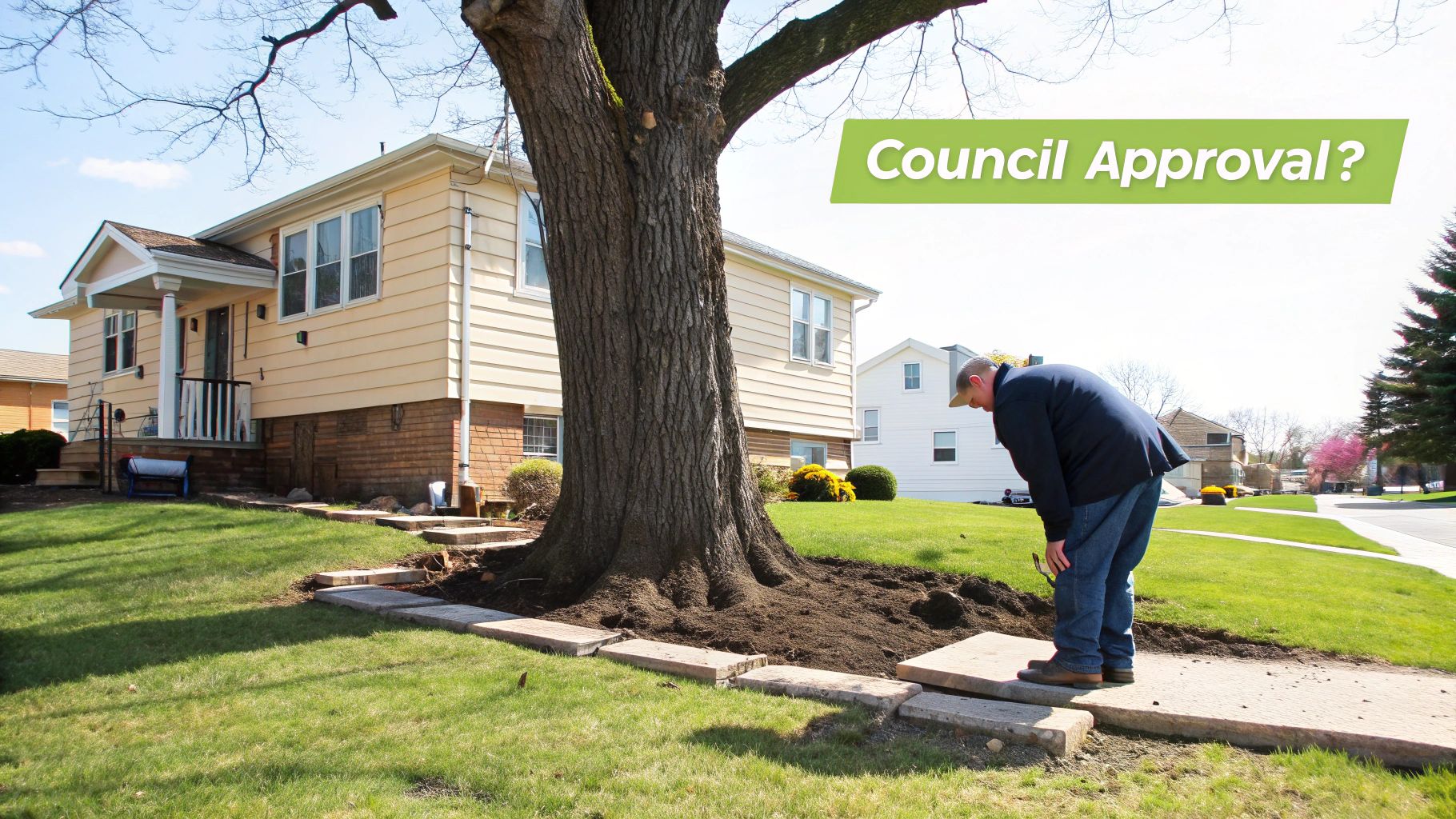
Before you think about getting a quote or scheduling a removal, you have to work out if the tree falls under your local council's protection. Councils across our region have specific regulations, often called Tree Preservation Orders (TPOs) or found within their Development Control Plans (DCPs). These aren't just red tape; they're designed to protect our valuable urban canopy, which benefits everyone.
Imagine you've got a massive Blackbutt in your Warners Bay backyard that’s starting to lift the foundations. Or perhaps a large gum tree in Terrigal is dropping heavy branches right where the kids play. In both scenarios, your first step isn’t calling for a removal crew. It’s checking with the council. Acting without permission can lead to some seriously hefty fines, so it pays to be certain.
When You Will Likely Need a Permit
While every council is a bit different, a permit is usually required if the tree is over a certain size, a significant native species, or located in a protected area like a heritage zone. For example, a tree over 5 metres tall or a classic Eucalypt often needs approval. Trees near waterways are also critical for soil stability, so their removal is scrutinised.
These rules exist because councils are managing a community-wide asset. A healthy, mature tree canopy does so much for our suburbs, from providing shade and cooling our streets to supporting native birds and wildlife. A formal council approval for tree removal is their way of balancing your needs as a property owner with the greater environmental good of the community.
Why Your Council Cares
Navigating the rules and paperwork can feel like a maze, but that’s where we come in. With over 25 years of local experience, we know the ins and outs of the application process for Central Coast Council, Newcastle City Council, and Lake Macquarie Council. We can help you figure out what's required and guide you every step of the way.
For a deeper look at the specifics, check out our detailed Central Coast guide to tree removal. Getting the right advice early makes the whole process smoother, ensuring your tree problem is solved safely and, most importantly, legally.
How to Identify a Protected Tree on Your Property
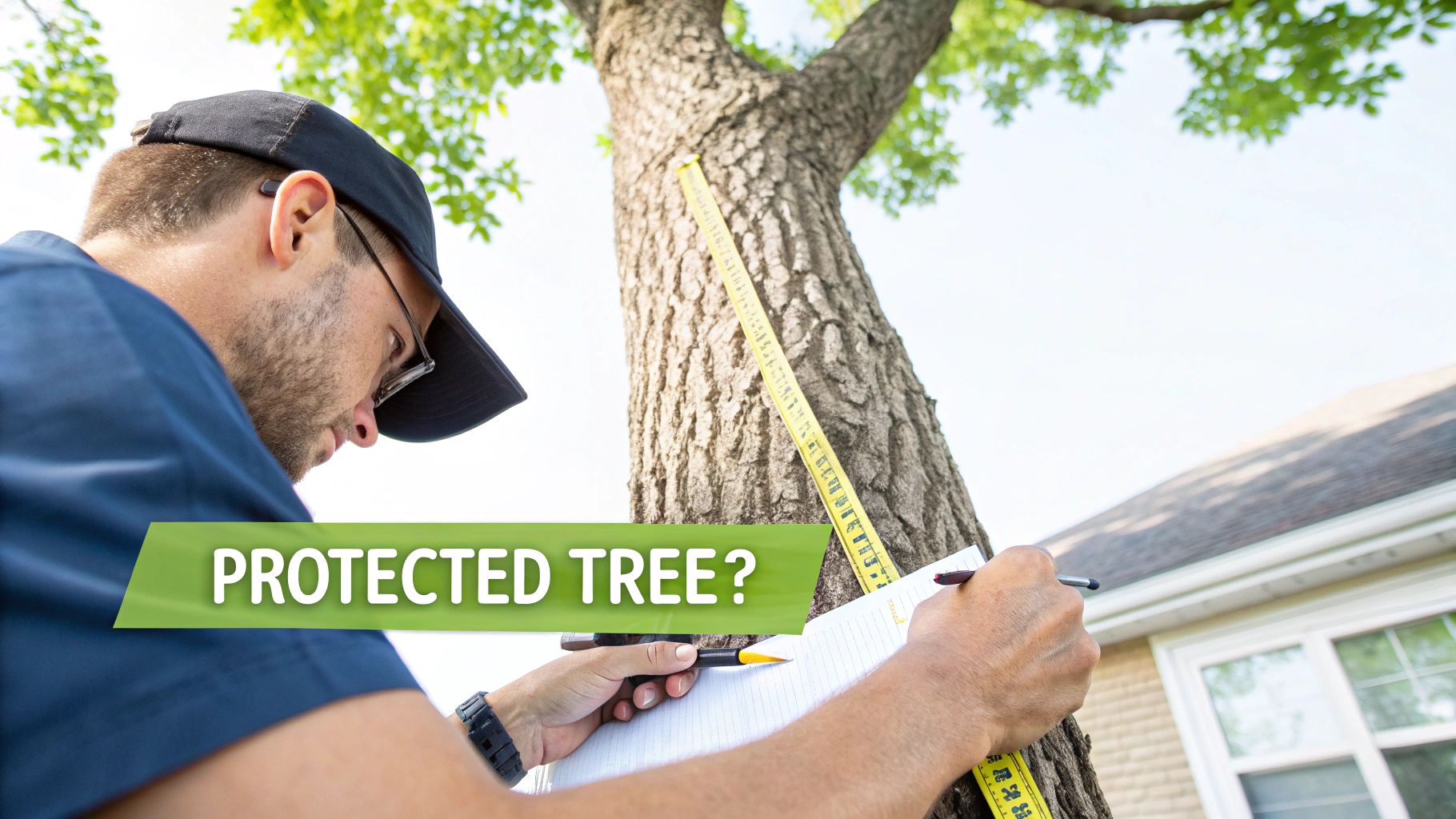
Figuring out if that big old tree in your backyard is protected can feel a bit like detective work. In our experience, it nearly always boils down to three things: its size, its species, and its location. Councils across the Central Coast, Newcastle, and Lake Macquarie all use these same core criteria, though the specifics might vary.
Most of the time, size is the first hurdle. Councils set clear thresholds for height or trunk diameter. For instance, a tree that's over 5 metres tall or has a trunk circumference greater than 500mm at chest height often automatically falls under a Tree Preservation Order (TPO).
But it’s not just the giants that get protection. The species is just as critical. Many native Australian trees—especially certain types of Eucalypts, Turpentines, and Angophoras—are often protected regardless of their size. A majestic old Fig tree in a Newcastle conservation area, for example, will have far more stringent protections than a small, introduced species in a standard Gosford backyard.
Key Takeaway: Never assume a tree is okay to remove just based on its size. A tree’s protection status is a mix of its dimensions, its species, and any location-specific overlays like heritage zones. You have to check all three.
Taking Some Basic Measurements Yourself
You can get a rough idea of where you stand with a quick check. While it won't replace a formal assessment from a qualified arborist, it’s a solid starting point. Look for height (is it taller than your house?), measure the trunk circumference about 1.4 metres from the ground, and eyeball the canopy spread. With these simple numbers, you'll be much better prepared when you look up your local council's specific rules.
Understanding Species and Location Factors
Nailing the exact species can be tough for the untrained eye, which is why a professional assessment is so valuable. Some species are protected because they’re vital to the local ecology, while others might be on an exempt list. A good place to start is learning about the most common trees on the Central Coast to see if you can spot what's in your yard.
Your property’s location adds another layer. If you live in a designated heritage conservation area, a bushfire-prone zone, or near a sensitive waterway, the rules instantly become stricter. A tree in a Belmont backyard bordering a creek will be viewed very differently by the council than the same tree in a standard residential block in Toukley. This approach is standard practice, as this in-depth review of urban tree protection in Australia shows.
If this all sounds a bit overwhelming, don't stress. As qualified arborists, this is what we do all day. We can identify the species, take precise measurements, and provide a formal report that spells out whether a permit is needed—the crucial first step for any successful council application.
When You Can Remove a Tree Without Council Approval
It’s a common worry we hear: the thought of drowning in council paperwork just to deal with a problem tree. But here's the good news—getting council approval for tree removal isn’t always on the cards. Knowing the specific situations where you can act without a permit can save you a huge amount of time and hassle.
One well-known exemption is the 10/50 Vegetation Clearing rule. If your home is in a designated 10/50 entitlement area, you may be able to remove trees within 10 metres of your house without a council application. This rule is designed for bushfire preparation, but it's critical to check the official Rural Fire Service online tool to confirm your property qualifies first.
Common Exemptions Beyond Bushfire Rules
Aside from the 10/50 scheme, each council has its own list of exempt trees and circumstances. You typically won't need a permit for trees that are under a certain size (usually 3 to 5 metres), a declared noxious weed like Camphor Laurel or Privet, or completely dead with no habitat value. It's always smart to take photos beforehand as proof, just in case.
The Immediate Risk Exemption
There’s also a crucial exemption for emergencies. If a tree presents a clear and immediate danger to life or property—like splitting in a storm and threatening your roof—you can often act without waiting for council's green light. However, this clause is for genuine emergencies. You must be able to prove the danger was real and imminent, so taking plenty of photos and videos before any work begins is essential. Our guide on managing storm-damaged tree removal has more detail on handling these urgent situations.
Our Arborist's Advice: Even when you think a tree is exempt, getting a professional opinion is your best insurance policy. We’ve seen homeowners in Umina Beach or Morisset mistake a protected native for a common weed. That one simple mistake can lead to fines running into the thousands. A quick assessment from a qualified arborist gives you peace of mind that you're acting within the law.
Navigating the Tree Removal Application Process
So, you've figured out your tree needs the green light from the council. This part of the process can feel daunting, but with the right preparation, it’s entirely manageable. The trick is to see it as building a clear, convincing case for why removal is the best option for your property and for safety.
First, you need to gather your evidence. A simple site plan showing your property boundaries, house, and the tree's location is a great start. Next, get your camera out. Take photos of the whole tree, close-ups of any worrying signs like cracks or dead branches, and shots showing how close it is to your home or powerlines. These images provide critical context.
The Power of a Professional Arborist Report
While your photos are essential, the single most powerful tool in your application is a professional arborist report. This is an expert assessment that gives the council an unbiased, data-driven analysis. It includes a formal identification of the species, a detailed health check, a risk assessment, and a clear justification for removal, explaining why other options like pruning won’t solve the problem.
Let's say you want to remove a large, leaning Tallowwood in your Eleebana backyard. Simply writing "it looks dangerous" on a form doesn't carry much weight. But an arborist report detailing the tree's 20-degree lean and documenting extensive internal decay makes the risk impossible to ignore. This is the hard evidence that gets applications approved.
An arborist report transforms your application from a simple request into a well-supported, professional submission. It demonstrates to the council that you've done your due diligence and dramatically increases your chances of a successful outcome.
What to Expect After You Submit
Once you’ve lodged your application, you can generally expect to wait somewhere between four to eight weeks for a decision. In that time, the council might send someone for a site inspection. This is a standard part of the procedure and why having an accurate arborist report is so crucial—it ensures everyone is working from the same set of facts.
We know pulling together an application is time-consuming. That’s why we often handle the entire process for our clients. From the initial assessment and professional report writing to submitting the paperwork, our complete approach to tree management gives your application the best possible chance of success.
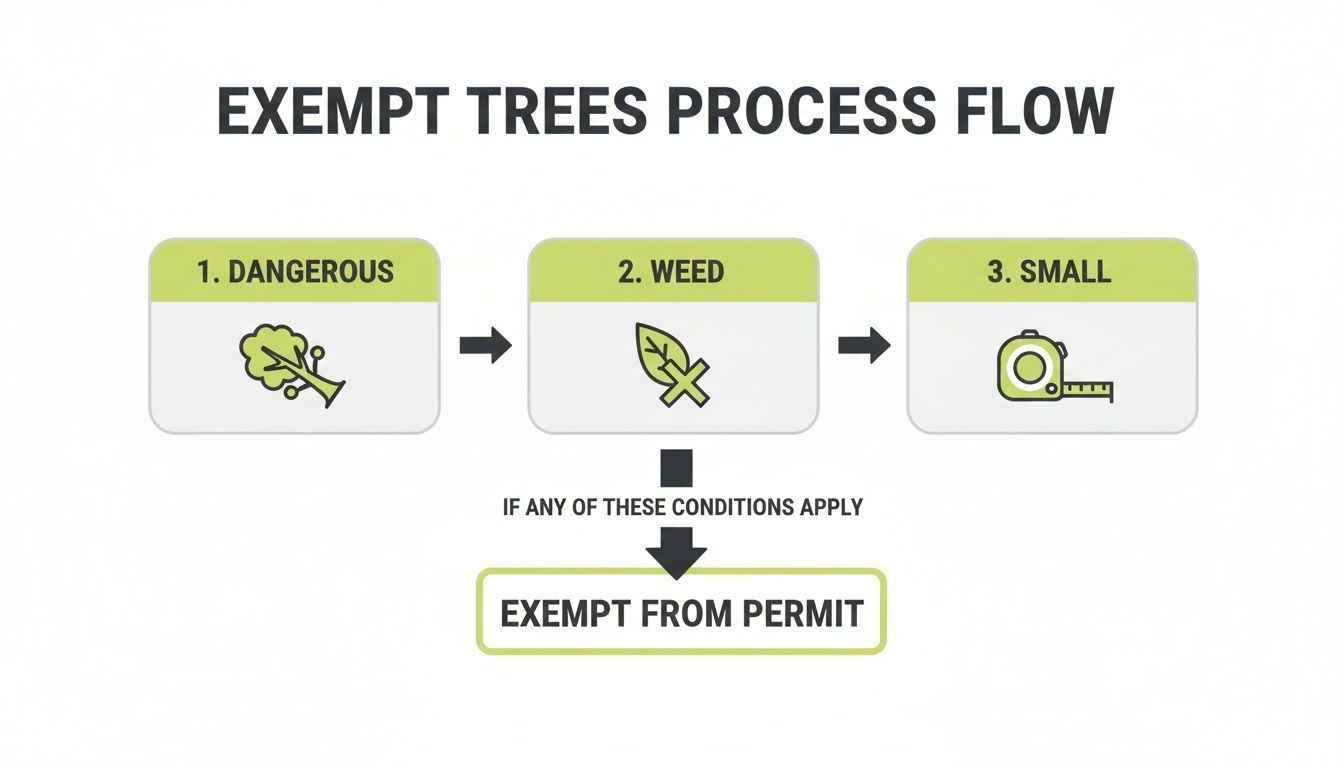
As you can see, key factors like immediate danger or being classified as a weed species can mean you avoid the formal application process entirely.
A Shift Towards Preservation
Councils across Australia, including our local ones, are putting more effort into preserving our urban tree canopy. As our suburbs get more crowded, a healthy network of trees provides critical benefits like shade and cleaner air. This is why you'll find councils now favour options like strategic pruning over complete removal whenever it's a viable choice. This is a national trend, as detailed in this analysis of Australian vegetation management frameworks.
Understanding this helps you frame your application successfully. You need to present a compelling reason for removal that outweighs the benefits the tree provides, usually by demonstrating a clear risk to safety or property. Our expertise, backed by $20 million in public liability insurance, ensures we consider all risks and present the strongest possible case on your behalf.
Common Questions About Council Tree Removal Permits
After 25 years in the business, we've heard just about every question you can imagine when it comes to council permits. Here are a few of the most common ones we get from homeowners across the Central Coast, Newcastle and Lake Macquarie areas.
What Happens If I Remove a Protected Tree Without Approval?
Put simply, it's a very bad idea. Cutting down a protected tree without the proper green light is a serious offence that can lead to massive fines—we're talking tens of thousands of dollars. These penalties can be applied to both you, the property owner, and whoever did the work. Councils don't mess around with enforcement, and pleading ignorance won't get you out of it.
My Neighbour's Tree Is a Problem. What Can I Do?
This is always a tricky situation. Legally, you can usually prune branches that hang over your property line, but the best first step is always a friendly chat with your neighbour. If that doesn't work, bringing in an arborist for a neutral assessment of the tree's health and risk can provide a professional opinion to work from.
How Much Do Tree Removal Permits and Reports Cost?
While we can't give exact figures, you'll have a non-refundable application fee that goes to the council. The main cost is the arborist report. It's better to think of this as an investment in getting your application approved. A quality report provides the detailed risk assessment and justification for removal that council officers need, dramatically increasing your chances of getting a "yes."
The Council Rejected My Application. What Are My Options?
A rejection isn't always the final word. A practical first step is to revisit the arborist report. Often, the council might be open to an alternative solution like canopy reduction or selective pruning. These options can often solve your problem while still meeting the council's goal of preserving the tree where possible. We can help you explore what makes the most sense.
How Long Does Council Approval Usually Take?
The timeline for getting council approval for tree removal can really vary. As a general rule, you should plan for a wait of anywhere from four to eight weeks after you’ve lodged your complete application. This window can be affected by the council's workload, especially after major storms, and the complexity of your request. Submitting an application with missing info is the surest way to hit delays.
Will My Application Definitely Be Approved?
Unfortunately, there’s no guarantee of approval. The council bases its decision on the tree's health, its significance to the local environment, and the actual level of risk it poses. But you can absolutely stack the odds in your favour. A comprehensive arborist report that clearly outlines the reasons for removal is your single greatest asset.
Can a Strata Body Corporate Approve a Tree Removal?
If you live in a townhouse or apartment complex in a place like Erina or Charlestown, you’ve got an extra layer of approval. The body corporate has to sign off on any work on common property first. However, even with strata’s blessing, you still have to follow the local council's rules. A body corporate cannot override a council's Tree Preservation Order. We have plenty of experience working with strata managers to ensure all approvals are handled correctly.
Important Safety Note: Never hire someone who offers to remove a protected tree for cash without a permit. This is illegal and exposes you to enormous fines and liability if something goes wrong. A professional and insured company will always insist on following the correct legal process. This protects you, your property, and our team.
After a major storm, things can get complicated, especially when insurance gets involved. To see how we can help, learn more about our process for handling tree-related insurance claims.
Navigating the world of council permits can feel overwhelming, but you don't have to go it alone. The team at Treecorp Solutions has over 25 years of experience helping homeowners and businesses across the Central Coast, Newcastle, and Lake Macquarie. We're known for our "On Time, Every Time" reliability.
From professional arborist reports to managing the entire application process, we're here to make it simple.
Get a free, no-obligation property assessment today. Call us on 0477 070 330 or request a free quote online.