

Choosing the right tree for your garden on the Central Coast, in Newcastle, or around Lake Macquarie, is about more than just good looks. As arborists with over 25 years of local experience, we see firsthand the costly damage caused by aggressive root systems. We've seen pipes cracked, driveways lifted, and foundations put under serious pressure. The solution is often selecting a tree with a root system that plays well with the built environments we live in.
This guide is your starting point for finding beautiful, small Australian native trees with non-invasive roots that will improve your property without becoming a future headache. We'll explore top choices suitable for everything from a tight backyard in Terrigal to a shared strata complex in Gosford, ensuring your new tree is an asset, not a liability. These species are selected for their manageable size and, most importantly, their friendly root behaviour, making them ideal for planting closer to homes, paths, and underground services.
Understanding which species work best in our local soil and climate is key. While this article focuses on trees with non-invasive roots for our region, exploring broader lists can also be helpful. For instance, to broaden your understanding of suitable species, you might explore general lists of top native plants for landscaping to see what thrives in different Australian-style climates. In this guide, however, we’ll dive deep into specific, locally-proven options, giving you the confidence to plant the right tree in the right place, avoiding expensive problems down the track. You'll learn which trees to choose, where to plant them, and how to care for them.
1. Lilly Pilly (Syzygium smithii)
The Lilly Pilly is a true workhorse of Australian gardens and a fantastic choice if you're looking for small Australian native trees with non-invasive roots. Specifically, we're talking about Syzygium smithii (also known as the Creek Lilly Pilly), a variety known for its compact, dense growth and predictable behaviour. It typically reaches a manageable height of 3-6 metres, making it perfectly suited for residential blocks across the Central Coast and Newcastle where space is often at a premium.
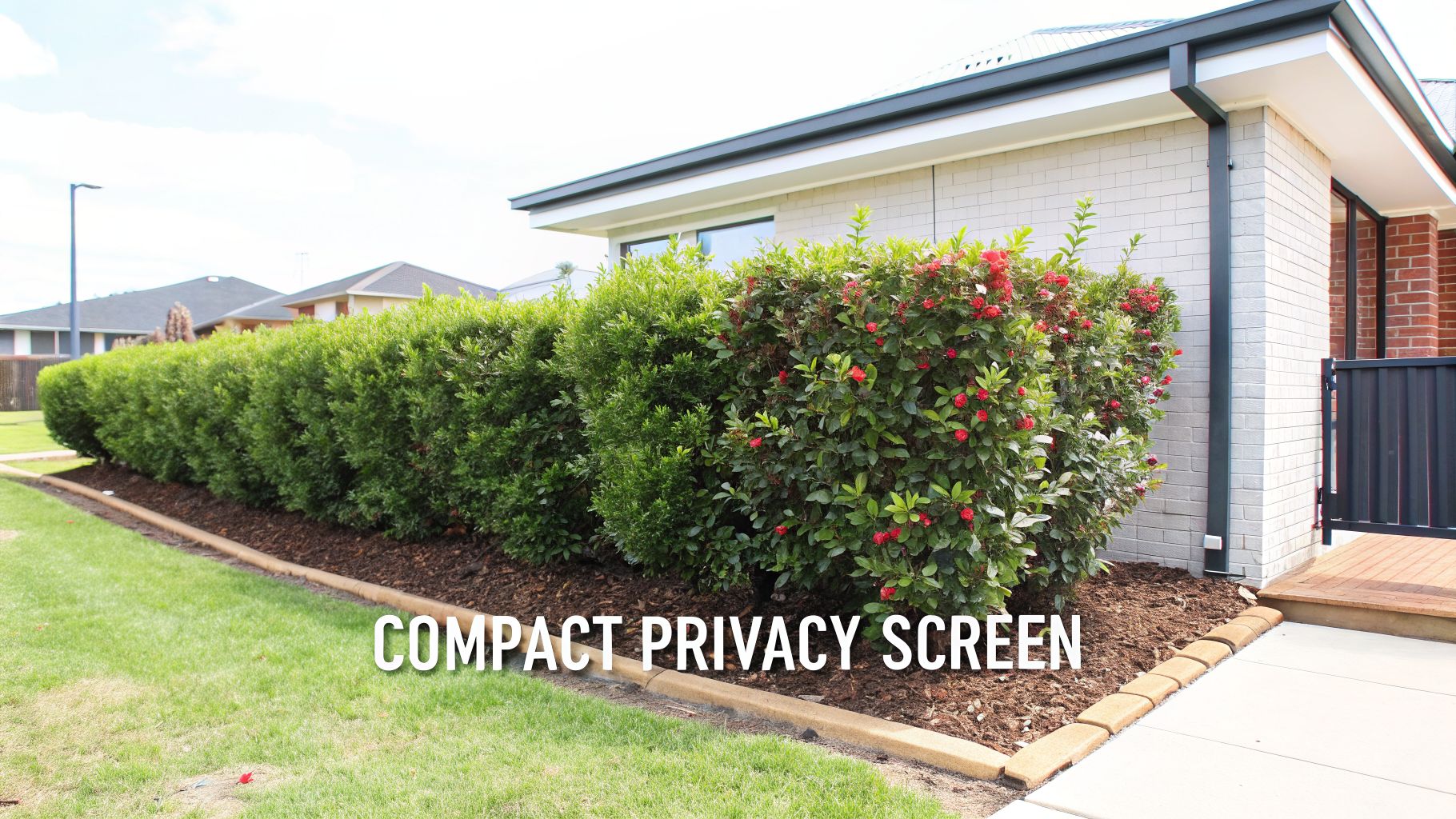
The key benefit for you as a property owner is its root system. Lilly Pillies feature a shallow, fibrous network of roots that spreads outwards rather than downwards. This structure is not aggressive and poses a very low risk to foundations, plumbing, pathways, and retaining walls. This is why you’ll often see them planted in strata complexes from Gosford to Terrigal, providing excellent privacy screening without the body corporate having to worry about future infrastructure damage. You can find more detail on tree selection in our guide to trees with non-invasive roots.
Planting and Maintenance Tips
To get the most out of your Lilly Pilly and ensure it thrives without causing issues, follow a few simple guidelines from our arborists.
Allow a buffer of at least 1.5 metres from any building, fence, or underground utility. This gives the canopy room to fill out to its mature size without pressing against structures. For an effective hedge or privacy screen, space individual plants about 1.5-2 metres apart. This allows them to grow together into a dense, continuous barrier.
Water new plants regularly for the first 12-24 months to help them establish a strong, healthy root system. Once established, they are reasonably drought-tolerant, a great feature for our sometimes-dry summers on the Central Coast. A light prune after flowering will help maintain a neat shape and encourage dense, bushy growth. This is also a good time to control its size if you need to keep it under a certain height.
Ensure your planting site has good drainage, as they don't like "wet feet." Applying a 100-150mm layer of organic mulch around the base will help retain soil moisture and protect the shallow roots from temperature extremes.
2. Angophora (Angophora costata, Sydney Red Gum)
For those looking for an iconic, sculptural native tree, the Angophora, or Sydney Red Gum, is an exceptional choice among small Australian native trees with non-invasive roots. This graceful tree is endemic to our coastal regions and is right at home in Newcastle, Lake Macquarie, and the Central Coast. Reaching a height of 6-12 metres, its distinctive smooth, salmon-pink to grey peeling bark and elegant spreading canopy provide both beautiful shade and valuable habitat for local wildlife. It's a true feature tree, often seen gracing older residential properties in Hamilton and Merewether.
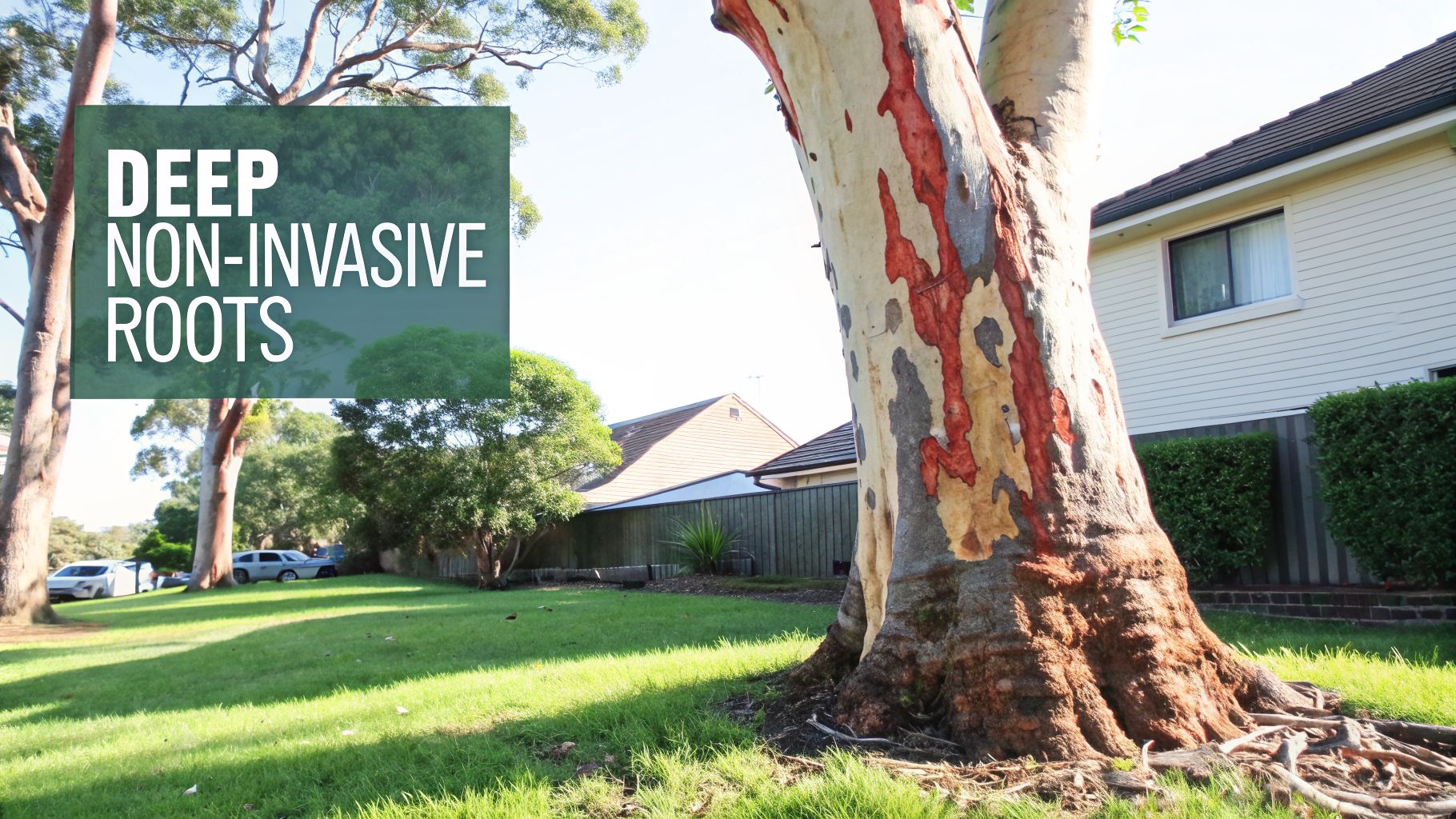
The primary advantage for you is the Angophora’s well-behaved root system. It develops a deep, non-aggressive taproot that anchors the tree firmly, complemented by a network of finer, lateral feeder roots near the surface. This structure means it is less likely to cause heave or damage to nearby infrastructure like foundations, pipes, or driveways. It's a popular choice for larger blocks and waterfront properties from Warners Bay to Terrigal, where its natural form can be appreciated without posing a threat to buildings.
Planting and Maintenance Tips
To ensure your Angophora thrives and develops its magnificent form without interfering with your property, here are our top tips from 25+ years of local experience.
Give it room to grow. We recommend a clearance of at least 3-4 metres from buildings, pools, and major plumbing lines. This allows its beautiful spreading canopy to develop fully without future conflict. This tree is naturally adapted to the sandy or gravelly soils common across our region. If you have heavy clay, make sure to amend the site to improve drainage, as it dislikes waterlogged roots.
During its establishment phase, typically the first 2-3 years, water deeply but infrequently. This encourages the taproot to grow deep into the soil profile, which increases drought tolerance later on. Less is more with an Angophora. Its natural form is its best feature, so pruning should be minimal. Focus only on removing dead, damaged, or crossing branches to maintain tree health. For insights on the best timing for this, you can explore our guide on when to prune trees in Australia.
Avoid over-fertilising. These trees are adapted to nutrient-poor Australian soils and feeding them too much can lead to weak, excessive growth. A slow-release native fertiliser once a year in spring is more than enough.
3. Dwarf Mountain Pine (Pinus pinaster subsp. atlantica, native to coastal zones)
When you think of native trees, a pine might not be the first to come to mind, but the Dwarf Mountain Pine is an excellent contender for a small Australian native tree with non-invasive roots. This compact conifer, adapted to our sandy coastal soils, typically grows to a very manageable 3-8 metres. Its evergreen nature provides year-round screening and fantastic aesthetic value, especially for properties needing a hardy, low-maintenance solution.
This tree is a great choice for homeowners from Lake Macquarie to the Central Coast who are battling coastal conditions. Its root system is fibrous and not aggressive, meaning it poses a minimal threat to house foundations, pools, or underground services. We’ve seen it used successfully as a windbreak on exposed properties in Wyong and Tuggerah, and as a salt-tolerant screen for waterfront homes in Gosford and Erina. Its reliability makes it a solid option for anyone wanting a beautiful, fuss-free tree.
Planting and Maintenance Tips
To ensure your Dwarf Mountain Pine establishes well and maintains its attractive form, a few key steps are important.
A good rule of thumb is to plant it at least 2 metres away from any major structures, fences, or plumbing. This gives the canopy sufficient space to develop its natural shape without interference. For an effective windbreak or privacy screen, space your pines about 2-3 metres apart. This spacing allows their branches to interlock as they mature, creating a dense and resilient barrier against coastal winds.
Like many natives, it needs consistent watering for the first 12 months to establish a strong root system. Once mature, it becomes very drought-tolerant, requiring minimal water, which is perfect for our region's climate. The Dwarf Mountain Pine generally requires very little pruning. However, a light trim of the lateral branches can be done to encourage a more upright and compact form if you prefer a tidier look.
This pine thrives in full sun and demands excellent drainage. If you have heavy clay soil, amend it with sand or gravel before planting. Applying a generous layer of mulch around the base will help retain moisture in sandy soils and protect the root zone.
4. Weeping Lillipilli (Acmena smithii var. minor, Water Gum)
For a touch of elegance in your garden, the Weeping Lillipilli is an exceptional choice among small Australian native trees with non-invasive roots. Also known as Water Gum, this variety (Acmena smithii var. minor) brings a graceful, flowing form to landscapes. It typically grows to a modest 3-5 metres, making it an ideal ornamental or feature tree for residential properties where its soft, weeping foliage can be appreciated without overwhelming the space.
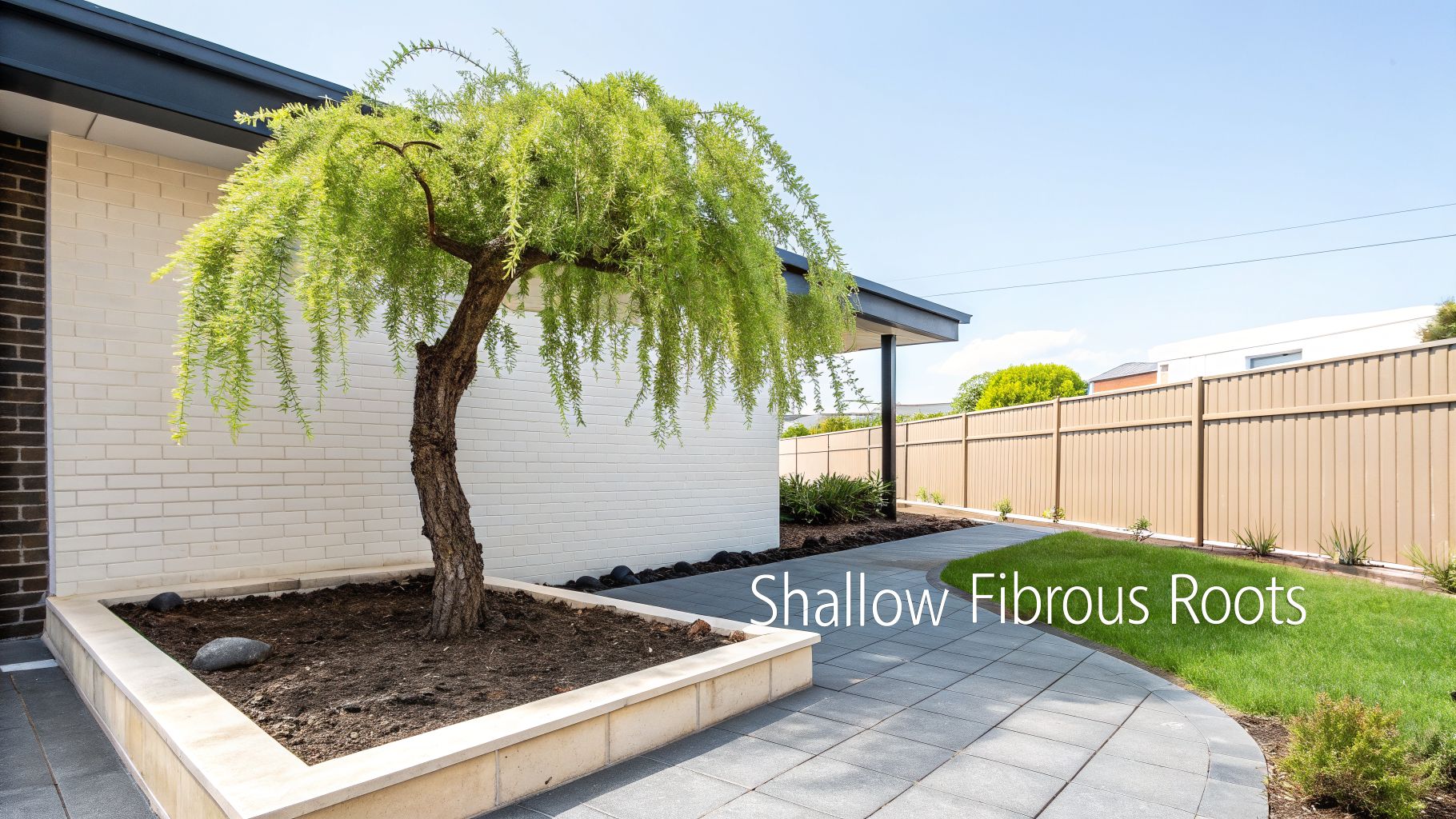
The primary appeal for you is its safe and predictable root system. Much like its relatives, the Weeping Lillipilli has a fibrous, non-aggressive network of roots that stays close to the surface. This means you can confidently plant it near pathways, patios, and garden walls without the worry of future structural damage. We often see it used successfully as a beautiful specimen tree in Terrigal courtyards and Lake Macquarie waterfront landscapes, adding year-round visual interest without posing a risk to valuable hardscaping.
Planting and Maintenance Tips
To ensure your Weeping Lillipilli thrives and maintains its beautiful form, a little care goes a long way.
While the roots are safe, give the weeping canopy space to cascade. We recommend planting at least 1.5-2 metres away from houses, fences, and high-traffic areas to protect its delicate foliage from being brushed against or damaged. This tree prefers well-draining soil. If you have heavy clay, common in parts of the Central Coast, amend the planting hole with organic compost to improve drainage and prevent the roots from becoming waterlogged.
Provide regular and deep watering for the first 12-24 months to help it establish. Once mature, it’s quite drought-tolerant, but a good soak during prolonged dry spells will keep it looking its best. The beauty of this tree is its natural weeping habit, so minimal pruning is required. Simply remove any dead, damaged, or crossing branches to maintain its health and shape. Avoid heavy pruning, which can spoil its natural form. If you're unsure about any significant cuts, it’s always best to get professional advice, especially if the tree's health is a concern. For larger tree work, you might also need to look into the rules for council approval for tree removal.
The tree produces small, decorative berries. To avoid potential staining on driveways or paths, consider its placement carefully. Applying a 100mm layer of organic mulch around the base will help retain soil moisture and protect the root zone.
5. Ivory Brush Box (Xanthostemon verticosus)
The Ivory Brush Box is a premium ornamental choice for property owners looking for small Australian native trees with non-invasive roots that also offer a stunning visual display. Endemic to NSW coastal rainforests, Xanthostemon verticosus is a striking small tree that typically grows to a height of 4-8 metres. Its compact size and contained root system make it perfectly suited for high-end residential landscaping in suburbs like Terrigal and Erina, and it's a popular feature in Lake Macquarie's native demonstration gardens.
The major benefit for you and any strata managers is its well-behaved root system. The Ivory Brush Box has a non-invasive, fibrous network of roots that won't threaten nearby infrastructure. This makes it an ideal specimen tree for planting near pathways, courtyards, or in tight garden beds where larger, more aggressive trees would be a liability. You'll see it used in upmarket strata complexes on the Central Coast where aesthetic appeal must be balanced with low-risk planting near buildings and underground services.
Planting and Maintenance Tips
To ensure your Ivory Brush Box thrives and becomes a beautiful feature, a little care during establishment goes a long way.
Give this tree at least 2 metres of space from any solid structure like a house foundation, retaining wall, or fence. This allows its canopy to develop its natural shape without interference. It prefers well-draining soil. If you have heavy clay, which is common in parts of Newcastle and the Central Coast, amend the planting hole with organic compost to improve drainage and soil structure.
Water regularly during the first two years to help it establish a robust root system. Once mature, it has moderate water needs but will appreciate a good soak during prolonged dry spells. Apply a generous layer of organic mulch, around 150mm deep, around the base of the tree. This helps retain soil moisture, protects the roots from temperature extremes, and suppresses weeds.
This tree has a naturally beautiful form and requires minimal pruning. Simply remove any dead or crossing branches as needed to maintain its health and structure. If you're unsure about the best approach, our guide to professional tree pruning services can provide further insight. Keep an eye out for scale insects, particularly during the warmer months. These can often be managed with organic pest control methods like horticultural oil.
6. Small-leaved Fig (Ficus obliqua, Port Jackson Fig)
While the word "Fig" can understandably make you nervous, the Small-leaved Fig (Ficus obliqua) is a very different beast to its more aggressive cousins. When managed and positioned correctly, it stands out as one of the more graceful and hardy small Australian native trees with non-invasive roots. In a garden setting, it forms a dense, attractive canopy and typically reaches a manageable height of 3-6 metres, making it a beautiful feature tree for spacious properties across the Newcastle and Lake Macquarie regions.
The key to success with Ficus obliqua is understanding its root system. Compared to other figs, its roots are far less aggressive, but they still require space. It develops a spreading, predominantly surface-level root network that is not known for aggressively seeking out and cracking pipes or foundations like other species might. This is why you see it used successfully in larger Newcastle gardens and on some Lake Macquarie properties where there is an adequate buffer zone. Its dense foliage also provides excellent habitat for native birds.
Planting and Maintenance Tips
The Small-leaved Fig's inclusion in this list comes with a critical caveat: correct placement is non-negotiable. It is not suitable for small courtyards or tight spaces.
This is the most important rule. You must position the tree a minimum of 3-4 metres away from any buildings, foundations, paths, retaining walls, or underground utilities. This gives its root system the room it needs to establish without causing problems. While it can be pruned into a screen, it's best suited as a standalone ornamental tree. If planting more than one, allow at least 4-5 metres between them to accommodate their mature canopy and root spread.
Water consistently during the first one to two years to help it get established. Once mature, it is remarkably drought-tolerant, a significant benefit for surviving our hot, dry summers. Annual pruning is recommended to maintain a desirable shape and size. This prevents the tree from becoming too large for its location and encourages a denser, more attractive form.
This fig thrives in full sun and well-drained soil. Applying a deep layer of organic mulch (around 150mm) over the root zone is vital. This helps retain moisture, protects the surface roots, and discourages them from seeking moisture elsewhere.
7. Brush Box (Lophostemon confertus, Brisbane Box)
The Brush Box, often known as the Brisbane Box, is a fantastic medium-sized native and one of the most reliable small australian native trees with non invasive roots. Growing to a height of 6-12 metres, it’s a staple in many spacious Newcastle residential properties and Lake Macquarie community gardens. Its lush, attractive foliage and showy pale pink to white bottle-brush-like flowers offer great ornamental appeal and provide excellent shade.
The primary advantage for property owners is its well-behaved root system. The Brush Box features a deep taproot that grows downwards, with lateral roots that are generally contained and not aggressive. This makes it a great choice for strata complexes and commercial landscapes from the Central Coast to Newcastle, as it poses a low risk to nearby foundations, plumbing, and paving. It provides the beauty and benefits of a substantial tree without the common infrastructure headaches.
Planting and Maintenance Tips
To ensure your Brush Box establishes well and becomes a long-term asset, follow these key recommendations from our arborists.
Give this tree room to develop its natural form. We recommend a clearance of at least 4-5 metres from buildings or solid fences. This allows the canopy to grow without interference and reduces the need for heavy pruning later on. While adaptable, the Brush Box performs best in well-draining soil. If you're planting in the heavy clay common in some local areas like around Cameron Park, amend the soil with some sand and quality compost to improve drainage and prevent "wet feet."
During its establishment phase, typically the first 2-3 years, water the tree deeply but infrequently. This encourages the taproot to grow deep into the soil profile, making the tree more stable and drought-tolerant in the long run. Apply a thick layer of organic mulch, around 150-200mm deep, around the base but keep it clear of the trunk itself. This is vital for retaining soil moisture during our hot summers and protecting the root zone.
One of the best features of the Brush Box is its naturally neat shape. Pruning should be minimal, focused only on removing dead, damaged, or crossing branches to maintain tree health. Avoid the temptation to over-prune, as this can spoil its form.
8. Desert Ash (Fraxinus phillyraeoides subsp. oxycarpa, Narrow-leaved Ash)
The Desert Ash is a graceful and often-overlooked candidate in the search for small Australian native trees with non-invasive roots. This elegant tree, also known as the Narrow-leaved Ash, presents a slender, upright form with delicate foliage, reaching a height of 4-8 metres. Its refined appearance makes it an excellent choice for modern gardens and tight spaces where a light, airy canopy is preferred over dense screening.
Its main advantage lies in its well-behaved root system. The Desert Ash develops a deep taproot, anchoring it firmly without sending out an aggressive network of surface roots. This structure means it poses minimal risk to nearby foundations, plumbing, and pavements. We've seen it used successfully in compact residential gardens from Gosford to Erina and even in drought-tolerant native plant demonstrations in Newcastle, where its safety and resilience are highly valued. For strata complexes and Lake Macquarie waterfront properties with sandy soils, its non-invasive nature and tolerance for coastal conditions make it a prime selection.
Planting and Maintenance Tips
To ensure your Desert Ash establishes well and maintains its graceful form, follow these key recommendations.
Its upright habit and deep roots allow for closer planting than many other species. A clearance of 2-3 metres from structures is generally sufficient, making it perfect for narrow garden beds. Plant in a full sun to part-shade position to encourage the best natural shape. It is critical to provide excellent drainage, as this tree will not tolerate waterlogged or heavy clay soils.
During the establishment phase (the first 12-18 months), water the tree deeply but infrequently to encourage the taproot to grow downwards. Once established, it is remarkably drought-tolerant and requires minimal watering. Unlike many garden plants, an established Desert Ash does not require heavy mulching as it is adapted to poor soils. Pruning is also minimal; its natural upright form is one of its key features, so it's best to let it develop without interference.
This species handles coastal winds and salt exposure well, making it a reliable performer for properties along the Central Coast shoreline, such as those in Wamberal or Forresters Beach.
8 Small Australian Natives — Non-Invasive Roots Comparison
| Species | Implementation complexity | Resource requirements | Expected outcomes | Ideal use cases | Key advantages |
|---|---|---|---|---|---|
| Lilly Pilly (Syzygium smithii) | Low — easy to plant and maintain; light pruning | Moderate water while establishing; well‑draining soil; 1.5–2m spacing | Dense evergreen privacy screen; wildlife habitat; long‑lived | Residential hedges, strata complexes, near infrastructure | Shallow non‑invasive roots; tolerant coastal/subtropical conditions; low maintenance |
| Angophora (Sydney Red Gum) | Medium — requires space and time to mature | Deep, well‑drained soil; 3–4m clearance; minimal ongoing inputs | Mature specimen tree with shade and ornamental bark; long lifespan | Specimen planting, heritage gardens, waterfront properties | Deep non‑aggressive taproot; drought tolerant; strong visual interest |
| Dwarf Mountain Pine (Pinus pinaster ssp. atlantica) | Low — hardy, straightforward establishment | Excellent drainage; full sun; minimal water after establishment | Evergreen windbreak/screen; salt and wind tolerance | Coastal windbreaks, exposed properties, sandy soils | Fine fibrous non‑invasive roots; hardy in poor sandy soils; year‑round screening |
| Weeping Lillipilli (Acmena smithii var. minor) | Low — ornamental, simple upkeep | Well‑draining soil; regular watering when young; ~1.5m clearance | Ornamental focal tree or small screen; attracts birds | Courtyards, small residential gardens, specimen planting | Shallow non‑invasive roots; graceful weeping form; adaptable to sun/part‑shade |
| Ivory Brush Box (Xanthostemon verticosus) | Medium — slower growth; specialist sourcing may be needed | Well‑drained soil; moderate watering initially; possible nursery sourcing | High‑impact ornamental with seasonal bottle‑brush flowers | Premium gardens, strata complexes, specimen planting | Striking flowers and glossy foliage; contained roots safe near infrastructure |
| Small‑leaved Fig (Ficus obliqua) | Medium–High — requires careful siting and management | Significant space (≥3–4m buffer) or root barriers; regular establishment water | Rapid dense screening and strong wildlife habitat | Large gardens, screening where buffer zones are available | Fast growth and dense foliage; hardy and adaptable |
| Brush Box (Lophostemon confertus) | Medium — needs space and good soil depth | Well‑drained soil; 4–5m clearance; deep soil preferred | Long‑term shade tree with seasonal flowers; resilient canopy | Shade for residential/commercial sites, parks, strata with space | Deep safe root system; attractive flowering; long‑lived and hardy |
| Desert Ash (Fraxinus phillyraeoides ssp. oxycarpa) | Low–Medium — straightforward in tight sites | Excellent drainage; 2–3m clearance; minimal water once established | Upright, drought‑tolerant specimen offering light shade | Narrow spaces, low‑maintenance and drought‑tolerant gardens | Deep non‑aggressive taproot; compact upright form; excellent drought tolerance |
Need Help Choosing the Right Tree for Your Property?
Selecting the right tree for your garden, courtyard, or strata common area is a decision that will have an impact for decades to come. As we've explored, choosing from a list of small Australian native trees with non-invasive roots is the first, most crucial step towards preventing future structural damage, blocked pipes, and costly repairs. Species like the versatile Lilly Pilly, the compact Weeping Lillipilli, and the hardy Brush Box offer incredible beauty and ecological benefits without the aggressive root systems that keep property owners awake at night.
The key takeaway from this guide is that a successful planting project goes beyond just picking a beautiful tree. It involves a thoughtful assessment of your specific site conditions. A tree that thrives in a sandy, salt-sprayed yard in Terrigal might struggle in the clay soils found further inland near Wyong. Likewise, the available space, proximity to foundations, and underground service locations are non-negotiable factors that must be considered before you even dig a hole. This is where our 25+ years of local experience becomes invaluable.
Turning Theory into a Thriving Tree
Making the right choice from the outset saves you from the stress and expense of dealing with a problematic tree down the line. It's the difference between creating a beautiful, low-maintenance asset for your property and inadvertently planting a future liability. The principles we’ve covered empower you to ask the right questions:
- Is my chosen species truly suitable for this exact spot? Consider sun exposure, soil drainage, and exposure to coastal winds, a common challenge for properties across the Central Coast and Newcastle.
- What are the local council requirements? Regulations can vary significantly between Lake Macquarie, Newcastle, and Central Coast councils, especially concerning tree planting in heritage or conservation areas. We can help you navigate this.
- For strata properties, has the body corporate approved the plan? A detailed proposal, often supported by an arborist’s report, is essential for gaining approval for planting in shared spaces in unit blocks from Gosford to Warners Bay.
By focusing on these practical details, you move from simply picking a tree to designing a sustainable, long-term addition to your landscape. A qualified arborist can help you visualise the tree at maturity, ensuring it fits the scale of your home and won’t interfere with powerlines, fences, or your neighbour's property.
A Proactive Approach Saves Time and Money: Investing in a professional site assessment before you plant is one of the smartest decisions a property owner can make. It costs far less to get it right the first time than it does to remove a mature, problematic tree and repair the damage it has caused.
For commercial property and facilities managers, this proactive approach is also a matter of compliance and risk management. Ensuring new plantings adhere to safety standards under WHS legislation and won't disrupt essential services is paramount. With our $20 million public liability insurance, we provide that assurance for every project we undertake.
Ultimately, planting a native tree is a wonderful way to enhance your property's value, support local wildlife, and create a greener, more pleasant environment. By carefully selecting one of the many fantastic small Australian native trees with non-invasive roots, you are making a wise investment in the future of your property. With the right planning and expert advice from a team that's "On Time, Every Time", you can enjoy all the benefits of a beautiful tree with none of the worry.
Ready to find the perfect tree for your Central Coast, Newcastle, or Lake Macquarie property? The team at Treecorp Solutions has over 25 years of local experience helping homeowners, strata managers, and developers select and plant the right trees for the right places. Our qualified arborists provide free property assessments to ensure your choice is beautiful, compliant, and problem-free for years to come.


