

So, you're looking at a tree on your Central Coast or Newcastle property and wondering, how much is this going to cost to remove? It's one of the first questions we hear, and honestly, there's no single, simple answer. The final price tag can swing from a few hundred dollars for a small, straightforward job to several thousand for a big, tricky one. It all comes down to the tree's size, where it’s located, and the overall complexity of the removal.
This guide is here to pull back the curtain on what goes into a professional arborist's quote. We’ll walk you through all the moving parts, from the type of tree standing in your Terrigal backyard to the tight access of a property in Merewether. With over 25 years of hands-on experience across the Central Coast, Newcastle, and Lake Macquarie, we believe in being upfront about pricing. We want you to feel confident you understand the value you're getting. Think of this as your practical playbook for budgeting properly and making a smart, informed decision for your home.
Your Guide to Understanding Tree Removal Costs
When we put together a quote, we're not just plucking a number from thin air. We're carefully assessing a unique worksite to ensure a safe, efficient, and clean job—protecting your home, our crew, and the public. Imagine you've got a large gum tree in Terrigal dropping branches; its removal will be a completely different task compared to a small bottlebrush in an open lawn in Wyong. Every detail, from the ground conditions right up to the highest branches, shapes the final cost.
The main factors influencing the price are the tree's size and species, its location and accessibility on your property, and its overall health. A towering, unstable tree wedged between two houses requires a highly skilled team, precision tools, and meticulous planning. Understanding these elements will help you see why one quote might be higher than another and ensure you’re paying a fair price for a safe, reliable service from a team that knows what they're doing.
Decoding Your Quote: The Main Cost Factors
So, what really goes into a tree removal quote? When one of our qualified arborists steps onto your property, we’re not just seeing a tree. We’re assessing a unique worksite, complete with its own set of challenges. It's a careful mix of factors we evaluate to guarantee a safe, efficient, and clean job—protecting your home, our crew, and the public.
Think of it like surgery. A simple, routine procedure is fairly predictable. But a complex operation near vital structures like your house, power lines, or a neighbour's fence? That requires a specialist team, precision tools, and meticulous planning. Every detail, from the ground conditions right up to the highest branches, shapes the final cost.
This diagram breaks down how three key areas—size, location, and complexity—all feed into the final price.
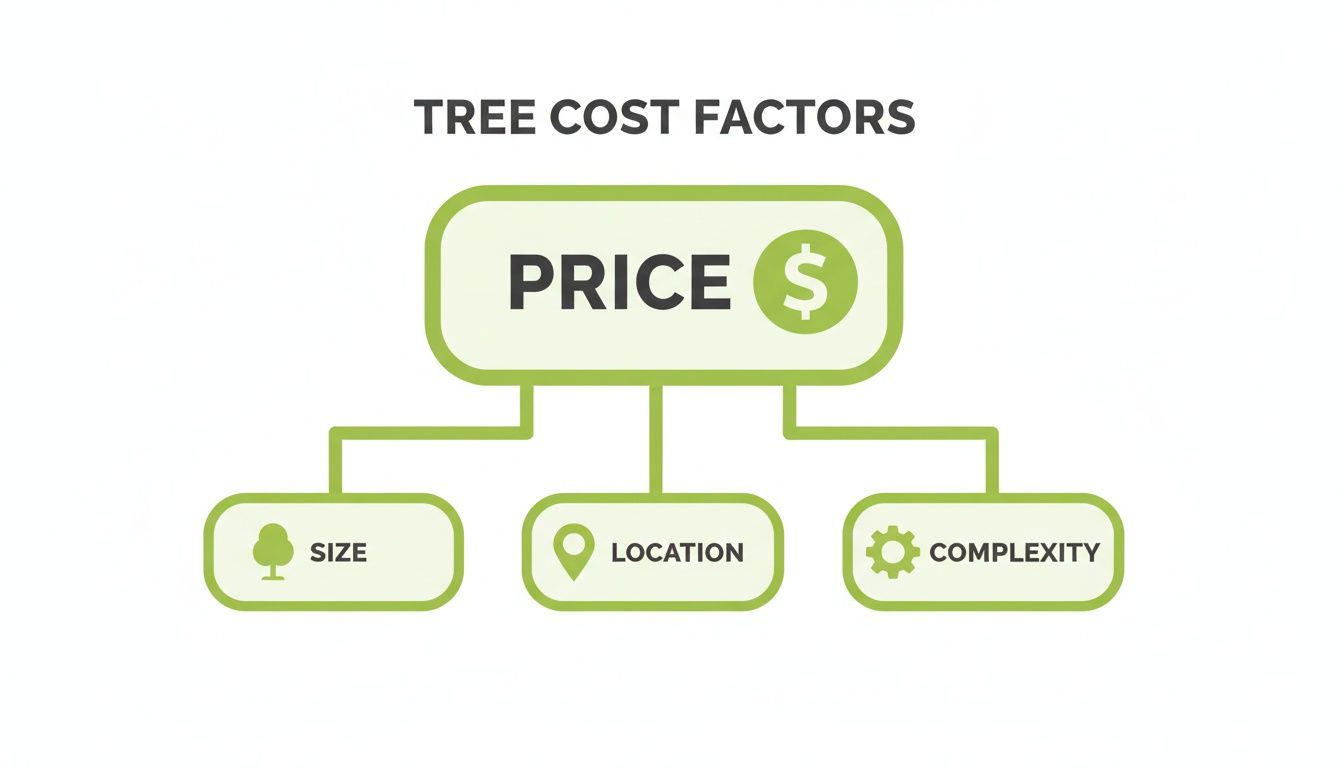
As you can see, these elements are all connected. Each one influences the amount of labour, the type of equipment, and the safety measures needed for the job.
Tree Size and Species
The most obvious factor is the sheer size of the tree. A towering Blackbutt with a massive trunk in a Gosford backyard is a completely different project than taking out a small bottlebrush in an open field in Wyong. Larger trees demand more time for our arborists to climb, dismantle piece by piece, and lower heavy branches safely to the ground.
This process, called rigging, is a highly skilled technique that prevents damage to your property. It involves specialised ropes and lowering devices to control every piece of timber as it comes down. Taller, wider trees mean more rigging, more sections to handle, and more green waste to process and haul away, all of which directly adds to the labour hours.
The tree species plays a big part, too. Some native hardwoods, like Ironbark or Grey Gum, are incredibly dense and heavy, making them much harder to cut and manage than softer woods. The tree's structure also matters—multiple trunks or wide-spreading limbs hanging over a roof add layers of technical difficulty and time to the job.
Location and Accessibility
Where the tree is on your property is just as critical as its size. A tree in an open front yard with direct street access for our trucks and wood chipper? That's the most straightforward scenario. But many homes on the Central Coast and in Newcastle suburbs like Warners Bay or Belmont have trees tucked away in tricky spots.
We often work with trees in backyards with only narrow side access, on steep slopes, or surrounded by delicate gardens and retaining walls. Imagine removing a huge gum tree from a terraced backyard in Terrigal. If we can't get our machinery close, every single piece of that tree has to be carried out by hand. This drastically increases the labour and time required.
Proximity to hazards is a major cost driver. A tree leaning over your home, swimming pool, or directly over power lines requires an exceptional level of precision. This is non-negotiable from a safety perspective. It often involves complex rigging or even bringing in a crane to lift sections up and away from the structure. This heightened risk and need for specialised gear are reflected in the quote. It’s also why our $20M public liability insurance is so important—it gives you total peace of mind that you're covered no matter what.
The Health and Condition of the Tree
Finally, the tree's health is a critical piece of the puzzle. A healthy, solid tree behaves predictably. A dead, decaying, or storm-damaged tree does not. Deadwood can be brittle and unstable, posing a much higher risk to our climbing arborists. It can break away unexpectedly, forcing us to use a different, more cautious removal strategy.
If the trunk is compromised, we might need to use an elevated work platform (EWP) instead of climbing, which adds machinery hire to the project cost. Trees with diseases or pest infestations can also have internal decay that you can't see from the outside. Our experienced team knows how to spot these risks during the initial assessment. Safely navigating these issues takes more time and expertise, which is factored into the price.
On top of all this, some removals require council permission. It's always a good idea to understand your local council's approval process for tree removal before you begin.
What to Expect: A Realistic Price Guide
So, let's put some real-world context to those factors. While nothing beats an on-site assessment for a precise quote, our 25+ years working across the Central Coast and Newcastle gives us a pretty good handle on what things cost. These figures should give you a solid baseline for your budget. The idea here is to help you spot a quote that sounds way too good to be true and feel confident you’re paying a fair price for a safe, professional, and fully insured job. Just remember, these are guides—every single tree and property is unique.
Small Tree Removal (Up to 8 Metres)
For smaller trees—think bottlebrushes, lilly pillies, or young gum trees under about 8 metres—you’re typically looking at the lower end of the price scale. Picture an easily accessible tree in a Tuggerah front yard or a small ornamental in an Adamstown garden bed. These jobs are usually quite straightforward. They don't often need complex rigging, and the crew size is smaller. If the tree is well clear of any structures and we can get our chipper close, the whole process is very efficient. The cost mainly covers the team’s time, basic gear, and proper disposal of the green waste.
Medium Tree Removal (8 to 18 Metres)
This is the sweet spot for most suburban jobs. We’re talking about that mature gum tree in your Erina backyard or a camphor laurel leaning a bit too close to the fence in Warners Bay. Trees this size demand a higher level of expertise, careful planning, and serious safety precautions. The work almost always involves an arborist climbing and dismantling the tree piece by piece. We use specialised rigging to lower heavy limbs safely, protecting your home, garden, and everything underneath. Access becomes a huge factor here; if every log and branch has to be manually carried through a narrow side gate, the labour costs will naturally climb.
Large and Complex Tree Removal (18+ Metres)
This is the big league. It covers the removal of massive, mature trees like a towering Norfolk Pine on a coastal property in The Entrance or a huge Blackbutt looming over a house in Kotara. These projects sit at the top end of the cost spectrum simply because they carry the highest level of risk and complexity.
Safety First: Removing large and hazardous trees is absolutely not a job for amateurs. It demands a highly experienced crew, advanced rigging skills, and sometimes even cranes or elevated work platforms to get it done safely and without a scratch to your property.
These removals are labour-intensive, often taking a full day or more with a larger team on-site. The sheer volume of timber and foliage we need to process and haul away is massive. Often, these trees fall under stricter council rules, which we can help you navigate. The price reflects the detailed planning, elite skills, and the $20M public liability insurance required to protect everyone.
For a rough idea of how these factors might add up for your specific tree, feel free to try our online tree removal cost calculator for a preliminary estimate.
Beyond The Cut: Understanding Additional Costs
When you get a professional quote for tree removal, it should be crystal clear about what's included. But it's good for you to know what other services might be needed to properly finish the job. The conversation around tree removal costs often goes way beyond just cutting the tree down; it’s really about leaving your property clean, safe, and ready for whatever you have planned next. Think of these extra services as the essential finishing touches. They're what stand between a job half-done—leaving you with a messy yard or a hazardous stump—and a truly complete, professional service. Let’s break down what these extras are and why they’re so important.
Stump Grinding: The Final Step
Once a tree is cut down to ground level, you’re left with the stump. Some people don’t mind having them around, but most want them gone—and for good reason. A stump is a stubborn tripping hazard, a pain to mow around, and it stops you from replanting or putting that patch of lawn to better use. Even worse, as a stump decays, it can become a magnet for termites, ants, and other pests you definitely don't want setting up camp near your home.
Stump grinding is the cleanest, most efficient way to solve this. We use a powerful machine to grind the stump and its main roots into small wood chips, turning a problem into useful mulch. It’s quoted as a separate service because it requires specialised gear and its own block of time, but it’s absolutely essential for fully reclaiming your yard. To get a better handle on how this all works, check out our detailed guide on the price of stump and tree removal.
Navigating Council Permits and Regulations
This one is a big deal. Here on the Central Coast, in Lake Macquarie, and right across Newcastle, you can’t just remove any tree you feel like. Each local council has its own specific rules, often called a Tree Preservation Order, which protects certain trees based on their size, species, or local significance. For example, Newcastle is well-known for its strict protection of heritage trees, while coastal councils are often focused on preserving trees that help stabilise sand dunes.
Important Note: Trying to remove a protected tree without a permit can land you with some incredibly hefty fines. It’s a risk that’s just not worth taking.
Figuring out the rules can be a real headache, as they change from one council area to the next—Wyong’s regulations aren't the same as Gosford's. This is where our local knowledge really helps. We can assess your tree against the local council regulations and tell you straight up if you'll need to lodge an application. We can even help prepare the paperwork to make sure the process is smooth and your removal is fully compliant with all local laws and WHS legislation.
Other Potential Job Costs
A few other items might pop up on a detailed quote, and they all come down to site safety and logistics. For instance, if your tree is near a public road or footpath—say, on a busy street in The Entrance or Charlestown—we may need to organise traffic control to keep the public, our crew, and your property safe while we work. This is a legal WHS requirement and ensures the job gets done without any incidents.
For those really tricky-to-access trees, like one stuck in a Belmont backyard with no side entry, we might need to bring in a crane. This lets us lift massive sections of the tree up and over your house, which is by far the safest method in tight spots. While it does add to the cost, sometimes it's the only way to get the job done without risking damage to your home. Any professional quote will also include the complete removal and disposal of all timber and foliage, leaving your property spotless.
How Storms and Emergencies Impact The Price
When a fierce southerly buster tears through the coast, a tree that was a minor worry can suddenly become a massive, urgent hazard. Storms and other emergencies completely change the game for tree removal, and that urgency is naturally going to be reflected in the price. It’s no longer a neatly scheduled job; it's a rapid-response operation where safety is everything. The biggest difference in cost comes down to an emergency call-out fee, which covers the immediate mobilisation of our crew and specialised equipment, often well outside of normal business hours.
Why Emergency Work Costs More
Working in post-storm conditions is a world away from a planned removal. The risks are significantly higher and the situation is far more complex. The worksite itself is often unstable, littered with unpredictable hazards like fallen power lines, slick surfaces, and damaged property. A tree might be twisted under incredible tension or balanced precariously, demanding an extremely cautious, step-by-step approach to safely take it apart.
Picture a huge gum tree that’s come down on your roof in Woy Woy during a gale. The sheer weight is putting immense stress on your home's structure, and every single cut has to be carefully planned to avoid making things worse. This isn't just felling a tree; it’s a delicate, high-stakes recovery operation that demands the highest level of skill from our qualified arborists. We take a much closer look at these scenarios in our guide to understanding emergency tree removal services.
Navigating The Aftermath Safely
If you ever find yourself in this situation, your safety is the absolute priority.
Safety Warning: Never, ever approach a fallen tree, especially if it’s anywhere near power lines. You must assume all downed lines are live and extremely dangerous. Stay inside, keep clear of the damaged area, and call for professional help immediately.
While you wait for our emergency crew to get there, we can often give you advice over the phone on how to secure the area. Once on-site, a crucial part of our job is to meticulously document all the damage with clear photos and a detailed report you can use for your insurance claim. After a tree falls in a storm, knowing how to handle your insurer is key to managing your costs. Understanding the process of fighting a fallen tree insurance claim can make a world of difference.
The financial hit from emergency work can be significant. On the Central Coast, Lake Macquarie, and in Newcastle, emergency surcharges can increase standard rates substantially. This premium isn't just for speed; it covers the immediate dispatch and the complex safety protocols required for high-risk work.
Choosing The Right Arborist, Not Just The Cheapest Quote
Getting a few different quotes for your tree removal is always a smart first step. But when those quotes land in your inbox, it's all too easy to just let your eyes scan for the lowest number. Here's the thing: focusing only on the cheapest price can expose your property, and your wallet, to some serious risks down the line. A cheap quote often means corners are being cut somewhere—whether it’s on safety gear, insurance, or proper training. A professional quote is more than just a price tag; it’s a detailed plan of action.
Reading Between The Lines of a Quote
A proper quote should be clear, itemised, and easy to follow. It needs to detail every part of the process, from the first cut to the final site clean-up. Vague quotes that don't spell out exactly what's included are a massive red flag. A good quote should clearly describe the work, the method of removal, include stump grinding as a separate item if requested, detail the waste removal process, and mention their public liability insurance policy. Don't be shy about asking to see the certificate.
Key Red Flags to Watch Out For
When you're figuring out how much tree removal should cost, learning to spot a dodgy operator is crucial. These warning signs should make you think twice before accepting a suspiciously cheap offer.
Lack of Proper Insurance
This is the big one. Any reputable arborist will carry a substantial public liability insurance policy. For your complete protection, we carry a $20 million policy. Always ask for a copy of their Certificate of Currency. If they can't provide it, walk away. Without proper insurance, if something goes wrong, you could be held liable for any damage to your property or even your neighbour's. This is especially crucial for strata properties, where body corporate approval often requires proof of comprehensive insurance to protect all residents.
Using the Wrong Terminology
Pay attention to the language they use. If you hear a company talking about "tree lopping" or "topping," it’s a huge red flag. These are outdated and incredibly harmful practices that no qualified arborist would ever recommend. A true professional will use terms like pruning, canopy reduction, and dismantling, which reflect proper, industry-standard techniques. You can learn more about the specific skills involved by reading about what qualified arborists do.
Pressure to Pay in Cash
If a company is pushing for a cash-only payment, often dangling a small discount as bait, they are almost certainly avoiding their tax and insurance obligations. This kind of unprofessional behaviour is a strong indicator of how they'll approach the job on your property. Choosing the right team is an investment in your peace of mind. A slightly higher price from a fully insured, qualified, and professional company is a small price to pay for knowing the job will be done safely and correctly, protecting your biggest asset.
Common Questions About Tree Removal Costs
Over our 25 years serving the Central Coast, Newcastle, and Lake Macquarie, we’ve heard just about every question there is when it comes to tree removal costs. It's a big decision, and you deserve to have all the facts. Here are the straight-up answers to the questions we get asked the most.
Is It Cheaper to Remove a Dead Tree?
You'd think so, but surprisingly, not always. The truth is, a dead tree can often be more complex and dangerous to work on than a live one. The wood becomes brittle and unpredictable, which means our arborists can’t just climb and dismantle it the way they normally would. Safety becomes the number one priority. This often involves using specialised rigging or bringing in an elevated work platform (EWP) to get the job done without risk to our crew or your home. All that extra gear and careful planning can add to the time and cost, sometimes making it more expensive than a healthy tree of the same size.
Do I Need a Council Permit for Tree Removal?
This is a big one, and the answer is a classic: it depends. Every local council—whether it’s the Central Coast Council, City of Newcastle, or Lake Macquarie City Council—has its own set of rules, often called a Tree Preservation Order. These rules outline what you can and can't remove based on things like the tree's size, species, and where it sits on your property. For instance, taking down a huge, old gum tree in a Newcastle conservation area is a completely different ball game to removing a pesky invasive species from a backyard in Wyong.
Our Pro Tip: Never just assume it's fine to remove a tree. Fines for illegal tree removal can be massive. It’s always cheaper and safer to get professional advice first.
The best way to get a clear answer is with an on-site look. A qualified arborist can identify the tree, tell you exactly what the rules are for your area, and even help you navigate the permit application if one is needed.
Does the Quote Include Taking the Wood Away?
Any good, professional quote will spell this out clearly. Our standard quotes absolutely include a full site clean-up, which means we take away all the timber and green waste. We chip the branches right there on-site and haul everything away, leaving your yard looking neat and tidy. That said, we find plenty of clients in places like Gosford or Warners Bay want to keep the larger logs for their fireplace. If that’s you, just let us know when we do the assessment. We're more than happy to adjust the quote to leave the firewood behind, which can save you a bit on the final bill.
Why Do I Need a Company with $20 Million Insurance?
Let's be honest: tree removal is a high-risk job. When you bring in true professionals who live and breathe safety protocols, accidents are incredibly rare. But you always need a safety net. That’s what comprehensive insurance is for. Our $20 million public liability insurance is your ultimate protection. It covers you, your home, your neighbours, and their property from any potential damage. Choosing a company with this level of cover isn’t just about ticking a box; it shows they are serious about their work, their safety standards, and protecting what’s most valuable to you. It's a non-negotiable that gives you total peace of mind.
Ready to get a clear, honest price for your tree removal project? The experienced team at Treecorp Solutions provides free, no-obligation property assessments across the Central Coast, Newcastle, and Lake Macquarie. We pride ourselves on transparent pricing and safe, reliable work—On Time, Every Time.
Request your free quote online today or call us on 02 4307 6555 for 24/7 emergency service.


