That sickening crack of a branch giving way in a Central Coast storm is a sound you don't forget. In those first few moments, your immediate actions are everything when it comes to keeping everyone safe. With over 25 years of experience helping homeowners across the Central Coast, Newcastle, and Lake Macquarie, we've seen firsthand how a clear head in a crisis makes all the difference.
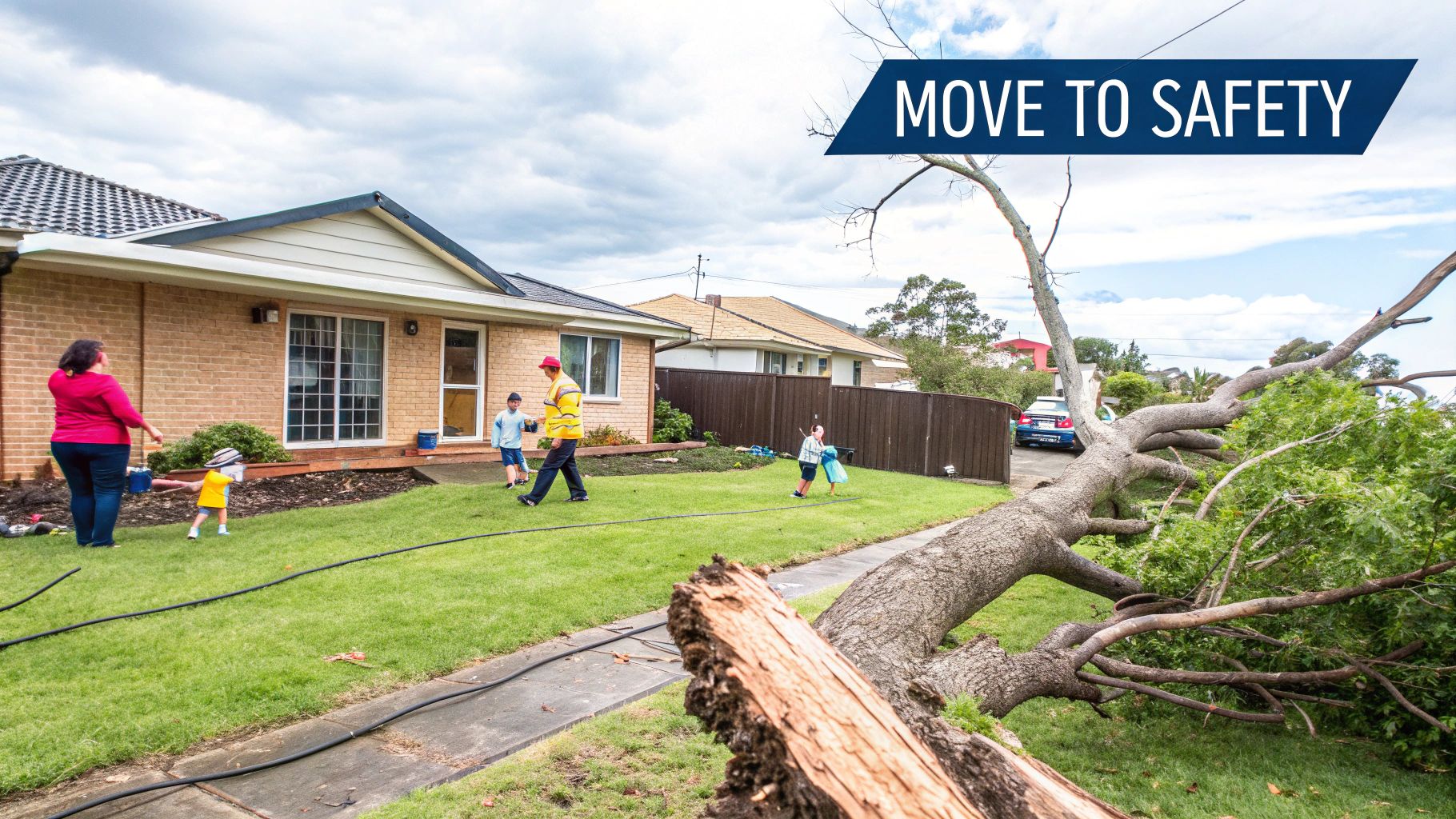
Before you do anything else, the absolute first priority is to secure the area by moving everyone to a safe distance. Seriously, don't even think about clearing debris or getting a closer look, especially if there are downed powerlines or unstable structures nearby. This guide will walk you through what to do next.
Your First Response Guide to a Tree Emergency
When a tree fails on your property, a calm, methodical approach is your best friend. It helps keep everyone safe and stops things from getting worse. The initial moments feel chaotic, but knowing what to do—and just as importantly, what not to do—makes all the difference.
Imagine this: a huge limb from a gum tree in your Gosford backyard comes crashing down near the house during a southerly buster. Your first thought shouldn't be about the mess; it should be about making sure the kids and pets are inside and well away from any potential danger. That's the professional mindset in action.
Once you've confirmed everyone is safe, you can start to size up the situation from a distance. Are there any obvious hazards like downed electrical wires? They can be live and are incredibly dangerous. Also, scan the tree for any other large, unstable branches that look like they could be next to fall. This quick observation is gold when you call for professional help.
This simple guide breaks down the three essential actions to take in any tree emergency.
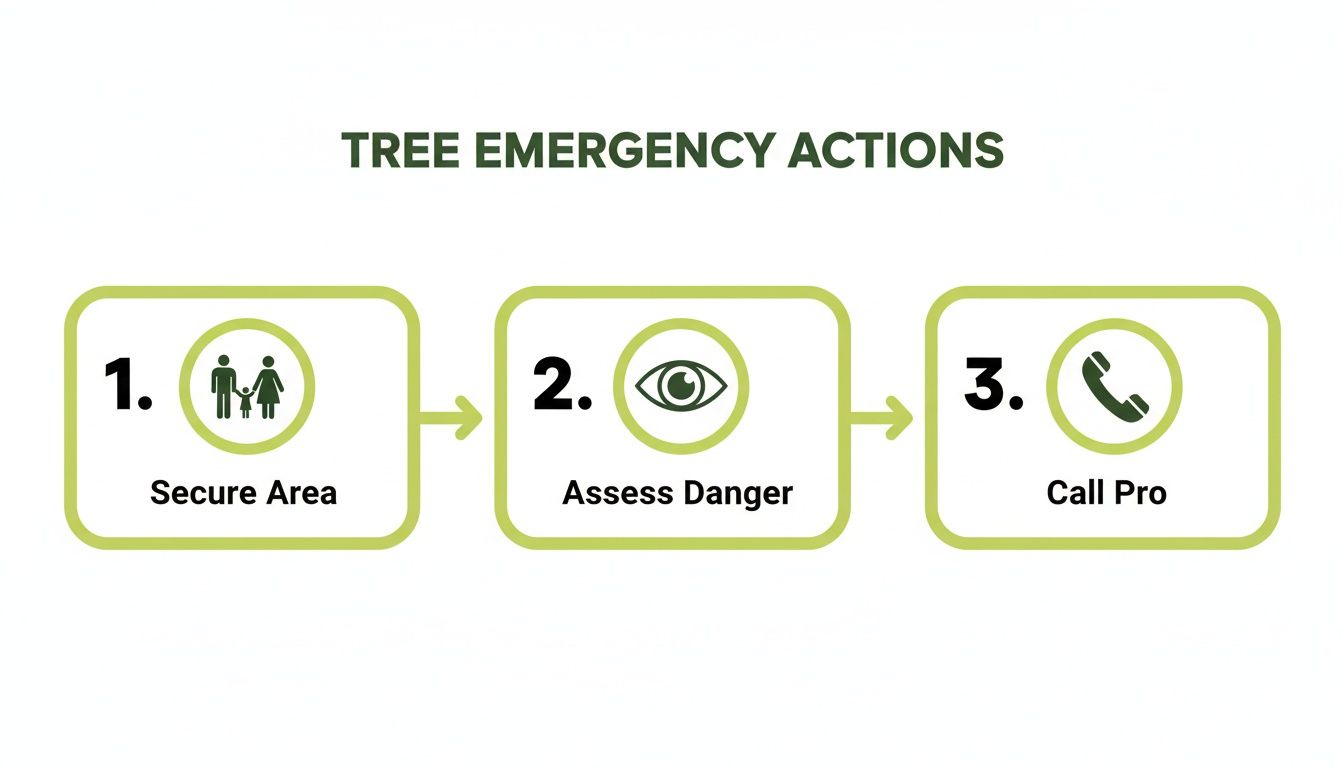
Following this sequence—Safety First, Assess from Afar, and Call the Pros—is the foundation of a safe and effective emergency response.
Securing the Area and Assessing the Damage
The golden rule is simple: do not approach the damaged tree. A fallen tree can be under incredible tension, and it might shift, roll, or snap without any warning. The same goes for hanging branches, often called 'widow-makers' for a good reason. They're dangerously unpredictable.
If you can, cordon off the area with tape or whatever you have on hand. Most importantly, keep kids and pets safely indoors.
The situation is high-priority if the tree has fallen on your house, crushed a car, or is blocking the only access to your property in a suburb like Erina or Terrigal. From your safe vantage point, grab your phone and take plenty of photos of the damage. These pictures will be invaluable for both our initial assessment and for your insurance claim later on.
After 25+ years in this business, the biggest mistake we see property owners make is trying to tackle the cleanup themselves. A qualified arborist is trained to spot hidden dangers—like structural fractures in the trunk or a compromised root system—that are completely invisible to the untrained eye.
Calling a Professional Arborist
Trying to handle a fallen tree yourself isn't just risky; it can easily cause even more damage to your property. When you're in the middle of a crisis, you need a team you can count on, day or night. Our 24/7 emergency tree services are set up for exactly this kind of rapid response across the Central Coast, Lake Macquarie, and Newcastle.
When you call us, be ready to provide a few key details:
- Your full address and the suburb (e.g., Belmont, Gosford).
- A quick description of what's happened.
- Any immediate risks you've noticed (like those downed powerlines).
Giving us this clear info right from the start means we can dispatch a crew with the right gear to make the site safe as quickly as possible. Our "On Time, Every Time" commitment is more than a slogan; it's how we operate, especially when you're facing an emergency.
How a Professional Arborist Assesses the Danger
After you've moved everyone to a safe location, the urge to get a closer look at the damage is completely understandable. But what looks stable to the untrained eye can be a ticking time bomb. With over 25 years on the tools here on the Central Coast, we’ve seen countless situations where a seemingly minor issue was actually the precursor to a catastrophic failure.
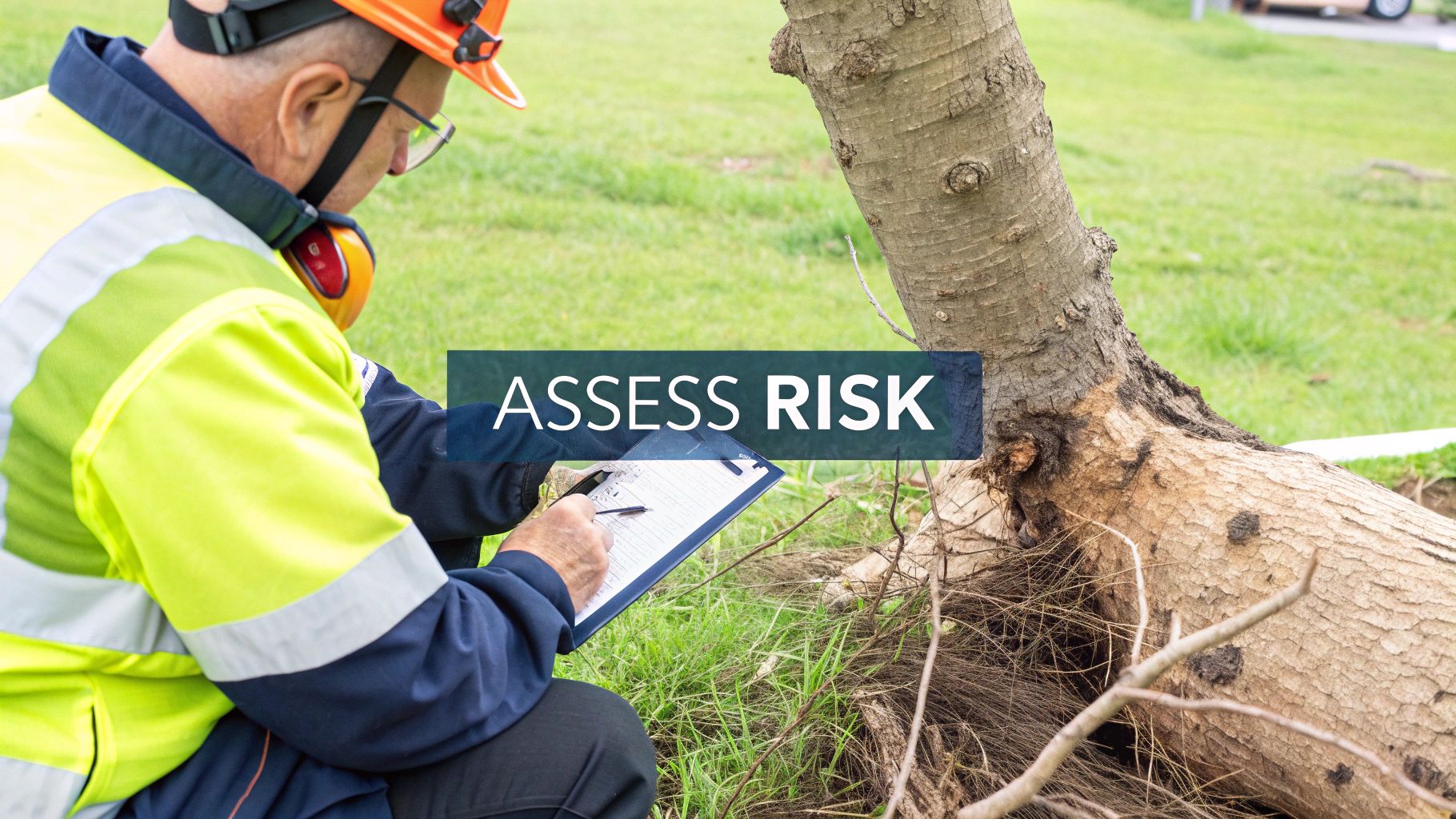
An emergency tree assessment is so much more than just glancing at a fallen branch. Our qualified arborists are trained to spot the subtle but critical signs of danger that most people would walk right past. We’re hunting for hairline fractures in the trunk, the slight upheaval of a root plate hidden under the lawn, or the immense stored energy in a limb left hanging by a thread.
Analysing the Full Picture
Let’s picture a real-world scenario. A big old Brush Box in a Toukley backyard is leaning menacingly after a week of classic coastal downpours. Our first job isn't to fire up the chainsaws; it's to perform a rapid but meticulous risk assessment. We're looking at things like soil saturation, the precise angle of the lean, and how close the tree is to your home and your neighbour's property.
This process means a thorough check for structural integrity, looking for cracks, splits, or pockets of decay that compromise the tree's core strength. A tree can look healthy on the outside while being dangerously weak internally, which is why knowing the symptoms of a sick tree is so important for long-term safety.
We also analyse the root system stability. Has the ground lifted or cracked around the base? This is a huge red flag. It often means the root plate is failing, making a complete uprooting far more likely. Finally, we assess the canopy and limb condition, identifying any suspended or partially broken branches, what we call 'hangers' in the trade. These can fall without warning and are a major risk.
To manage these hazards methodically, professional arborists use principles similar to the structured approach found in risk registers for agriculture, forestry & fishing. It’s not guesswork; it’s a systematic way to ensure every potential danger is identified and controlled.
Why Professional Assessment is Non-Negotiable
The stakes in our line of work are incredibly high. That’s why a professional assessment before a single cut is made is absolutely essential. Tree work is one of Australia's most hazardous jobs, with crews facing extraordinary risks every day. This is why our team adheres strictly to WHS legislation and Australian Standards.
A fallen tree is never just a pile of wood. It's a complex, dynamic system under immense tension. Our job is to safely de-energise that system, piece by piece, protecting your property, the public, and our crew every step of the way. That’s why we’re backed by $20M public liability insurance.
Whether it’s limb shear from the gale-force winds we get around Lake Macquarie or a complete uprooting in the waterlogged soil of a Newcastle suburb like Mayfield, we've dealt with it. This deep local experience allows us to accurately assess the unique risks of your situation and develop the safest, most efficient plan for your emergency tree removal.
What the Emergency Removal Process Involves
Once our qualified arborist has completed a thorough risk assessment and we’re confident the site is safe to enter, our crew gets to work. You'll see us establish a clear work zone using signs and tape. This isn't just for show; it's a critical step that complies with WHS legislation and keeps everyone—you, your neighbours, and our team—safe.
We're methodical and professional because, frankly, there's no room for error. The gear we bring is tailored entirely to the situation on the ground. For a massive tree down in an open paddock, we might bring in heavy machinery to lift and shift large sections.
But for a tricky removal in a tight suburban backyard in Erina or beside a commercial property in Tuggerah, it’s all about specialised rigging and climbing gear. This lets us dismantle the tree with surgical precision, lowering each piece safely without putting your home, garden, or fences at risk.
Safely Dismantling a Dangerous Tree
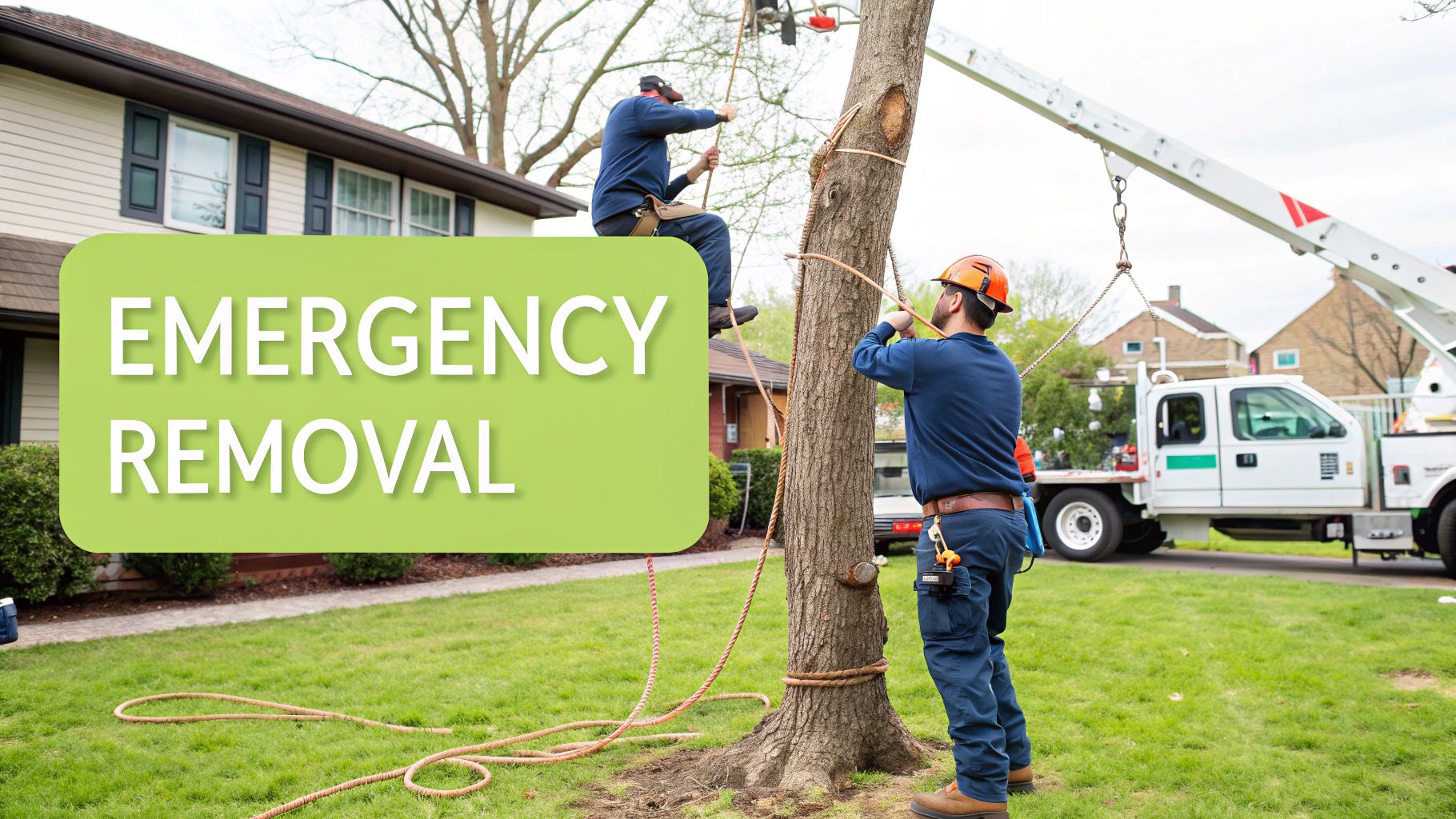
A core technique we use for hazardous trees in confined spaces is called sectional felling. Instead of felling the tree in one go, think of it as carefully deconstructing it piece by piece, from the top down. Our climbers ascend the tree, secured by ropes and harnesses, and systematically cut smaller, manageable sections.
Each piece is then lowered to the ground crew below using a controlled rigging system. This method gives us total control over where every single branch and log lands. It’s the safest, most reliable way to handle a compromised tree leaning over your house or tangled in powerlines. For any complex storm-damaged tree removal, this is a non-negotiable part of our safety procedure.
We operate under strict Australian Standards for all our arboricultural work. This commitment to safety is why we carry $20M in public liability insurance. It’s your guarantee that from the first cut to the final cleanup, your property is fully protected.
Our Commitment to Safety and Compliance
Tree felling is a high-risk activity, and WHS regulations are in place for very good reasons. According to resources from bodies like SafeWork SA, a structured and professional approach is vital to managing the inherent dangers of the job, especially in an emergency.
This relentless focus on safety underpins every single action we take on-site. Before any work begins, our lead arborists conduct a pre-start safety briefing with the whole crew. We discuss the specific hazards of your site—from unstable limbs hanging overhead to the soggy ground conditions in Lake Macquarie after heavy rain.
This ensures everyone on our team knows the plan and their role in executing it safely. It’s this meticulous process that has built our "On Time, Every Time" reputation across the Central Coast and Newcastle for over 25 years.
Navigating Council Permits and Insurance Claims
When a tree comes crashing down, the last things you want to think about are paperwork and phone calls. But an emergency doesn't magically pause council regulations or insurance processes. Knowing how to handle the admin side of an emergency tree removal can save you a world of stress later on.
The good news? In a genuine emergency—where a tree poses an immediate and obvious threat to people or property—councils on the Central Coast and in Newcastle generally don't require pre-approval for its removal. Your safety is always the top priority.
That said, you can't just forget about it once the danger is gone.
Staying Compliant with Council and Strata
Most councils will ask you to provide evidence after the fact to justify the emergency work. This is where a qualified arborist's report becomes your best friend. We've seen this with both Central Coast Council and City of Newcastle regulations.
Our detailed reports, packed with photographic evidence and a professional risk assessment, give the council everything they need to sign off on the work retrospectively. This simple step keeps you compliant and helps you steer clear of potential fines.
For strata managers, there's an extra layer of complexity. If a tree has fallen in a common area, say in a complex in The Entrance or Warners Bay, body corporate approval processes are still in play. We've spent over 25 years working with strata bodies, so we know exactly how to provide the urgent quotes and safety reports needed to get approvals sorted fast, even in a crisis.
Making Your Insurance Claim Easier
Documenting the damage is the single most important thing you can do for a successful insurance claim. Before any cleanup kicks off, grab your phone and take clear photos and videos of the fallen tree and all affected property from every angle possible.
Make sure you capture where the tree came from and the full extent of the damage—whether it's your roof, fence, or car.
Our Promise: We provide detailed, itemised quotes and comprehensive reports specifically designed to meet the requirements of insurance assessors. This documentation is your best tool for a smooth claims process.
Navigating the insurance world can be tricky. It helps to understand some common reasons for insurance claim denials so you can build a stronger case. To make things even simpler, you can learn more about how we support Central Coast insurance claim tree removal in our detailed guide.
Cleanup and Preventing Future Tree Emergencies
Once the immediate danger has been dealt with and the hazardous tree is safely on the ground, the job is far from over. A professional emergency tree removal isn’t truly finished until your property is left clean, safe, and tidy. This post-removal phase is just as critical as the removal itself, focusing on meticulous cleanup and, most importantly, preventing the next emergency before it can happen.
Our team takes a lot of pride in leaving a site better than we found it. We don't just haul away the big logs; we process all the branches and foliage through a wood chipper and rake the entire area to clear away any lingering leaves and small twigs. The goal is to make it look like we were never there—minus the dangerous tree, of course.
For most property owners, the final piece of the puzzle is the stump. Leaving it in the ground can be a stubborn trip hazard and an eyesore. We offer professional stump grinding to grind it well below ground level, letting you reclaim the space for a new patch of lawn, a garden bed, or even a new tree. You can dive deeper into how that works in our comprehensive guide to everything you need to know about stump grinding.
Shifting from Reactive to Proactive Tree Care
With the immediate crisis sorted, now is the perfect time to think about the health and safety of the other trees on your property. An emergency is often a wake-up call, shining a light on potential risks you might not have noticed before. Taking a proactive approach is hands-down the best way to protect your home and avoid future stress and unexpected costs.
A simple walk around your property every few months, especially after strong winds or heavy rain, can reveal early warning signs. You should look for dead or hanging branches, cracks or splits in the trunk, a sudden lean, or fungus growing on the base. These are all potential indicators of a problem that needs a closer look.
The Value of a Professional Tree Assessment
While your own checks are a great start, they can't replace the trained eye of a qualified arborist. We recommend a professional tree assessment every couple of years, particularly for properties with large, mature trees or those in high-wind spots like Terrigal or Wamberal on the Central Coast.
After more than 25 years serving the Central Coast, Newcastle, and Lake Macquarie, we know exactly what to look for. Proactive, strategic pruning is one of the most effective ways to prevent storm damage, improve a tree's structure, and keep it healthy for the long term.
An arborist can spot subtle issues an untrained eye would easily miss—things like compacted soil, the first signs of a pest infestation, or poor limb structure. By getting ahead of these problems with targeted pruning, you’re not just preventing future emergencies; you’re investing in the long-term health and beauty of your landscape.
Your Emergency Tree Removal Questions Answered
With over 25 years on the tools, handling urgent callouts from the Central Coast to Newcastle and Lake Macquarie, we’ve heard just about every question in the book. An emergency is stressful enough without a list of unknowns adding to the worry.
To give you some peace of mind, we’ve laid out clear, simple answers to the queries that pop up most often.
How quickly can you be here for an emergency?
Our entire operation is geared for rapid response because we’re a dedicated 24/7 emergency service. When a situation is critical—think a tree has smashed through a roof in Adamstown or is completely blocking a driveway in Gorokan—we dispatch a team right away. Our local crews mean we can usually be on-site within hours to assess the damage and, most importantly, make the area safe. Our promise of "On Time, Every Time" is something we live by, especially when you need us most.
Will my home insurance cover the cost of removal?
This is a big one, and rightly so. In most cases, a standard home and contents insurance policy will cover the cost of removing a tree that has fallen and damaged an insured structure—like your house, garage, or fence. The catch is that every policy is slightly different, and they almost never cover the removal of a standing tree, even if it's a hazard. It's vital to check the specifics of your cover. To help, we provide incredibly detailed, itemised quotes and arborist reports formatted to meet the strict requirements of insurance companies.
What’s the difference between an arborist and a tree lopper?
This is a critical distinction, particularly in a high-stakes emergency. A qualified arborist is a trained professional who understands tree science, biology, and Australian safety standards. We use precise, calculated techniques like pruning and sectional felling to manage trees safely. The term "tree lopper" often refers to someone without formal qualifications who might use outdated, harmful methods like topping. In an emergency, choosing a qualified, fully insured arborist isn't just a smart move; it's the only way to guarantee the job is done safely and correctly.
At Treecorp Solutions, our focus is on providing safe, reliable, and professional emergency tree services exactly when you need them. If you're facing a tree emergency or simply want a proactive assessment of your property, our team is ready to help.