

When you’re staring up at a problem tree on your property, the first question that probably pops into your head is, "How much is this going to cost?" It’s the big unknown, and we find that getting a clear answer helps you make the right decision for your home and budget.
For a professional, fully insured tree removal here on the Central Coast, Newcastle, or Lake Macquarie, you’re looking at a range from $350 for a small, straightforward job to well over $5,000 for a massive, tricky removal. The final price really comes down to the tree’s size, where it’s located, and the risks involved in getting it down safely and in line with WHS legislation.
Your Upfront Guide to Tree Removal Costs
Getting a handle on tree removal costs helps you budget properly and avoid any nasty surprises. While every single job is unique, our 25+ years of experience working with property owners across the region gives us a pretty clear idea of what to expect. A simple removal might only take a couple of hours, but a hazardous tree leaning over your house requires a full day, specialised gear, and a highly skilled crew. We’re all about being "On Time, Every Time," and that starts with a transparent quote.
Let’s paint a picture. Imagine you're a homeowner in Gosford, and there's a medium-sized gum tree getting a bit too friendly with your fence. You know it’s a risk, especially with the wild storms we get. The average cost to remove a tree in Australia is around $1,150, but for a tree between 5m and 10m in our local area, you're more likely looking at $700 to $1,500.
That price reflects the expertise needed from qualified arborists who have to navigate tight suburban backyards, power lines, and the specific council rules we have here in NSW.
Breaking Down the General Costs
The size of your tree is easily the biggest factor driving the price. To give you a better sense of the numbers, here are the general cost brackets we see for standard tree removals in suburbs like Terrigal, Charlestown, and Warners Bay.
- Small Trees (under 5 metres): These are often quick and easy jobs, usually costing a few hundred dollars. Think of smaller ornamental trees or large shrubs that can be removed with minimal equipment.
- Medium Trees (5 to 10 metres): This is the sweet spot for many trees in residential backyards. The price typically lands in the high hundreds to mid-thousands, depending on how easy it is to access and any tricky obstacles.
- Large Trees (over 10 metres): For those towering gums or mature pines, the cost will climb into the thousands. These jobs demand advanced rigging techniques, a bigger crew, and sometimes heavy machinery to bring the tree down safely piece by piece.
This infographic gives you a quick visual on how tree size affects the starting cost.
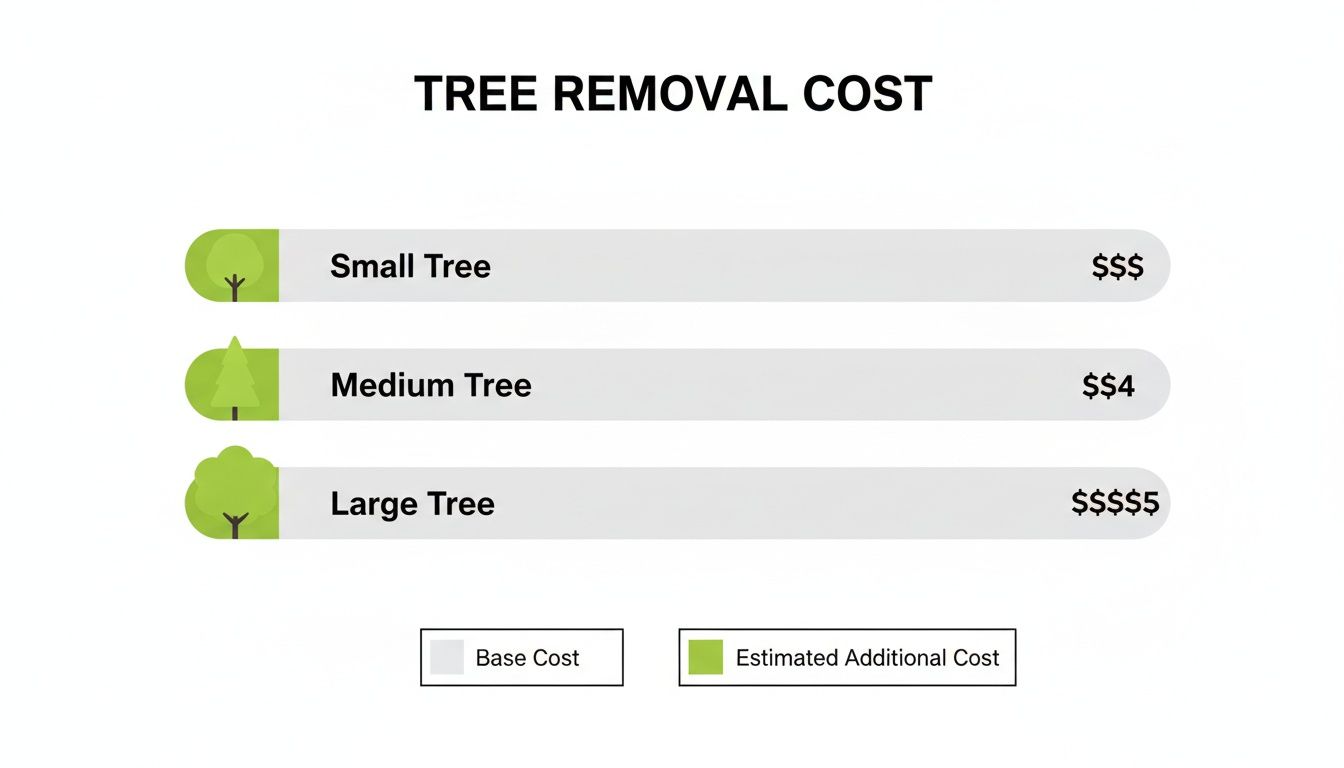
As you can see, the price jumps significantly as the tree gets bigger, which makes sense given the extra time, risk, and equipment needed.
While these figures are a great starting point, the final quote will always depend on a few other key factors, which we’ll dive into next. For a more detailed estimate tailored to your situation, you might find our guide on how to use a tree removal cost calculator helpful.
The 7 Factors That Really Shape Your Quote
Ever wondered why tree removal quotes can feel a bit all over the place? It’s a fair question. When a qualified arborist from our team gives you a price, it's never just a wild guess. We're carrying out a detailed on-site assessment, and that final number is a careful calculation based on the time, equipment, and risk involved in getting the job done safely.
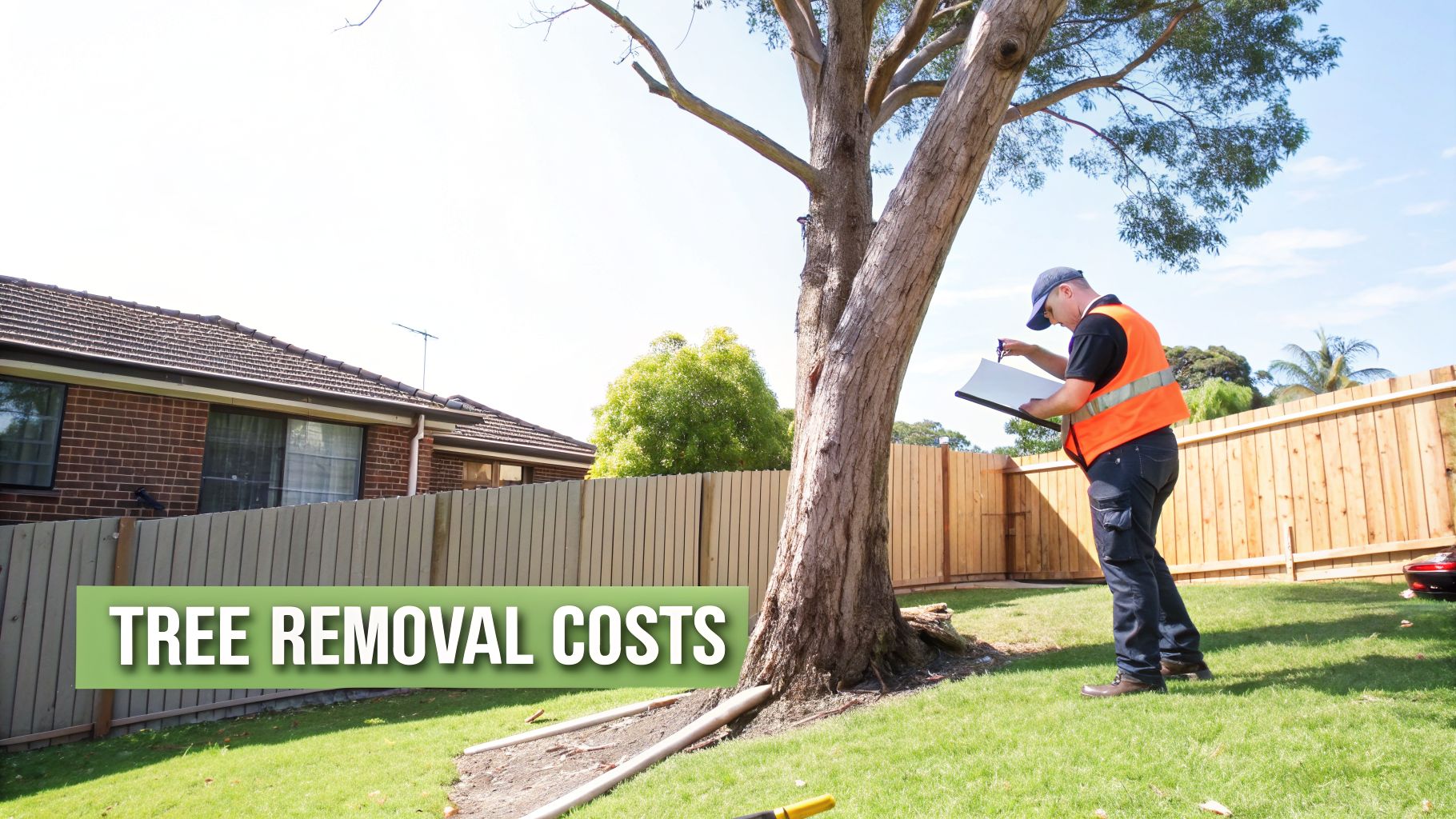
Understanding these factors helps you see exactly what goes into our work. Here are the seven key things we’re looking at when we visit your property, whether you’re in Belmont, Woy Woy, or anywhere in between.
1. Tree Size and Height
This one’s the most obvious starting point. A taller, wider tree simply has more mass, which means more time, more labour, and more green waste to manage. A little five-metre tree might be a quick job for us. But a towering 20-metre Blackbutt? That’s a whole different ball game, demanding advanced rigging, a bigger crew, and a much more methodical approach. The trunk's diameter also matters a lot—thicker trunks need more powerful saws and take longer to cut.
2. Tree Species
Not all wood is created equal. The type of tree directly affects how we tackle the removal. Dense hardwoods like an Ironbark or Spotted Gum are incredibly heavy, making them far more challenging to cut and handle than a softer pine. That extra density puts more strain on our equipment and requires more physical grunt from the team. Every single piece we lower weighs more, so we need stronger ropes and more careful rigging. It’s a crucial detail that always factors into the final cost.
3. Tree Condition and Health
A tree’s health is a huge factor in job safety. It might seem like a dead or dying tree would be easier to remove, but the opposite is often true. They can be dangerously unpredictable. Brittle limbs can snap without warning, and a rotten trunk might not safely support a climber or the rigging gear.
A compromised tree often forces us to bring in specialised gear like an elevated work platform (EWP) or even a crane. This avoids putting our crew in a risky situation but naturally adds to the job's cost due to the extra machinery and safety protocols. On the other hand, a healthy, solid tree is predictable, which can make the dismantling process more straightforward.
4. Location and Accessibility
Where the tree is on your property is one of the biggest cost drivers. A tree in an open front yard in Wyong with the truck parked right beside it is a world away from a massive gum tree crammed into a sloping backyard in Terrigal with only a narrow path for access. We have to ask a few questions, like can we get the truck and woodchipper close? If not, every branch and log has to be carried out by hand, adding significant labour time. Is the ground flat or on a slope? Working on steep ground slows everything down. What’s underneath? Working around pools, sheds, or fences requires far more precision.
5. Proximity to Hazards
This is where risk assessment becomes absolutely critical. A tree standing alone in a paddock is a low-risk job. A tree with branches hanging over your house, the neighbour’s roof, or a set of power lines in a suburb like Adamstown? That's high-risk, high-skill work. Every single cut has to be planned with surgical precision to lower branches safely without causing any damage. This complexity demands highly skilled arborists and a methodical, piece-by-piece approach, which is reflected in the quote. Our $20 million public liability insurance is there for your peace of mind, but our number one goal is to avoid any incidents through meticulous planning.
6. Stump Grinding Requirements
Removing the tree is just one part of the job. A standard removal quote usually doesn't include getting rid of the stump. Stump grinding is a separate service using specialised machinery to chew the stump and its main roots down below ground level. You’ll need to decide if you want this done, and it will be listed as a separate line item on your quote. It's an essential step if you're planning to lay new turf, build something, or plant a new garden in that spot. To get a better sense of these expenses, you can learn more about what an arborist costs for various services.
7. Site Cleanup and Green Waste Disposal
Any professional quote from us will always include a full site clean-up. That means we chip all the branches, cut the trunk into logs, and haul every last bit away, leaving your property looking tidy. The sheer volume of green waste from a single large tree can be massive, and tip fees are a real cost for our business. Some clients ask to keep the woodchips for mulch or the logs for firewood, but the standard quote assumes we’re taking care of all disposal to leave your property neat and safe.
When You Need to Remove a Large or Hazardous Tree
Removing a small, healthy tree is one thing. Tackling a towering giant or a tree that’s become a genuine danger? That’s a whole different ball game. These high-stakes scenarios are where tree removal costs climb, and for very good reason. This isn’t just about cutting down a tree; it's about managing immense risk with surgical precision.
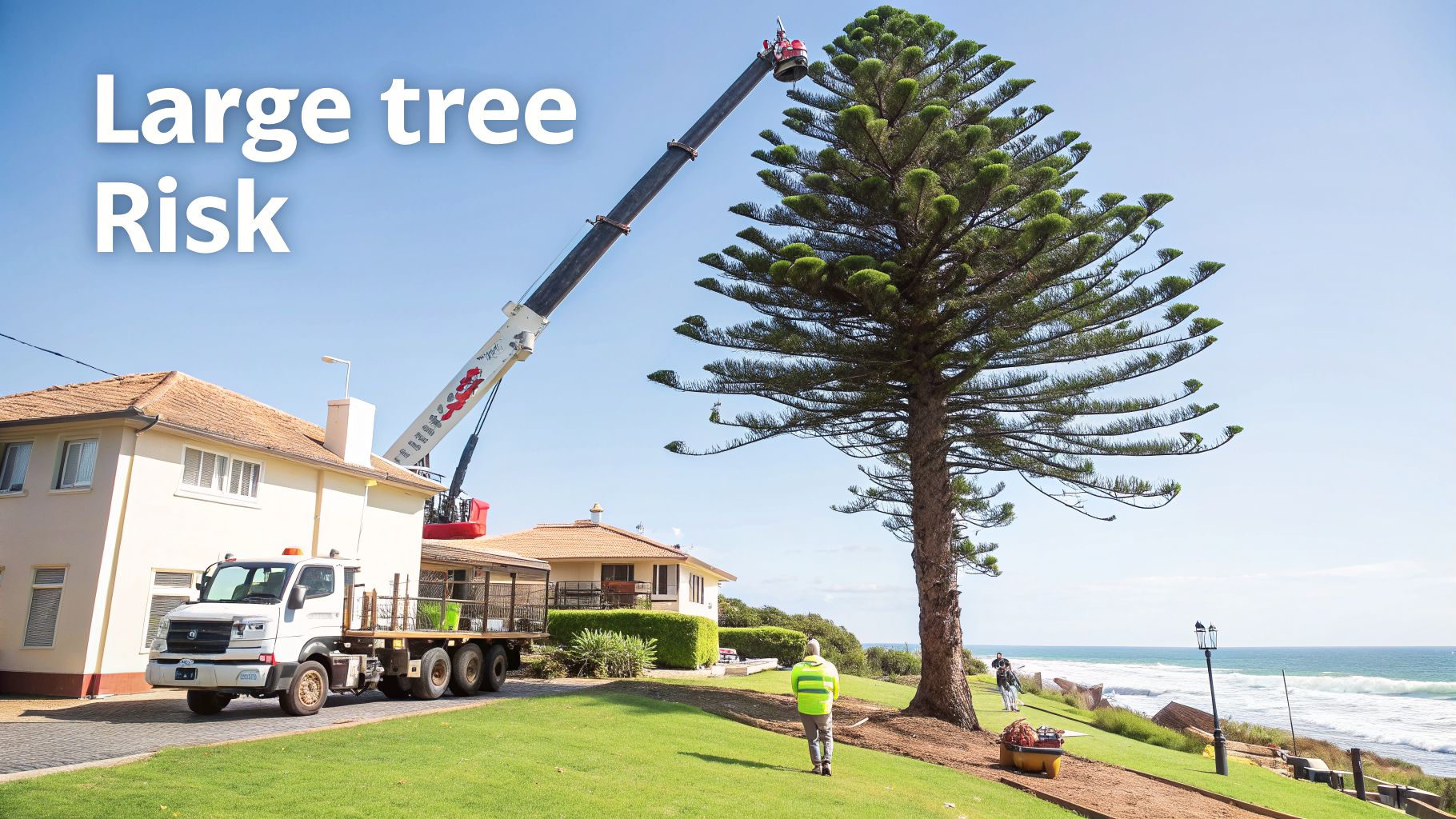
Imagine a huge Norfolk Pine in Wamberal dropping heavy branches near your home. Or maybe a storm-damaged gum tree in Lake Macquarie that's leaning precariously over your fence. When a tree is over 10 metres, structurally unsound, or poses an immediate threat, the job becomes far more complex. This is where the skills of a qualified arborist and specialised equipment become non-negotiable—for the safety of your property, the public, and our crew.
Why Size and Hazard Level Drive Up Costs
You can't just yell "timber!" and drop a massive tree in a built-up suburban area. It has to be dismantled piece by piece, from the top down. This process, known as sectional felling, requires an arborist to climb the tree and use advanced rigging techniques—a system of ropes and pulleys—to safely lower each heavy section to the ground.
The presence of a large or hazardous tree demands a thorough risk assessment before any cuts are made. It's a practice deeply understood in industries like forestry where mastering risk assessment in forestry is critical for preventing accidents. For us, it means creating a detailed plan that complies with all Work Health and Safety (WHS) legislation to protect everyone involved. For example, a huge gum tree leaning over a house in Charlestown requires a completely different approach to one standing in an open field. We might need to bring in an elevated work platform (EWP) or even a crane to lift sections of the tree up and away from the roof. This machinery adds a significant cost, but it's essential for a safe, controlled removal.
Understanding Emergency and After-Hours Call-Out Fees
Storms on the Central Coast and in Newcastle can create chaos in an instant. Picture this: a wild storm hits, and now your large pine tree is uprooted in the front yard, blocking the driveway and threatening your roof. It's time for urgent action. In Australia, the cost for large tree removal (10m-20m) typically ranges from $1,500 to $3,000, with extras like stump grinding adding more. Locally, a towering Norfolk Pine could even hit $10,000 if a crane is needed—something we see often in coastal zones where winds can top 100km/h.
Safety Warning: An uprooted or storm-damaged tree is extremely unstable. Never attempt to assess it yourself or cut branches. Stay well clear of the area and call a professional arborist immediately.
When we get an emergency call, especially after hours or on a weekend, the work carries a premium. This isn't about price gouging; it's a reflection of the reality of the situation. We have to pull a crew away from their downtime and get them on-site with the right equipment, fast. Working in post-storm conditions, often in the dark or bad weather, is inherently more dangerous and requires extra safety protocols. The work is prioritised to make your property safe as quickly as possible and prevent any further damage. This immediate response is crucial for securing your property. For more detail, our guide on what to expect during an emergency tree removal can provide valuable clarity. These situations are exactly why investing in a professional, insured team with over 25 years of local experience is the only safe option when you’re facing a large or hazardous tree.
What About Stump Grinding and Green Waste?
Getting a tree safely on the ground is a huge part of the job, but it’s not the end of the story. The final price tag for a tree removal always has to account for what happens next—dealing with the stump and clearing away all the leftover branches and logs. At Treecorp Solutions, our quotes are all-inclusive, meaning we handle the complete clean-up so your property is left tidy and safe.
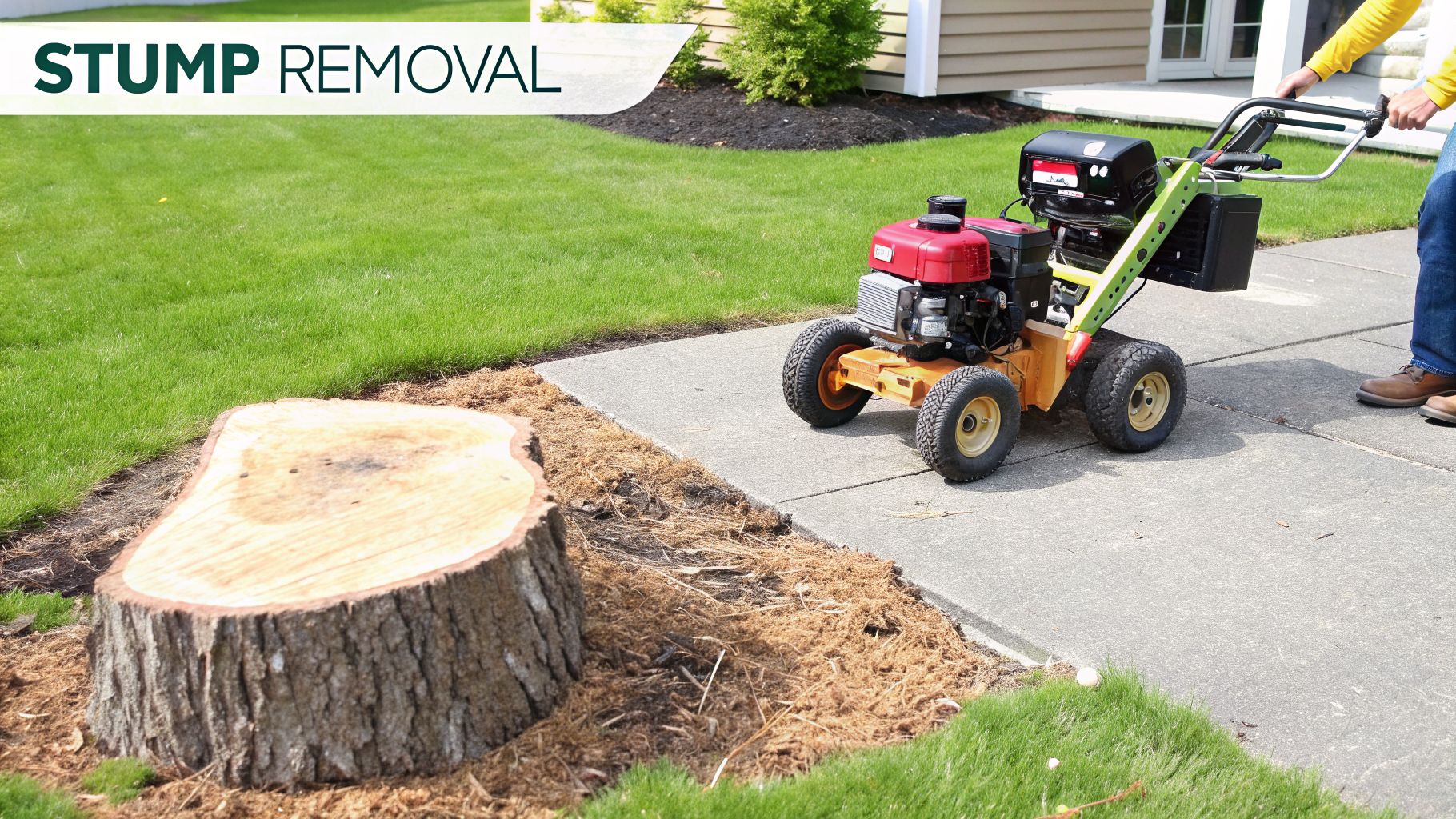
It’s crucial to understand these "after-costs," as they can sometimes be overlooked. Deciding what to do with the stump and how the debris is managed are key parts of the project that contribute to the final price.
To Grind or Not to Grind: The Stump Question
Once a tree is down, you’re left with its stump. You have a couple of options here, but leaving it isn't one we'd recommend. A decaying stump can attract termites and other pests, which can then become a serious problem for your home. It's also a frustrating obstacle for mowing and a trip hazard for kids and adults alike. The most common and effective solution is stump grinding. This process uses a powerful machine to literally chew the stump and its major surface roots into small wood chips, grinding it down well below ground level. This allows you to lay new turf, create a garden bed, or simply reclaim your lawn space without any fuss. The alternative, complete stump excavation, is a much larger and more disruptive job, usually reserved for major land clearing projects.
How Much Does Stump Grinding Cost?
The cost of stump grinding mostly comes down to the stump's diameter and how easy it is to get our machinery to it. For instance, grinding a small stump on a flat lawn in Erina will be quicker and cheaper than a large, difficult-to-reach stump on a sloped block in The Entrance. Nationally, stump removal averages around $225, but prices in our NSW region for a standard job typically fall between $120 and $450. This price scales with size and complexity. A big 85-120cm stump could easily cost $600-$800 because of the extra labour and stubborn root systems involved.
When you get a quote, always clarify if stump grinding is included. It’s often listed as an optional extra, but we always advise it for a complete, professional finish. For the vast majority of homeowners on the Central Coast, Lake Macquarie, and Newcastle, stump grinding is the clear winner. It's efficient, cost-effective, and gets the job done without turning your garden into a construction site.
Factoring in Green Waste Disposal
A single tree, especially a large one, creates a massive amount of green waste. All those branches, leaves, and logs have to go somewhere. Our process involves using an industrial-grade woodchipper to turn all the branches into valuable mulch right there on-site. This is a game-changer, as it significantly reduces the volume of waste we need to transport away. The larger logs are cut into manageable sections and loaded onto our trucks for disposal. Both the chipping and hauling take time and labour, and tip fees for green waste are a direct business cost that gets factored into your quote. For our clients across the Central Coast and Newcastle, this full-service approach ensures you aren’t left with a mountain of debris to deal with yourself.
Knowing these final steps helps you understand the full scope of a professional tree removal project. For a clearer picture of how these elements come together, check out our detailed look at the costs associated with stump removal. It's about ensuring the job is truly finished—from the highest branch down to the last wood chip.
Navigating Permits, Insurance, and Strata Rules
Figuring out how much a tree removal will cost goes beyond just the physical work. There’s a whole other side to it—the "paperwork" part. This includes council permits, insurance, and strata rules, all of which can seriously affect your final costs and legal duties. Getting this wrong can lead to some pretty hefty fines or nasty disputes, turning a straightforward job into a massive headache. We’ve seen it happen more times than we can count over our 25 years in the business, and our local experience means we can help you get it right from the start.
Do You Need a Council Permit?
Before you can even think about removing certain trees, you often need the green light from your local council. The rules for tree removal on the Central Coast can be quite different from those in Newcastle or Lake Macquarie, especially when it comes to native species, heritage trees, or trees in conservation zones. For instance, a big old gum tree in a suburban backyard in Long Jetty will likely need a permit, but a smaller, non-native species over in Warners Bay might not. As a general rule, you’ll probably need a permit if a tree is over a certain height or trunk diameter, is a protected native species, or sits in an environmentally sensitive area. We handle these applications for our clients all the time because, let’s be honest, the process can be confusing. For a deeper dive, check out our guide on how council approval for tree removal works.
Why Insurance Is Non-Negotiable
This is one area you absolutely cannot afford to cut corners on. Tree removal is a high-risk job. While accidents are rare with seasoned professionals, they can still happen. It's crucial to understand what is liability insurance for contractors to make sure you're covered if anything goes wrong. Hiring an uninsured operator puts your property, your neighbour's place, and your own financial security on the line. It’s just not worth the risk. We are fully insured with a $20 million public liability insurance policy. This isn’t just a number; it’s your guarantee that if the unexpected happens, you are completely covered. Always, always ask to see a company’s insurance certificate before any work begins.
Working Within Strata and Body Corporate Rules
If you live in a townhouse complex, an apartment building, or any strata-managed property, you’ve got another layer of rules to deal with. You can’t just wake up and decide to remove a tree, even if it’s technically in your private courtyard. Trees on common property are the responsibility of the body corporate, and removing them requires a formal vote and approval from the committee. Let's say you're in a complex in Toukley and a tree is blocking all your sunlight. Your first step isn't to call an arborist—it's to contact your strata manager. They'll walk you through the process, which usually involves getting a professional arborist report and quote to present to the committee. We work with strata managers across the region all the time, providing clear assessments and handling the job smoothly while respecting shared spaces and access rules.
How to Get a Quote You Can Trust
Not all quotes are created equal. Getting the right one is the final, crucial step in figuring out what it will really cost to remove your tree. It's important to remember that a cheap quote isn't always a good one, and a professional price should come with professional guarantees. This is where you can easily spot the difference between a reliable arborist and someone just looking to make a quick dollar. A trustworthy quote can never be given over the phone. Every single tree and property is unique, which is why we always carry out an on-site assessment. It’s the only way to accurately evaluate access, potential hazards, and the specific needs of the job.
What a Professional Quote Includes
When you get a quote from a reputable company like ours, it should be a clear, detailed document—not just a number scribbled on a piece of paper. This transparency is what protects you and sets clear expectations for the work ahead. Think of it as the blueprint for a safe and successful job. Your quote should always have a detailed scope of work, a clear cost breakdown listing any optional extras like stump grinding, and proof of our $20 million public liability insurance and arborist qualifications. Always be wary of cash-only deals or quotes that seem too good to be true. They often signal a lack of insurance or the expertise needed to do the job safely, putting your property at serious risk.
Questions to Ask Before You Hire
To feel confident in your choice, it pays to ask a few key questions. A true professional will be happy to answer them and put your mind at ease. Consider asking if they are familiar with the local council rules in areas like Gosford or Wyong, what safety procedures and WHS standards they follow, and if they can provide a recent reference from a similar job. By asking these questions and insisting on a detailed written quote, you can effectively compare your options and choose a team that values safety, quality, and reliability above all else. For a free, no-obligation property assessment and a quote you can count on, get in touch with our team today.
Frequently Asked Questions About Tree Removal Costs
We get a lot of questions from property owners trying to budget for tree work. To help you plan, we’ve put together answers to some of the most common queries we hear from our clients across the Central Coast, Lake Macquarie, and Newcastle.
Is It Cheaper to Remove a Tree in Winter?
Sometimes, yes. The theory is that deciduous trees have no leaves in winter, making them a little lighter and quicker to dismantle. This can sometimes translate to a small saving on labour costs. But in reality, factors like urgency and the tree's condition have a much bigger impact on the final price than the season. A dangerous tree should never be left standing just to chase a potential seasonal discount. Safety always comes first.
Does My Home Insurance Cover Tree Removal?
This is a really common point of confusion. As a general rule, your home insurance will only cover the cost of removing a tree if it has already fallen and damaged an insured structure, like your house, garage, or fence. Most policies do not cover the removal of a healthy, standing tree as a preventative measure. If a storm does bring a tree down on your property in suburbs like Kariong or Belmont, we can provide all the necessary paperwork and documentation to help support your insurance claim.
What's the Difference Between an Arborist and Someone Who Does "Tree Lopping"?
Understanding this difference is absolutely critical for the safety of your property and family. A qualified arborist is a trained professional who understands the science behind trees—from biology and soil health to the complex physics of safe rigging, all guided by Australian Standards. The term 'tree lopping' often refers to an untrained individual. They might use outdated and dangerous practices like "topping" or indiscriminate pruning, which can seriously harm or even kill your trees. Always ask for qualifications (like a Certificate III in Arboriculture) and proof of insurance to be certain you're hiring a genuine professional.
Can I Keep the Firewood or Wood Chips to Save Money?
Absolutely! If you’d like to keep the wood chips for mulch or the logs for your fireplace, just let us know when we're preparing your quote. This can often reduce the overall cost because it saves us time and disposal fees. We can cut the logs to a manageable size for you, and our industrial wood chipper produces top-quality mulch that’s perfect for local gardens in areas like Umina Beach or Swansea. It's a fantastic way to recycle the green waste right there on your own property.
Ready to get a clear, upfront price for your tree removal project? The team at Treecorp Solutions has been helping property owners across the Central Coast, Newcastle, and Lake Macquarie for over 25 years. We offer free on-site assessments to provide a detailed quote you can trust.
Request a free quote online or call us for emergency service.


