There's nothing quite like the satisfaction of pulling a crisp, juicy apple from your own tree. But getting that picture-perfect harvest, especially here in Australia, is rarely a matter of luck. The real secret lies in knowing how to prune your apple tree correctly and, just as importantly, when to do it.
As arborists with over 25 years of local experience on the Central Coast, we've helped countless property owners turn their backyard trees into productive assets. Think of pruning less as a chore and more as a crucial check-up that guides your tree toward a long, healthy life. We're here to share some of that expertise with you.
Why and When to Prune Your Apple Trees in Australia
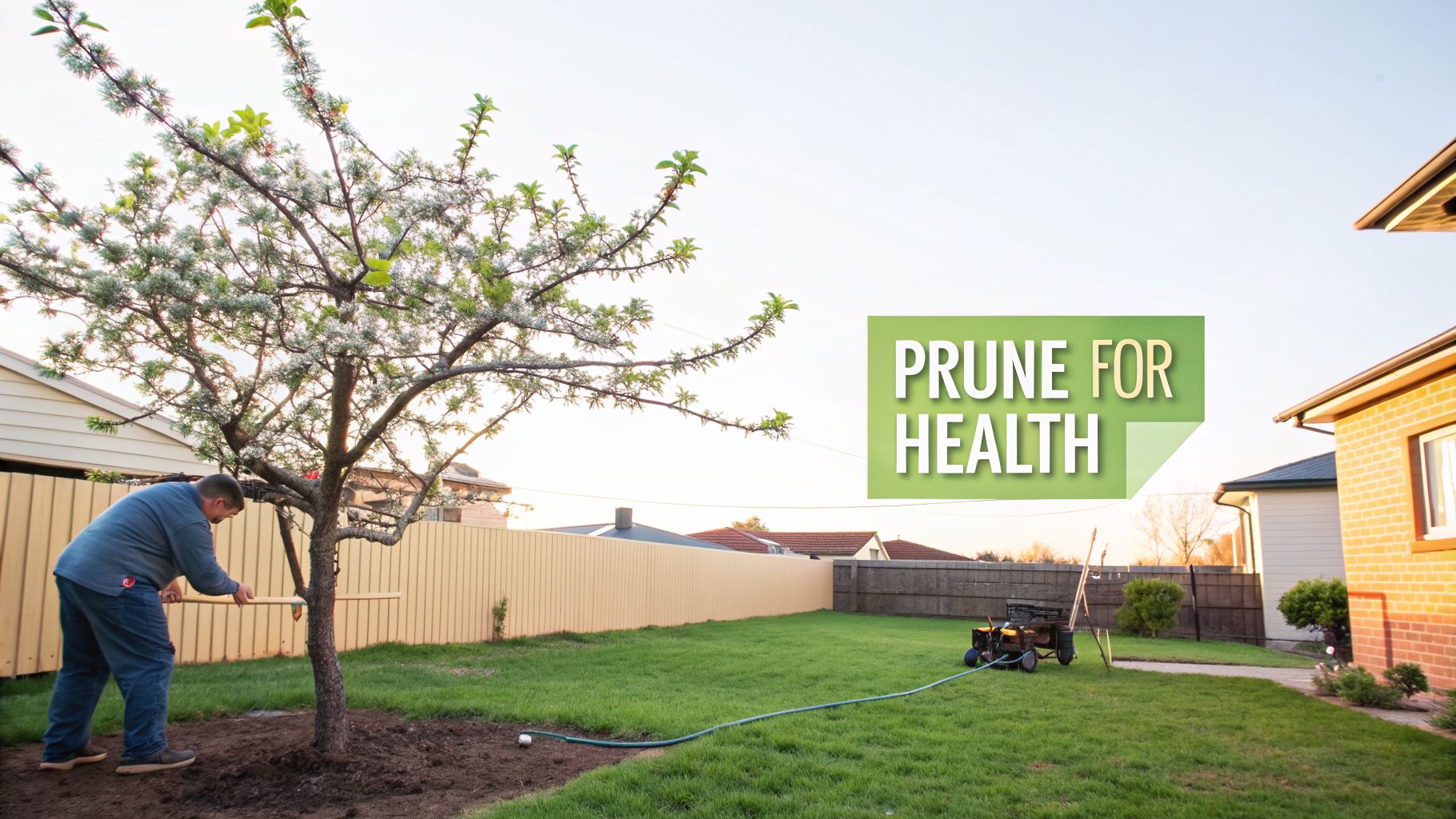
Smart pruning is one of the best things you can do for your apple tree's health and the quality of its fruit. When you make the right cuts at the right time, you're not just giving it a tidy-up; you're setting it up for success. Good pruning lets the tree breathe by opening up the canopy to improve airflow, which is your best defence against fungal diseases that thrive in our humid coastal air.
It also builds a strong frame, encouraging a solid structure that can handle a heavy load of fruit without branches snapping, even when those southerly busters roll through the Central Coast. By making careful cuts, you focus the tree’s energy into growing delicious fruit, not just a jungle of weak, leafy branches. This also lets more sunshine in, meaning better-ripened fruit with superior colour and flavour.
Imagine you've got a young tree just getting started on a Terrigal property. The right cuts now will build the framework for decades of great apples. Or perhaps you have an overgrown, neglected tree in a Newcastle backyard; a restorative prune can bring it back to life. Getting the timing right is everything. To get the full picture, you can learn more about the best time to prune trees in Australia in our detailed guide.
Why It Matters: Think of pruning as a conversation with your tree. You’re guiding it, telling it where to focus its energy. A neglected tree will often produce lots of leaves and small, poor-quality fruit, while a well-pruned tree will deliver the delicious, crisp apples you're hoping for.
In Australia, we generally have two main windows for pruning apple trees, each with a different goal. Most of the heavy lifting and structural work happens in winter when the tree is dormant (asleep for the season). Then, a much lighter prune in summer helps manage new growth and improve the fruit that's already on the way.
The Right Tools and Safety Checks Before You Start
Before you make that first cut, let’s talk gear. Heading out with blunt or incorrect tools isn't just frustrating; it's a recipe for ragged cuts that damage your apple tree and open the door for disease. A quality set of tools is a fantastic investment for any home gardener.
Your essential kit is pretty straightforward. You'll want a sharp pair of bypass secateurs for the small stuff, a set of loppers for branches up to about 4cm thick, and a clean, sharp pruning saw for anything larger. Always go for bypass tools over the anvil type. Bypass tools cut like scissors, giving you that clean slice that helps the tree heal quickly.
Keep It Clean and Sharp
Here’s a step people often miss, but it’s one of the most important: tool sanitation. Imagine you’re pruning a tree in your Erina garden with a hidden fungal issue. If you move on to the next tree without cleaning your tools, you've just become a disease-spreader. It's a simple habit to get into. Just wipe your blades with a cloth soaked in methylated spirits between cuts, especially when moving from one tree to another. It makes a massive difference.
To get those clean cuts, you also need to keep your blades in top condition. Learning how to sharpen your cutting tools is an invaluable skill. A sharp blade slices cleanly through the wood fibres, which is exactly what a tree needs to mend itself efficiently. For a deeper dive into cutting techniques, you can explore our guide on Tree Pruning 101.
Safety Always Comes First
At Treecorp Solutions, we live and breathe safety, and you should too. Before you start, take a minute to look up and around. Are there any overhead powerlines? Is the ground uneven? Never, ever attempt to prune branches that are near or touching powerlines. That is strictly a job for professionals who are trained and authorised to work in these dangerous situations.
Trying to balance on a ladder while holding sharp tools is a classic recipe for a serious accident. If you can't reach the branches you need to prune safely from the ground, that’s your cue to stop. At that point, a DIY job becomes a job for a qualified arborist.
As professionals with over 25 years of experience, we have the specialised equipment, rigging, and safety training to work at height safely. Crucially, we also carry $20M in public liability insurance, which is essential for protecting you and your property from any potential incidents. If you're feeling unsure, it's always better to be safe.
Mastering the Winter Prune for Structure and Health
When winter rolls around and your apple tree drops its leaves, it’s giving you the perfect opportunity. This is your chance to do the most important prune of the year—the structural prune. With the branches completely bare, you can see the tree's entire skeleton, making it easy to decide where to cut for a strong, healthy future.
The aim is to create that classic ‘vase’ shape. Think of a wine glass—you want a handful of main branches growing up and out from the trunk, leaving the centre wide open. This shape is fantastic because it lets sunlight and air right into the middle of the tree, which means better-ripening fruit and far less chance of fungal problems taking hold.
The First Cuts: The Three Ds
Before you even think about shaping, your first job is to clean house. This means tackling the ‘Three Ds’, the absolute foundation of a good prune. You're looking for any wood that is: Dead, Diseased, or Damaged.
Dead wood will be brittle, often look a different colour, and will have no live buds. For diseased wood, keep an eye out for cankers (sunken, discoloured areas), weird growths, or unusual bark. Damaged wood includes any branches that are cracked, broken, or—importantly—rubbing against each other.
When branches cross and rub, they create open wounds on the bark. It’s a constant source of stress for the tree and a perfect gateway for pests and diseases to move in. Getting rid of this problem wood is a simple tidy-up that prevents much bigger headaches later on.
For anyone with property in Lake Macquarie, you know how punishing our coastal winds can be. A strong frame isn't just a nice-to-have; it's your tree's best insurance policy against storm damage. A huge part of our work providing professional pruning on the Central Coast focuses on building this kind of resilience from a young age.
Shaping the Tree for Future Growth
Once the ‘Three Ds’ are cleared out, take a few steps back and have a proper look at the tree's overall form. Now you can start picking out your main ‘scaffold’ branches. These are the primary limbs that will form the permanent skeleton of your apple tree. You’re aiming for three to five strong branches, well-spaced and radiating out from the trunk. Before you make those first cuts, though, a quick safety check on your tools is essential.
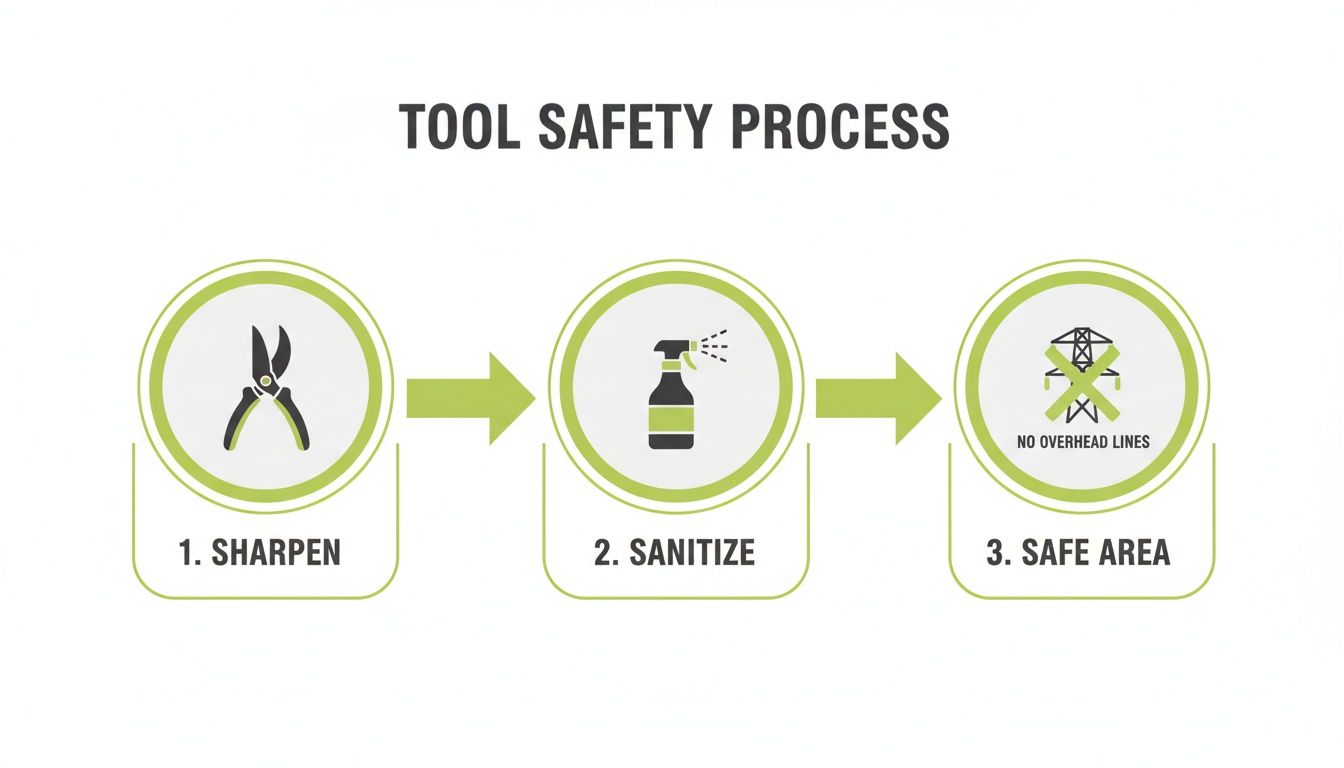
These three simple actions—sharpening your tools, sanitising the blades, and making sure your work area is clear—are non-negotiable for a safe and effective job. Clean, sharp cuts heal faster and prevent the spread of disease, which is a core principle we follow on every job.
Don't underestimate the power of timing. Australian research has shown just how vital a proper winter prune is for your harvest. One detailed trial found that trees pruned consistently in mid-winter produced a staggering 62.8 tonnes per hectare more in cumulative yield compared to other pruning schedules. This is a core principle our qualified arborists apply to trees across Newcastle and the Central Coast because small adjustments can lead to massive results.
Summer Pruning for Better Fruit and a Tidier Tree
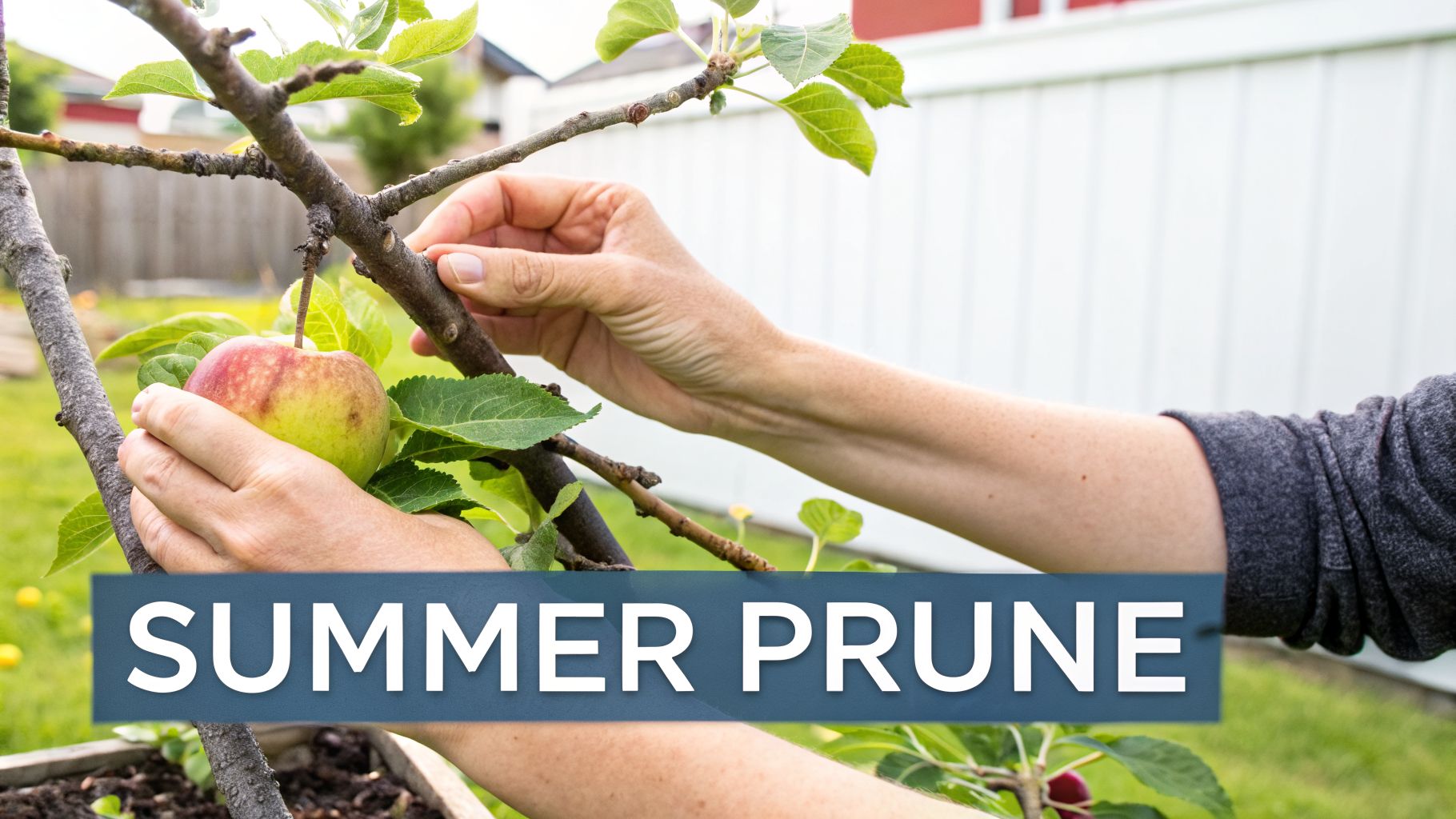
If your big winter prune built the skeleton of your apple tree, think of summer pruning as the fine-tuning that delivers a top-quality harvest. This is a much lighter, more delicate job we do in late summer, usually around late January to February, just after the main flush of spring growth has hardened off. It’s all about managing the tree’s energy and getting more sunlight onto those developing apples.
More light means better colour, richer flavour, and sweeter fruit. It really is that simple. When we’re doing a summer prune on an apple tree, our main target is those ridiculously vigorous, straight-up shoots that seem to appear out of nowhere. We call them ‘water shoots’ or ‘suckers’, and they are absolute energy thieves. They grow fast and leafy but almost never produce fruit, stealing resources that should be going into your apples.
Directing Your Tree’s Energy
Getting rid of these water shoots is the first job. You can just cut them cleanly back to the branch they sprouted from. This one simple action immediately redirects the tree's energy back into ripening the current crop and developing fruiting wood for next year. It also instantly improves airflow and sunlight getting into the tree’s canopy.
Another great technique we use is ‘pinching back’. This just means trimming the soft tips of new, leafy growth. Doing this encourages the tree to convert what would have been a leaf bud into a productive fruiting spur for next season. It’s a gentle nudge, telling the tree where to focus its efforts. This is especially effective for popular varieties like Granny Smith and Pink Lady™, which you’ll find in many gardens from Gosford to Wyong.
Why This Matters: Summer pruning is your chance to manage a tree that's a bit too vigorous. By carefully removing unwanted growth, you're not only improving this year's fruit but also telling the tree to calm down and invest in a better harvest for next year.
Expert advice for Aussie conditions often highlights this technique. Summer pruning is highly recommended to turn leaf buds into fruiting spurs, particularly on vigorous shoots that are over 23 cm long. Trimming these back encourages the tree to develop more fruit-bearing wood, a practice that can turn a previously unproductive tree into a reliable fruiter. A light summer tidy-up also keeps your apple tree at a manageable size, making it far easier to net, spray, and harvest. For an overview of how this fits into a yearly plan, check out our guide on the benefits of regular tree pruning.
When to Call a Professional Arborist for Your Apple Tree
While this guide should give you the confidence to tackle basic pruning, it’s just as important to know your limits. There are times when a DIY job can quickly turn risky or ineffective, and that’s the perfect moment to call in a qualified arborist.
Imagine your once-small apple tree is now a mature giant, with heavy branches looming over your roof or creeping towards powerlines. This is no longer a simple ladder job. Situations like these demand specialist equipment, technical rigging skills, and a solid understanding of tree physics to lower massive limbs without damaging your property. It's a task that carries significant risk, which is exactly why our crews are fully trained and covered by $20M public liability insurance for your complete peace of mind.
Beyond Just Cutting Branches
When you call us, you aren’t just hiring someone to make a few cuts. We start with a full assessment of your tree’s health, its structural integrity, and any potential risks it poses to your property. If your apple tree is showing signs of advanced disease, has large dead limbs, or is leaning at a worrying angle, a professional evaluation is crucial. You can learn more about what a qualified arborist does in our detailed article.
That professional touch also translates directly to a better harvest. A 2019 NSW Apple Industry survey found that precision hand pruning is a major factor in producing high yields of quality fruit. While commercial orchards have dedicated teams for this, a qualified arborist brings that same level of precision to your backyard, making cuts that boost both fruit production and the tree’s long-term health. You can read the full NSW Apple Industry survey to see the data for yourself.
Our Promise: With over 25 years of hands-on experience and a reputation for being "On Time, Every Time," we bring professional efficiency to every job. An arborist can often get more done in a few hours than a homeowner could achieve in days, ensuring the job is done right the first time.
Navigating Council Rules and Strata Bylaws
Another key reason to call a professional is to deal with the inevitable red tape. Council regulations for tree work can vary dramatically across our service areas. For instance, many mature trees in heritage parts of Newcastle have strict protections, while Central Coast Council has its own specific vegetation management plans. Trying to make sense of these rules can be a real headache, but it’s a standard part of our service.
We handle these council applications for you, making sure all work is fully compliant and meets Australian Standards (AS 4373-2007, Pruning of amenity trees). The same goes for strata properties. If your apple tree is in a shared garden in a complex in Toukley or Belmont, any pruning will almost certainly require body corporate approval. We have extensive experience working with strata managers, providing the clear, detailed quotes and work plans they need to get approvals sorted, ensuring a smooth process for everyone involved.
Common Apple Tree Pruning Questions Answered
Even with the best plan, it’s natural to have a few questions when you’re standing in front of your tree, secateurs in hand. We get calls all the time from folks across the Central Coast and Newcastle about the finer points of apple tree pruning. Here are the answers to the questions we hear the most.
How Much Should I Prune Off My Apple Tree Each Year?
As a firm rule, you never want to remove more than 20-30% of the tree's total canopy in a single year. Taking off more than this can seriously stress the tree. It often responds by sending out a panicked mess of weak, leafy 'water shoots' instead of putting its energy into growing fruit. For a healthy, mature apple tree, a light tidy-up removing about 10-15% is usually plenty to keep it in great shape.
If you're tackling a tree that's been neglected for years, you might get closer to that 30% limit. Even then, it's often much smarter to spread the heavy work over a couple of seasons to avoid shocking it.
If you're staring at a tangled, overgrown apple tree in your Wamberal backyard and feeling out of your depth, that’s a pretty good sign it’s time for a professional eye. We can map out a multi-year plan to bring it back to health without causing any undue stress.
What Is the Difference Between a Fruiting Spur and a Leaf Bud?
Getting this right is absolutely crucial for a good harvest. A fruiting spur is where all the magic happens. It’s a short, stubby, and often wrinkly-looking little branch system that produces the tree's flowers and, ultimately, your apples. A leaf or growth bud, on the other hand, is usually smaller, pointier, and sits flatter against the stem. These are destined to become leaves or new shoots that won't bear fruit this year.
The whole point of pruning is to encourage the tree to form more of these productive fruiting spurs, while still keeping a healthy balance of new growth for the future. You have to be incredibly careful not to snip off too many of these precious spurs. Our arborists can spot these structures instantly, making sure we only take what's necessary to boost the tree's health and your crop.
Can I Prune an Apple Tree That Has Been Untouched for Years?
Yes, you can definitely bring an old, forgotten apple tree back from the brink. The trick is to be patient and strategic. We call this a 'restorative' or 'renovation' prune, and the key is to tackle it over two to three years to avoid shocking the tree. Trying to fix years of neglect in one afternoon is a classic mistake that can cause more harm than good.
A proper restoration prune is a staged process. In Year 1, we start with the most critical issues: clearing out all dead, diseased, and damaged wood and thinning the canopy just enough to let some light in. In the following winters, we continue with careful, strategic cuts to gradually shape a strong, open framework. We’ve helped plenty of clients in suburbs like The Entrance and Belmont revive ancient, tangled apple trees and get them producing again using this gentle, step-by-step method.
My Apple Tree Only Fruits Every Second Year. How Can Pruning Help?
This is a really common issue called 'biennial bearing'. It happens when a tree puts all its energy into producing a massive crop one year, leaving it too exhausted to produce much, if anything, the next. Pruning is one of the best ways to break this boom-and-bust cycle.
In a heavy-fruiting 'on' year, we can strategically thin out some of the fruit buds and spurs. This helps balance the tree's energy output, encouraging it to produce a more consistent, moderate crop every single year. Summer pruning is also a great tool for this. By trimming off those vigorous water shoots, you redirect the tree's energy away from making excess leaves and back toward developing fruit buds for the next season. Combine that with thinning out some of the small, developing fruitlets early on, and you can break the cycle for good.
If you're facing a complex pruning job or simply want to ensure your apple trees get the best possible care, the team at Treecorp Solutions is here to help. With over 25 years of local experience, we provide professional, safe, and reliable arborist services across the Central Coast, Newcastle, and Lake Macquarie.
Request a free quote online or call us for an obligation-free property assessment.