When you think of oak trees in Australia, what comes to mind? For many, it’s the grand, sprawling European oaks you see in historic parks and big country gardens. They’re certainly part of the picture, but there's another "oak" that is quintessentially Australian: our very own native she-oak. Understanding which one you have on your Central Coast or Newcastle property is the crucial first step in caring for it properly.
As qualified arborists with over 25 years of local experience, we see this confusion all the time. Knowing whether you're dealing with an introduced 'true' oak or a native she-oak affects everything, from pruning methods and safety assessments to council permit requirements. Let us walk you through what you need to know.
Understanding "Oak" Trees in Australian Landscapes

Here in Australia, the word "oak" can be a bit of a curveball. It’s a name given to two completely different families of trees that don't share much besides the name. Getting this straight from the outset is key to being a responsible property owner and ensuring your trees get the right care.
First, you have the introduced "true" oaks. These are the classic trees from the Quercus genus, like the English Oak (Quercus robur) or the Pin Oak (Quercus palustris). Famous for their distinctive lobed leaves and acorns, these are the deciduous giants brought over by European settlers. You’ll often spot them in older, more established suburbs and parks across Newcastle and the Central Coast.
Then you have our native she-oaks, which belong to the Casuarina and Allocasuarina families. Don’t let the name fool you – they aren't true oaks at all. These are tough, evergreen Aussie battlers with fine, needle-like branchlets instead of broad leaves, and they produce small, woody cones, not acorns.
Why This Distinction Matters on Your Property
For a property owner, knowing which ‘oak’ you have is everything. Imagine you're caring for a heritage property in Newcastle with a century-old English Oak. Its pruning needs, the risk of it dropping heavy limbs in a storm, and how its root system behaves are worlds apart from a stand of River She-oaks lining a creek on a block out in Wyong. Proper identification is the foundation of a safe and healthy garden.
Likewise, if you’re a strata manager in a coastal suburb like Terrigal or The Entrance, you need to know that a she-oak’s ability to handle salty winds is far superior to a true oak’s. Their maintenance routines, potential risks, and even local council regulations can differ dramatically. You can find out more about how local conditions impact the most common trees on the Central Coast in our detailed guide.
With over 25 years of hands-on experience across the Central Coast, Newcastle, and Lake Macquarie, our qualified arborists know these trees inside and out. We provide practical advice that protects your property, keeps your trees healthy for the long haul, and helps you navigate any council requirements with ease.
Identifying True Oaks and Native She-Oaks
It’s one of the most common mix-ups we see on properties right across the Central Coast and Newcastle: someone has a beautiful, mature tree they call an "oak," but it’s not what they think it is. Getting the identification right is the first, most crucial step. It dictates everything that comes next, from proper care and pruning to managing risk and navigating council rules.
Think of it this way: a true oak is like a classic, heavy wool coat—it’s grand, broad-shouldered, and really designed for a different climate altogether. Our native she-oak, on the other hand, is more like a high-performance Aussie windcheater—it’s tough, lightweight, and perfectly suited to our local sun and coastal breezes. Their needs are worlds apart.
The Key Differences at a Glance
For a homeowner in a leafy suburb like Gosford or Warners Bay, a quick glance at the leaves and fruit is usually the easiest way to tell them apart. Imagine a strata manager in The Entrance worried about a large tree leaning near a building—correct identification is the absolute foundation of any professional tree risk assessment, a service we provide with every free property evaluation.
A true oak (Quercus species), like the iconic English Oak, has broad, wavy-edged leaves and drops the classic acorns you see in storybooks. A native she-oak (Casuarina or Allocasuarina species) has fine, needle-like branchlets that make a soft, whispering sound in the wind and produces small, woody cones. To help you tell them apart with confidence, here’s a quick guide comparing their most obvious features.
True Oak vs Australian She-Oak Quick Identification Guide
This table breaks down the main characteristics to look for. You'll find that once you know what to spot, the differences are quite striking.
| Feature | True Oak (Quercus species) | Australian She-Oak (Casuarina/Allocasuarina species) |
|---|---|---|
| Leaves | Broad, with wavy, lobed, or serrated edges. Most are deciduous, dropping their leaves in autumn. | No true leaves. Instead, they have fine, drooping, needle-like branchlets (called cladodes) that function as leaves. |
| Fruit | A classic nut called an acorn, which sits in a cup-like base (a cupule). | A small, woody, cone-like fruit that contains tiny winged seeds. They look like miniature pine cones. |
| Bark | Typically grey and becomes deeply furrowed and rugged with age, giving it a very old, textured look. | Bark is often darker (grey to black) and can be finely fissured or scaly, but generally appears less rugged than a mature true oak. |
| Overall Shape | Develops a wide, spreading canopy with thick, heavy limbs. They are known for their massive, imposing structure. | Generally has a more upright, slender form, though some species can become quite large and rounded. The foliage has a soft, weeping appearance. |
Seeing them side-by-side makes it clear—they really are two fundamentally different types of trees, despite sharing a common name.
Why Correct Identification Is Non-Negotiable
Knowing the difference isn't just a botanical fun fact; it has real-world consequences for you as a property owner. For example, the dense, heavy limbs of a mature English Oak in a Wallsend backyard pose a very different kind of storm risk compared to the more flexible branches of a River She-oak. Their root systems also behave differently, which is a major factor when trees are close to foundations, pipes, or pavement.
Furthermore, the way we prune them couldn't be more different. A true oak needs careful structural pruning by a skilled arborist to manage its weight and maintain a safe form. In contrast, she-oaks are often pruned to reduce wind-loading or lift canopies, but the wrong cut can cause major dieback and stress the tree.
Ultimately, correctly identifying oak trees in Australia informs every single decision we make. From watering schedules and disease prevention to navigating local council tree preservation orders, it all starts with knowing exactly what tree is growing on your property.
The Ecological Value of Native She-Oak Forests
When we're focused on the trees in our own backyards, it's easy to miss the bigger picture. But it's worth taking a step back to appreciate the incredible value of our native she-oak woodlands. These aren't just collections of trees; they are vibrant, hardworking ecosystems, especially here in New South Wales.
For anyone with a property backing onto bushland in suburbs like Kariong or Belmont, understanding this value adds a whole new dimension to managing your trees. Our native she-oaks are genuine ecological powerhouses. Their deep, fibrous root systems, for example, are brilliant at holding soil together, which prevents erosion along creek banks and coastal dunes—a vital job in areas prone to heavy rain.
A Haven for Wildlife and a Protector of Land
One of the most important roles she-oaks play is providing critical food and shelter for native wildlife. They're famous for being the main food source for the endangered Glossy Black-Cockatoo, which feeds almost exclusively on the seeds found in Allocasuarina cones. Protecting these trees means protecting this iconic bird. Simple as that.
They also act as fantastic natural windbreaks. If you have a coastal property, say in an exposed spot in Terrigal or Redhead, a healthy stand of she-oaks can dramatically lessen the impact of salty, damaging winds, protecting your home and garden. This diagram really clears up the difference between the 'true' oaks and our native she-oaks, which offer these unique local benefits.

As the illustration shows, while we call both 'oaks', our native She-Oak with its distinctive cone is a true blue Aussie, unlike the acorn-producing True Oak. This distinction is key to understanding their completely different roles in our environment.
The Bigger Picture of She-Oak Woodlands
The scale of these native forests is immense. In fact, Australia's Casuarina forests cover about 1.3 million hectares nationwide. And New South Wales is the absolute heartland for these woodlands, home to 0.6 million hectares—a massive 44 percent of the country's total. Viewing tree management through an ecological lens changes everything. It’s not just about property maintenance; it becomes an act of environmental stewardship.
Suddenly, a decision to remove a tree isn't taken lightly. Selective pruning often becomes a much better solution for both your property and the local ecosystem. When we approach any job involving native trees, our qualified arborists always consider this broader context. We make sure our methods, from precision pruning to a full removal, respect the tree’s ecological role and fully comply with all environmental protection laws.
This is especially important when clearing larger areas, where responsible practices are essential to preserve local biodiversity. If you're planning a bigger project, our guide on environmentally conscious land clearing services offers some crucial insights. As arborists with over 25 years of experience in this region, we see ourselves as custodians. Our goal is to balance your needs as a property owner with the health of the local environment.
Practical Care For Your Oak and She-Oak Trees
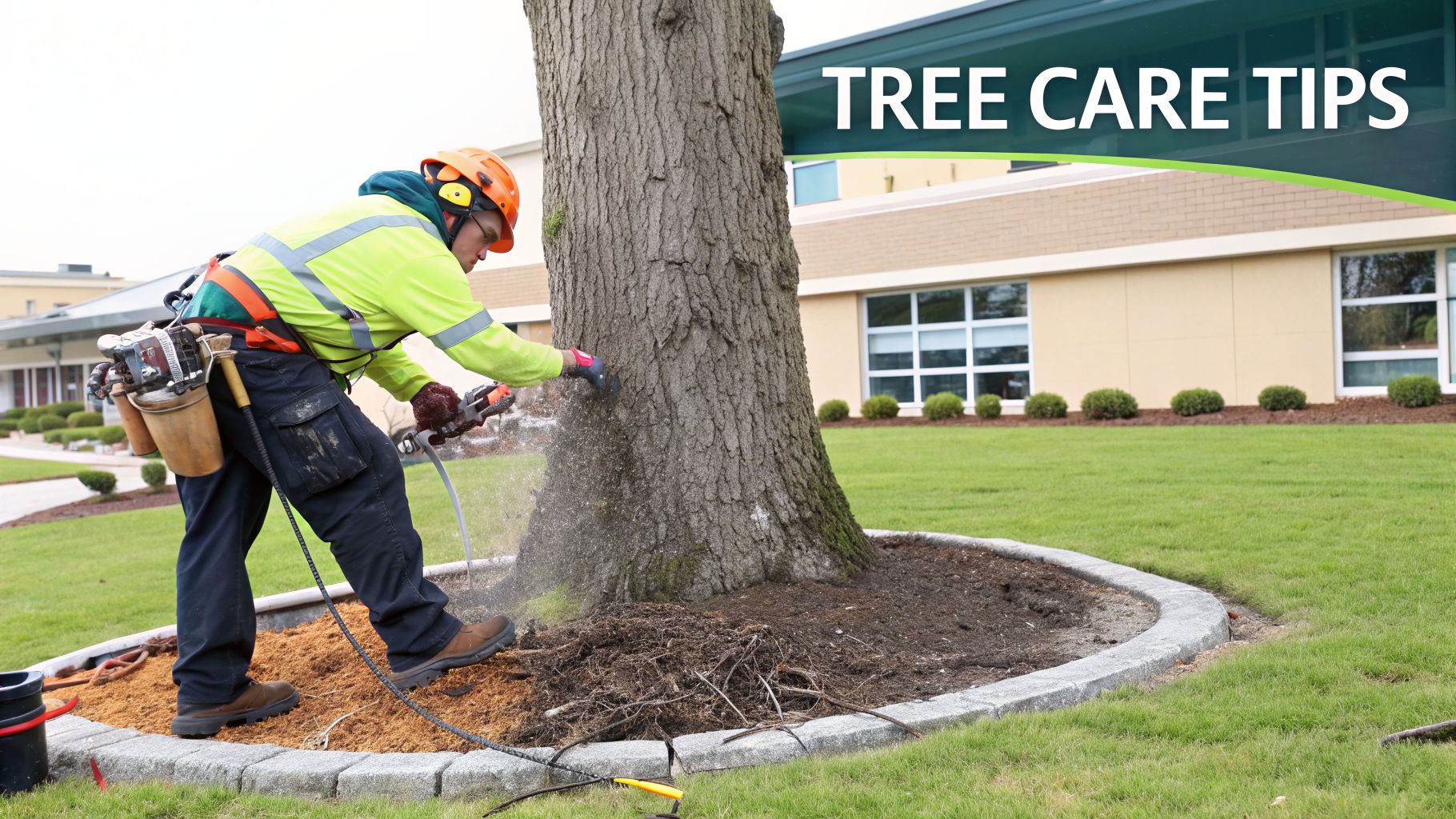
Keeping your true oak or native she-oak healthy isn't just about watering it now and then. Real, proactive care is what makes sure your tree stays a magnificent garden feature, not a ticking time bomb. With the right approach, these trees can live for generations, but they absolutely need care tailored to our local environment.
Whether you're dealing with the sandy soils of the Central Coast or the heavier clay around Newcastle, understanding what your tree needs is the first step. This is where our 25+ years of local, hands-on experience makes all the difference. We deliver the reliable, consistent care your trees depend on—we’re ‘On Time, Every Time’, so you can set your watch by our scheduled maintenance.
Essential Watering and Soil Health
Both true oaks and she-oaks need a reliable source of water, especially when they're young and during our region's increasingly brutal summer dry spells. Giving them a deep, thorough watering once or twice a week is far better than a quick daily sprinkle. This encourages the roots to grow deep in search of moisture, making the tree much more resilient to drought.
Good soil is the other half of the puzzle. Our coastal soils can be quite sandy and lacking in nutrients. A simple fix is to spread a layer of organic mulch around the tree's base. This is a triple win: it helps the soil hold onto moisture, keeps weeds at bay, and slowly adds nutrients back into the ground as it decomposes. Just be careful not to create a "mulch volcano" by piling it up against the trunk. This common mistake traps moisture right against the bark, often leading to rot. Always keep mulch at least 10cm away from the trunk itself.
Professional Pruning: The Only Safe Option
When it comes to cutting branches, there's a world of difference between professional pruning and what some call 'lopping'. Lopping is the reckless, indiscriminate cutting of branches back to stubs. It's a damaging practice we absolutely refuse to do, as it creates weak, poorly attached regrowth that is almost guaranteed to fail in the next big storm.
Proper pruning, on the other hand, is both an art and a science. A qualified arborist makes precise, targeted cuts to achieve specific goals like improving structure, reducing risk, or increasing light penetration. Let’s say you have a big English Oak in your East Gosford garden that’s throwing too much shade. A professional arborist can perform a canopy lift or selective thinning, opening up the space without mangling the tree's structure. For more detail on timing this correctly, check out our guide on the best time to prune trees in Australia.
Never attempt to prune large trees yourself. This work is incredibly dangerous. It requires specialised safety gear, a deep understanding of tree biology, and years of experience. One wrong cut can permanently maim the tree or, far worse, lead to a serious accident.
As professional arborists, we strictly adhere to the Australian Standards for tree work (AS 4373) and all WHS legislation on every single job. This ensures all pruning is done safely and correctly, promoting the long-term health and stability of your tree. For a homeowner in Lake Macquarie or a strata manager in Newcastle, this commitment gives you total peace of mind that the job is done right, the first time.
Recognising Problems and When to Call an Arborist
Even the toughest trees can run into trouble. For a property owner, the real skill is learning to spot the early warning signs of a problem before it spirals into a dangerous and expensive emergency. Knowing when to simply monitor your tree versus when to pick up the phone and call a qualified arborist can save you a world of stress and, most importantly, protect your home.
Your oak or she-oak will often give you subtle clues that it’s under stress—you just need to know what to look for. A casual stroll through the garden every so often can make all the difference.
Common Signs of Tree Stress
Keep an eye out for any changes in your tree’s appearance. One of the most obvious signs is canopy dieback, where you start seeing dead, leafless branches at the very top of the tree. Other red flags include unusual leaf discolouration, leaves dropping prematurely in summer, or new leaves coming through much smaller than usual.
Another major warning sign is the appearance of fungal brackets, or ‘conks’, growing on the trunk or major limbs. These are the fruiting bodies of decay fungi, which means there's likely significant internal rot you can’t see. If you notice any of these symptoms, it’s wise to investigate further. You can find more detail in our guide to understanding sick tree symptoms.
When a Problem Becomes a Risk
While overall tree health is important, structural defects are what pose a direct threat to people and property. These are absolutely not DIY situations and demand an immediate assessment by a professional arborist. Look out for these high-risk indicators:
- Deep Cracks: Significant cracks in the trunk or large branches are a clear signal of structural failure waiting to happen.
- Weak Unions: Look for V-shaped joins where two large limbs meet, especially if there's included bark (bark pinched inside the union). These are notoriously weak and prone to splitting apart in high winds.
- Over-extended Limbs: A long, heavy limb that grows almost horizontally with a lot of weight at the end is under immense strain. It’s a classic failure point during a storm.
- Sudden Leaning: If a tree that was once upright suddenly starts to lean, or if you see the ground heaving around its base, the root system could be failing. This is an emergency situation.
Ignoring these signs is a gamble you don’t want to take. Imagine a huge limb from an old oak tree failing and crashing through your roof in the driveway. It happens more often than you think, especially during the wild storms we get on the Central Coast.
Why You Must Call a Professional Arborist
Attempting to deal with a high-risk tree yourself is incredibly dangerous. This is work that requires a deep understanding of tree dynamics, specialised rigging equipment, and strict safety protocols to control exactly how and where massive sections of timber fall.
This is where calling a qualified, insured arborist becomes non-negotiable. When we assess a high-risk tree, whether it’s in a tight backyard in Woy Woy or overhanging a busy commercial area in Warners Bay, our absolute priority is safety. We meticulously plan every single cut in line with Australian Standards and WHS legislation.
Crucially, our comprehensive $20M public liability insurance gives you complete peace of mind. In the highly unlikely event of an accident, you, your property, and the public are fully protected. This is a level of security you simply don’t get when you hire an uninsured operator or try to tackle the job yourself. If you see any structural red flags, don't delay—get a professional assessment.
Navigating Council Permits for Tree Work
Thinking about some serious pruning or even removing a large oak or she-oak from your property? Hold on a second. Before you even think about picking up a saw, your very first step should be to check in with your local council. It’s a common point of confusion for homeowners, but getting this right is crucial to avoid hefty fines and make sure all work is above board.
The rules change quite a bit between the Central Coast, Lake Macquarie, and Newcastle council areas. Whether you need a permit often comes down to the tree's species, its size, and exactly where it’s standing on your block. Many significant trees, both native and introduced, are protected under what’s known as a Tree Preservation Order (TPO) or a similar local vegetation plan.
Understanding Your Local Council Rules
Let’s get practical. Imagine you have a big English Oak in your Merewether backyard that’s starting to loom a little too close to your house. In Newcastle, a tree of that size and significance is almost certainly protected, meaning you'll need council approval for removal. It could be a completely different story for a she-oak causing problems on a property in Morisset, where Lake Macquarie council's specific rules will be the deciding factor. This is exactly why a blanket approach just doesn't work.
With over 25 years of experience working across these very council areas, we’ve seen it all and can help you make sense of the local regulations. In fact, as part of our free property assessment, we can help figure out if your planned tree work requires a permit. This simple check saves you a world of time and potential legal headaches. You can get a deeper dive into the specifics in our guide to getting council approval for tree removal.
The Arborist Report and Compliance
If it turns out a permit is needed, you'll almost always need a professional arborist report to go with your application. This is a detailed document put together by a qualified (AQF Level 5) arborist that councils require. It assesses the tree's health, its structural integrity, and any risk it poses, before providing a professional recommendation for how to manage it. Our team prepares these reports to the exact standards that councils demand.
For strata managers and body corporates, ensuring 100% compliance isn't just a good idea—it's non-negotiable. The financial penalties for illegal tree work can be incredibly steep, and it's a risk no body corporate should be taking. We can manage this entire process for you, giving you complete peace of mind that all work is fully approved and documented.
Protecting Our Rare Native Species
Getting the right approvals is especially critical when you're dealing with native species, some of which are surprisingly rare. Take the Swamp She-oak, for example. It was thought to be extinct in NSW after 1979, only to be rediscovered in 1999. It's a powerful reminder of why legislation designed to protect our fragile native flora is so important. You can read the fascinating story about the rediscovery of this threatened species on the NSW Government site.
Of course, when you’re facing significant tree problems that need professional help, you also need to budget for the work. Understanding how much does landscaping cost in general, including arborist fees, is a key part of the planning process.
Your Questions About Oak Trees Answered
With over two decades of hands-on experience as arborists, we've heard just about every question there is about oak and she-oak trees. Here are our answers to the queries we hear most often from property owners across the Central Coast, Newcastle, and Lake Macquarie.
How Much Does It Cost to Prune an Oak Tree?
The final cost of pruning an oak tree really boils down to its size, its health, and how tricky it is for our team to access. Think about it this way: carefully pruning a huge English Oak crammed into a tight Tuggerah backyard is a much bigger job than just trimming dead branches off a smaller tree in an open field. The type of pruning needed also plays a big part in the price.
The only way to get a firm number is with an on-site look. We offer free, no-obligation quotes where a qualified arborist comes to you, inspects your tree, listens to what you want to achieve, and gives you a fixed price for the entire job. That includes the work itself, a full site cleanup, and hauling away all the green waste.
Can I Remove a She-Oak Tree Myself?
We can't stress this enough: please do not attempt to remove a medium-to-large tree yourself, she-oaks included. They might not look as formidable as a true oak, but tree removal is incredibly unpredictable and dangerous work. The risk of seriously injuring yourself, dropping a branch on your house, or damaging a neighbour’s property is just too high without proper training and equipment.
Professional arborists follow strict safety protocols set by Australian Standards and WHS legislation. We use specialised rigging gear to dismantle trees safely, piece by piece. Just as crucial, our team is covered by $20M public liability insurance for your complete peace of mind. Tree removal is one job that should always be left to the pros.
Are Oak Tree Roots a Problem for Foundations?
Both true oaks and she-oaks have powerful, sprawling root systems. But they don't actively seek out and destroy solid foundations or pipes. The trouble usually starts when a growing root finds a pre-existing crack or weak spot in a structure and takes advantage of it. Another common issue, especially in suburbs like Erina with reactive clay soils, is when root activity changes moisture levels in the ground, causing it to shrink or swell and damage nearby foundations.
If you have a big oak or she-oak close to your home, getting an arborist to check it out is a smart move. We can spot potential problems early and suggest solutions like installing a root barrier or performing careful root pruning to protect your property while keeping your tree healthy.
At Treecorp Solutions, our qualified arborists are here to help with any questions or concerns you have about your trees. For expert advice and a free, no-obligation property assessment, get in touch with our friendly team today.
Request a Free Quote Online or call us on (02) 4307 6555 for 24/7 emergency service.