If you've got a property on the Central Coast, around Lake Macquarie, or in Newcastle, you know our trees are the heart and soul of the landscape. But the biggest question we get from homeowners, strata managers and business owners is always, “When is the best time to prune my trees?” It’s a great question, because getting the timing right is crucial.
Get it wrong, and you can stress a tree, open it up to disease, or even encourage weak, dangerous growth right before storm season hits. After more than 25 years helping locals, we’ve seen it all. The good news is that this common mistake is easy to avoid with a bit of local know-how. This guide will walk you through it.
Why Pruning at the Right Time Matters
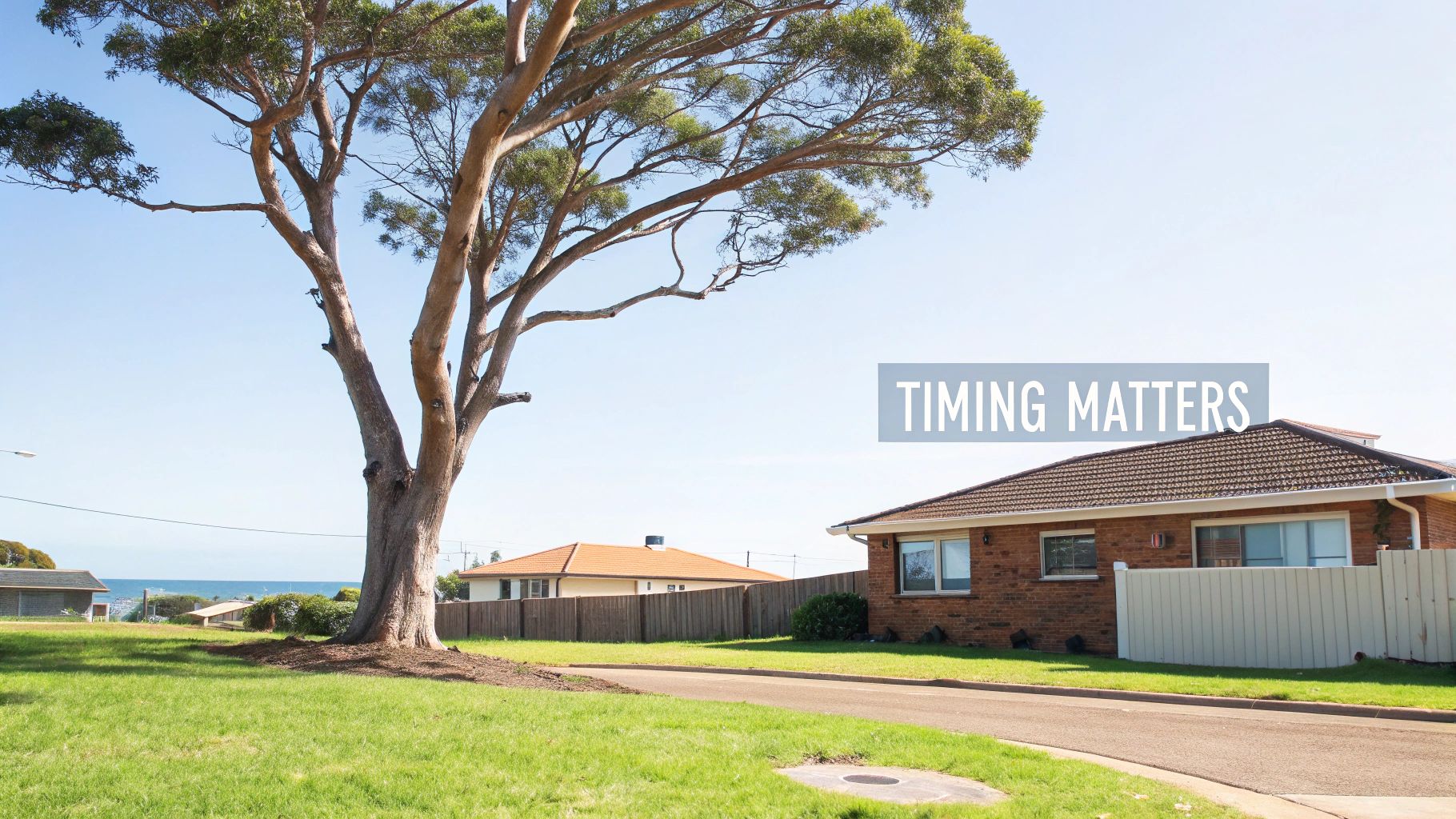
Keeping your trees healthy and your property safe isn’t about guesswork—it's about doing the right thing at the right time. As qualified arborists with over 25 years of hands-on experience across the Central Coast and Newcastle, we've seen firsthand how much timing matters for our local trees.
Imagine you've got a large gum tree in Terrigal dropping branches near your driveway. Pruning it in the peak of summer heat can leave it wide open to pests and dehydration. For your fruit trees, the wrong timing could mean a season with almost no fruit. It really is that simple. While there are many benefits of regular tree pruning, you only get them if the job is done correctly and at the optimal moment.
This guide is built on our local knowledge, walking you through what your trees need, season by season. Whether you're in a family home in Gosford, managing a commercial site in Warners Bay, or looking after a strata complex in The Entrance, understanding the why behind the when is key to protecting your property and your beautiful green assets.
The Golden Rule of Pruning: The Dormant Season
For most trees we look after on the Central Coast, the 'golden rule' for pruning is simple: work with the seasons, not against them. The absolute best time for any major structural pruning is almost always the dormant season. For us here in NSW, that means late winter into early spring—generally from July to September.
Why then? Think of it like this: pruning a tree during its peak growing season is like trying to perform surgery on someone while they're running a marathon. It’s disruptive and adds a huge amount of stress. In winter, however, a tree's metabolism slows right down to a crawl, almost like it's hibernating.
This dormancy means any pruning we do causes minimal shock to the tree's system. Sap isn’t flowing with much force, so the cuts are far less likely to ‘bleed’—a messy process that can attract pests and diseases. For our qualified arborists, this timing is also a massive practical advantage for safety and precision.
A Clear View for Precision Work
Once a deciduous tree drops its leaves, we get a clear, unobstructed view of its entire branch structure. It’s like looking at a road map instead of trying to navigate through dense bush. This is a critical part of how we work safely and effectively in accordance with Australian Standards.
This clarity allows our team to spot and precisely remove any crossing, weak, or dead branches that are often hidden during the leafy summer months. It's a strategic approach we apply from Woy Woy all the way up to Wyong, and it sets the tree up for a vigorous burst of healthy growth once spring finally arrives. It’s also the professional standard for reducing risks before the storm season kicks in.
Did you know? In New South Wales, pruning during the dormant season can reduce the risk of certain disease transmissions. That’s because sap flow is low and pathogens like fungal spores are far less active in the cooler months. You can discover more insights about Australian tree health statistics to see why timing is so crucial.
Seasonal Pruning Guide for Central Coast Trees
Understanding the general rhythm of the seasons is key to planning your tree care. While every tree has its own specific needs, here’s a quick overview of what we focus on throughout the year for properties in areas like Gosford, Belmont, and Adamstown.
Winter (July-September) is perfect for major structural pruning, removing deadwood, and shaping deciduous trees. The tree is dormant, which minimises stress and allows us a clear view of the branch structure. For example, this is when we would shape a large liquidambar in an Erina backyard to improve its form and remove weak limbs before spring growth.
Spring (October-December) is the time for light trimming of new growth and pruning flowering trees right after they bloom. This avoids removing the buds for next year's flowers and tidies up rapid spring growth. A good example would be lightly pruning a magnolia in a Terrigal garden just after its flowers have faded to maintain its shape.
Summer (January-March) is when we focus on removing hazardous, storm-damaged, or dead branches. We generally avoid heavy pruning as the tree is actively growing and under heat stress, making it vulnerable. Only essential safety work should be done, like the emergency removal of a branch on a gum tree in The Entrance that was cracked during a summer storm.
Autumn (April-June) is ideal for very light pruning and final inspections before the dormant season. Growth is slowing, and it's a good time to identify any dead wood that has become obvious. This might involve removing a few dead lower branches from a paperbark tree on a property near Lake Macquarie.
How Tree Type Affects Your Pruning Schedule
While the "golden rule" of dormant season pruning is a fantastic starting point, it's not a one-size-fits-all solution for every backyard on the Central Coast. Not all trees run on the same clock, and the best time to prune often comes down to the specific species growing on your property. Getting this right is the difference between a thriving tree and one that’s stressed or unproductive.
Most deciduous trees—the ones that lose their leaves in winter—are perfect candidates for dormant pruning. With their branches bare, our arborists can easily get a clear view of the tree’s structure and make precise, well-informed cuts. Simple enough. But this rule changes completely for certain ornamental and native trees.
Timing for Flowering and Native Trees
Imagine you have a beautiful magnolia in your Saratoga garden. If you prune it back hard in winter, you'll likely cut off all the buds that are set to become next season's stunning flowers. For flowering trees like these, the smart move is to prune them lightly right after they finish blooming. This lets you enjoy their floral display while still keeping them healthy and well-shaped.
Our iconic Australian natives, like many eucalypts and banksias, also have their own preferences. They often respond best to a light trim after their main flowering period, which is typically in late spring or summer. This approach works with their natural cycle to maintain their form without causing unnecessary stress. We know how the tough coastal winds in Forresters Beach affect a Norfolk Pine differently than a spotted gum in a sheltered Belmont yard. You can find more details in our guide to the most common trees on the Central Coast.
The diagram below breaks down exactly why the dormant season is so beneficial for many trees, leading to minimal shock, a clear view for us, and a solid foundation for healthy new growth.
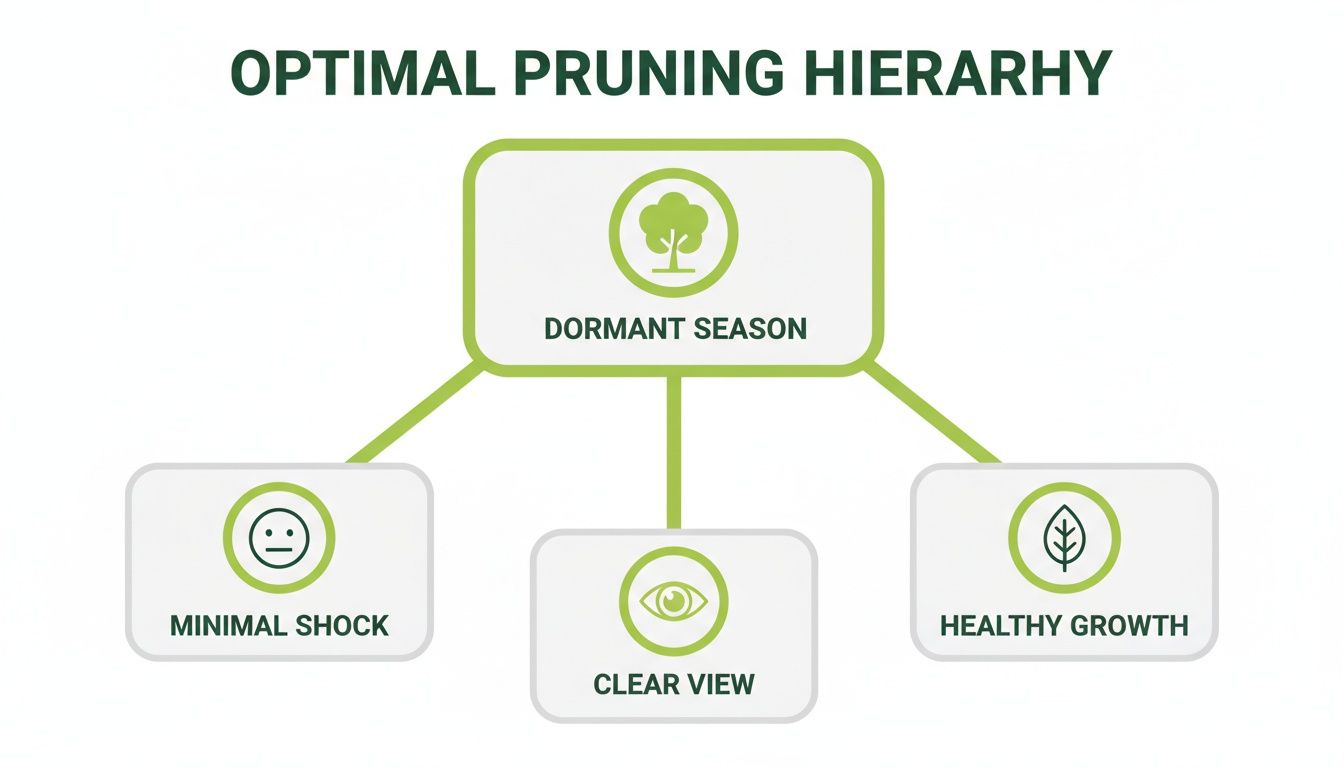
As you can see, pruning during dormancy is a strategic choice that supports the tree’s long-term health by working with its natural energy cycle, not against it.
Special Care for Fruit Trees
Fruit trees are another category altogether. They need careful, strategic winter pruning to clear out old, unproductive wood and encourage the growth of new spurs that will actually bear fruit. It’s a specialised skill that directly impacts the quality and quantity of your harvest.
An apple tree in a Lisarow garden, for instance, needs its water sprouts removed and its canopy thinned to let sunlight reach the developing fruit. Each species has its own set of rules; for example, learning about mastering fig trees reveals their unique care and pruning requirements. This tailored approach is absolutely key to a successful crop.
An experienced arborist doesn’t just see a tree; they see its species, its environment, and its unique needs. This local knowledge is vital for ensuring any pruning work we do on your property, whether in Newcastle or Lake Macquarie, is perfectly timed to benefit the tree's health and your goals.
When You Cannot Wait for the Ideal Season
Sometimes, waiting for that perfect winter pruning window just isn't an option. When a tree becomes a hazard, safety has to come first, and the best time to prune is right now. This is what we arborists call ‘reactive’ or ‘emergency’ pruning—it’s about taking urgent action to protect people and property from immediate harm.
This scenario is all too common for property owners after severe weather hits. Those notorious high winds that sweep across the Central Coast and Lake Macquarie can snap or weaken even the healthiest-looking branches, leaving them hanging precariously overhead. This is when you need a professional team you can rely on to respond quickly.
Identifying Immediate Tree Hazards
Knowing how to spot a tree that needs immediate attention is crucial for every property owner. We’re not talking about cosmetic tidy-ups here; these are genuine risks that need a professional eye on them straight away.
A key warning sign is any branch that’s visibly cracked, split, or just hanging loose. It's a ticking time bomb that could fall at any moment. If a tree suddenly develops a lean, particularly after a storm, it’s a massive red flag for root failure. Large, dead branches—you can often spot them by their lack of leaves—are structurally weak and can snap off without warning.
And of course, a branch touching or growing too close to power lines is an extreme danger. Never, ever attempt to trim these yourself. This is a job strictly for qualified arborists with specialised training, who work in compliance with WHS legislation.
Your safety and the protection of your property are our absolute top priorities. If you spot any of these signs, the ideal pruning season becomes irrelevant. The risk of waiting is far greater than any potential stress to the tree.
Real-World Scenarios We Handle
In our 25 years on the job, we've seen countless situations where a quick, reactive prune has prevented a genuine disaster. Imagine a massive gum tree branch cracking in a summer storm, now dangling directly over your home in Charlestown. Or a heavy paperbark limb threatening to fall across your driveway in Toronto, blocking you in and putting your family at risk.
These aren't just hypotheticals; they are urgent realities we deal with all the time. It’s why our 24/7 emergency service is such a core part of what we do. When you call us for an emergency, you’re not just getting a team with a chainsaw. You’re getting qualified arborists backed by $20M in public liability insurance. This gives you complete peace of mind that the work is being done safely and responsibly, especially when the stakes are so high.
If you’re facing a dangerous situation after a storm, our team can guide you on the safest and most effective steps for storm damaged tree removal. Don't hesitate to call for a rapid property assessment.
Navigating Council Permits and Strata Rules
Knowing the perfect time to prune your trees is really only half the battle. Before our team even thinks about starting our equipment, we have to tackle the paperwork: local council permits and strata by-laws. It's an absolutely crucial step that protects you, your neighbours, and the beautiful trees that define our local area.
Councils across the Central Coast, Newcastle, and Lake Macquarie have specific regulations to protect our urban canopy. These rules, often called Tree Preservation Orders (TPOs), mean you might need a permit before you can prune a tree. This is especially true if it’s a protected native species, is over a certain height, or is considered a significant part of the local landscape, such as in areas with Newcastle's heritage tree protection overlays.
Understanding Council Requirements
The rules can change quite a bit from one suburb to the next. What's required for pruning a big gum tree in a Gosford backyard might be completely different from the protections on a property in Warners Bay. It’s definitely not something you want to get wrong, as the penalties for unapproved tree work can be severe.
As qualified arborists with over 25 years of hands-on local experience, we make it our job to stay on top of these shifting regulations. We can help you figure out if a permit is needed for your specific job—whether you're in Toukley or Morisset—and can even assist with the application to make sure everything is fully compliant. It’s part of the professional service we provide. You can find more details in our guide on navigating council approval for tree removal and pruning.
Strata and Body Corporate Rules
If you live in a townhouse, unit, or apartment complex, there’s another layer of approval you’ll need to work through. Tree work in common areas like shared gardens or courtyards almost always requires formal sign-off from the body corporate or strata manager.
This process exists to protect all the residents and make sure the work is done safely by insured professionals. In fact, one of the key requirements is that any arborist working on the property must be fully insured. We frequently work with strata bodies to ensure all approvals and resident notifications are handled smoothly.
Safety and compliance are non-negotiable in shared spaces. Strata managers must ensure that contractors hold adequate public liability insurance. Our $20M public liability insurance provides this essential protection, safeguarding all residents and the property against any potential incidents.
We have a long history of working with strata managers from The Entrance to Toronto. We get it—clear communication, careful scheduling to minimise disruption, and providing all the necessary paperwork are key. Our reliable, ‘On Time, Every Time’ approach ensures strata maintenance schedules are met without any fuss, keeping those shared green spaces safe and beautiful for everyone.
DIY Pruning vs. Hiring a Professional Arborist
It’s always tempting to grab the tools and tackle a bit of tree maintenance yourself, especially when a job looks straightforward. A little light shaping on the hedges or snipping a few low-hanging branches from a small shrub can often be done safely without much fuss. The most important part of any DIY project, though, is knowing when to stop. With tree work, that line is drawn by safety.
Our golden rule for property owners is simple: if the job requires you to climb a ladder, start up a chainsaw, or cut a branch thicker than your wrist, it's time to call in a professional. Anything beyond that introduces serious risks of property damage or, worse, severe personal injury. This is precisely where the skills of a qualified arborist become non-negotiable.
The Arborist's Advantage: Expertise and Safety
A professional arborist does a whole lot more than just cut branches. We’re trained specialists who understand the science of tree biology. Every cut we make is precise and strategic, designed to promote proper healing, prevent disease, and encourage strong, healthy growth for years to come. It’s the polar opposite of harmful ‘lopping,’ which just leaves ugly stubs that become open invitations for pests and decay.
We’re also equipped to handle the complex, high-risk jobs safely. Think about that huge branch hanging over your house in Erina, or a tree creeping dangerously close to power lines on your commercial property in Warners Bay. Tackling these scenarios requires specialised gear, strict safety protocols that meet WHS standards, and years of hands-on experience. You can learn more about the specific skills we bring to every site in our guide explaining what do arborists do.
When you hire a professional, you're not just paying for a service; you're investing in peace of mind. Our team is fully insured with $20M in public liability insurance, and we strictly adhere to Australian Standards for all our pruning work.
Investing in Long-Term Tree Health
Ultimately, bringing in an arborist is an investment in the long-term health and safety of your trees and your property. With 25+ years of local experience serving the Central Coast, Newcastle, and Lake Macquarie, we know exactly what local trees need to thrive in our unique environment. We can spot potential problems long before they turn into major hazards and map out a pruning plan that enhances your tree's natural structure and beauty.
Choosing a professional ensures the job isn't just done, but done right—and safely. You get the assurance that comes from having experts look after your trees and protect your property, leaving you with a beautiful, healthy, and safe landscape to enjoy for years.
What's Your Next Move for Healthy Central Coast Trees?
Now that you know how much timing matters for your trees, you’re probably looking at your own backyard and wondering where to even begin. The best first step is always the simplest: go for a walk around your property. Keep an eye out for those tell-tale signs we've talked about—dead or hanging branches, limbs creeping a little too close to the roof, or any trees that just look a bit off.
Next, have a think about what you’re trying to achieve. Are you hoping to let more sunlight into the garden? Make sure your trees are secure before storm season rolls in? Or maybe you just want to improve a tree’s overall shape. Knowing your goals makes all the difference. For instance, getting more sun might call for canopy thinning, which is a completely different technique to removing hazardous lower branches.
Getting a Professional Opinion
If you're feeling unsure about what your trees need or when to tackle it, getting a professional in is always the safest and most effective move. It takes the guesswork out of the equation and guarantees the job is done right, protecting your beautiful green assets for the long haul. We offer a free property assessment where one of our experienced arborists can visit you on-site, anywhere from Gosford to Newcastle.
During this visit, we’ll talk with you about your goals, identify any potential safety hazards, and give you a clear, straightforward plan that’s perfectly timed for your trees. We’ll also check their current health and pinpoint the exact tree species you have. This friendly chat is the first step towards a safer, healthier yard.
Taking Proactive Steps Today
To keep your Central Coast trees looking their best for years, you need a holistic approach that includes comprehensive tree and plant care. Proactive pruning is a massive part of this, stopping small issues from turning into big, expensive headaches down the track. A well-maintained tree doesn’t just look better; it’s also far more resilient against the coastal winds and storms we get right across the region.
With over 25 years of local experience, we’ve built our reputation on being ‘On Time, Every Time.’ It’s the reliable, professional service our clients from residential, strata and commercial sectors have come to trust. Don't wait for a branch to fall—let's work together to create a plan that keeps your trees thriving.
Ready for a clear path forward? Request a free quote online or give our friendly team a call to book your no-obligation property assessment. And if you're dealing with an urgent hazard, our 24/7 emergency service is always here to help.
Your Tree Pruning Questions, Answered
Property owners across the Central Coast, Newcastle, and Lake Macquarie often have similar questions when it comes to tree care. Here are our answers to some of the most common ones we hear from our clients.
How Often Do My Trees Need a Professional Prune?
For most established, mature trees, a professional inspection and a good maintenance prune every 2 to 3 years is a solid rule of thumb. This routine check-up lets our arborists clear out deadwood, fix any emerging structural problems, and keep the canopy healthy and safe. Younger trees are a different story; they often need structural pruning every 1 to 2 years to help them develop a strong, resilient frame. The perfect schedule always comes down to the tree's species, where it's located, and its current health.
What's the Difference Between Pruning and Lopping?
This is a really important one. Think of professional pruning as a skilled surgical procedure. We make precise, careful cuts to remove specific branches, all with the goal of improving the tree’s health, structure, and safety, based on our understanding of tree biology. Lopping, on the other hand, is the indiscriminate cutting of branches, leaving ugly stubs that invite disease and decay. This kind of damage forces the tree to produce weak, hazardous regrowth. As qualified arborists who stick to Australian Standards, we only ever prune; we will never lop a tree.
Can Pruning Really Help My Tree Survive a Storm?
Without a doubt. Strategic pruning is one of the best things you can do to prepare your trees for the wild weather we get on the Central Coast. By selectively thinning the canopy, we reduce the 'sail effect'—this allows fierce winds to pass through the branches instead of hitting the tree like a solid wall. We also remove weak, dead, or poorly attached branches that are most likely to fail. A professionally pruned tree is dramatically more resilient and poses a far lower risk to your home and family when a storm rolls in.
What Does Your Quote and Service Actually Include?
We believe in being completely upfront. Our free quotes are always detailed and transparent, breaking everything down so there are no surprises. You’ll see the exact work planned, all labour and equipment costs, and the full removal and recycling of all green waste. We always leave your property spotless. Every job is handled by our qualified team, follows strict Australian Standards, and is covered by our $20M public liability insurance for your total peace of mind. We'll even help you with any council permit applications.
Ready to make sure your trees are healthy, safe, and looking their best? The team at Treecorp Solutions brings decades of local know-how to every job.
Request a free, no-obligation quote online or give us a call to arrange a property assessment. If you're facing an urgent hazard, our 24/7 emergency service is always on standby.