
If any branch, tool or equipment could come within 1.5 metres of a bare overhead power line, stop and contact the electricity distributor before any cutting begins. Treat the line as live, and don't rely on a visual gap to decide whether the work is safe.
You might have a blue gum in Terrigal that has grown towards the street wires, with small branches landing on the driveway after windy weather. In Woy Woy, Erina or The Entrance, the same problem can involve coastal winds, salt exposure and fast regrowth. The decision isn't only whether to prune or remove the tree. First, you need to establish who controls the electrical risk, what clearance applies and whether the crew is authorised to work near that line.
Tree work near power lines is never a routine chainsaw job. The right sequence protects your household, neighbours, the crew, passing traffic and the tree itself.
Why Tree Work Near Power Lines Demands Extra Caution
A homeowner often notices the problem after a branch drops. The foliage may not be touching the wire, but the canopy has started to overhang it, and the next strong gust could change the situation quickly. A branch can move into a conductor while it's being cut, fall across a line, or pull other limbs into the clearance zone.
Electricity can also arc across a gap. That means a dry branch isn't automatically safe, and a person doesn't need to make obvious physical contact before a serious incident occurs. SafeWork NSW explains that trees and branches can conduct electricity even when dry, and that work inside prescribed approach distances must be completed by authorised people approved by the electricity supply authority. SafeWork NSW guidance for work near electric lines also warns that electricity may arc across a gap.
The first decision is not pruning
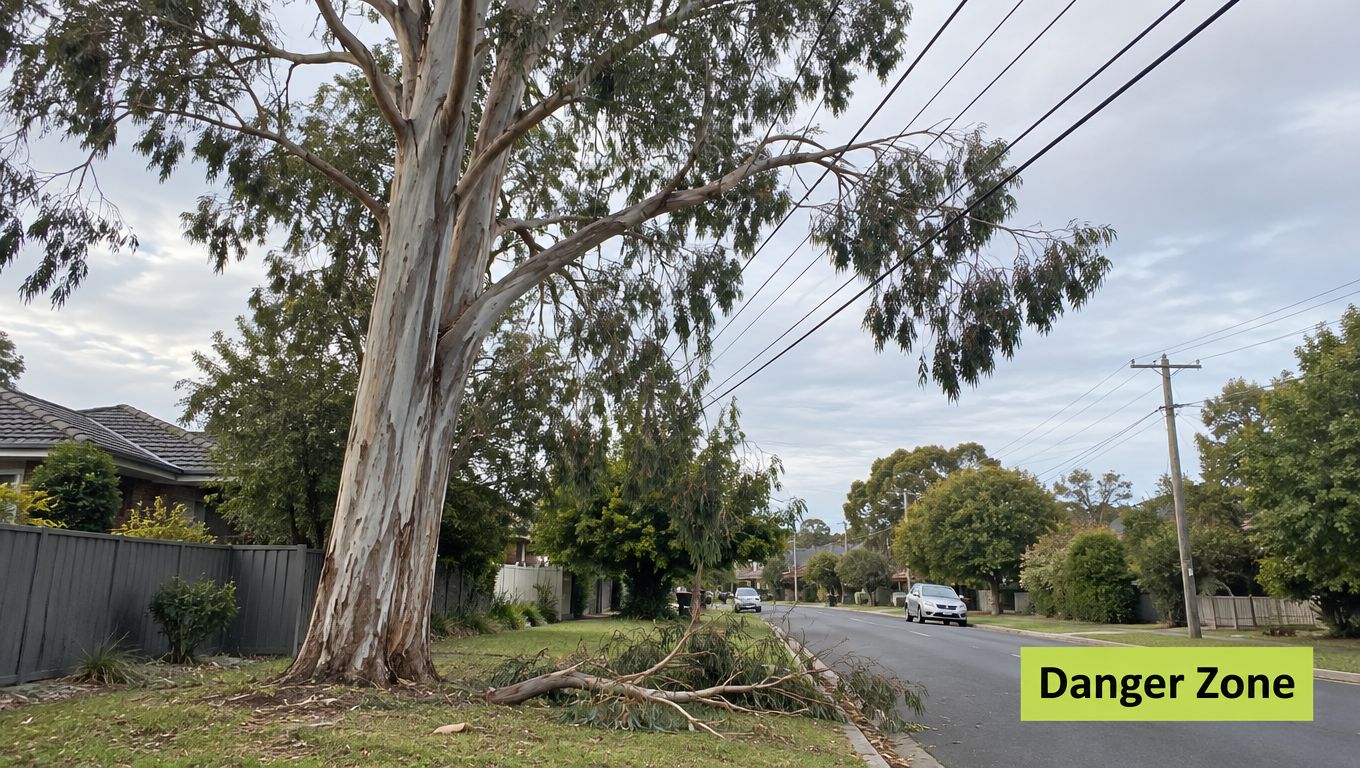
Before anyone parks a truck, raises a ladder or starts a chainsaw, identify the line arrangement from a safe position. Look at whether the conductors appear bare, covered, insulated or bundled, and note whether branches, ropes, ladders or a raised work platform could move towards them.
Practical rule: If the proposed work could bring vegetation, a person or equipment into the approach zone, stop and contact the distributor first.
A good arborist will assess the tree's structure, movement, fall direction and regrowth, but that assessment doesn't replace network approval or isolation where those controls are required. If you're reviewing broader workplace controls, you can also find 2026 incident prevention tips from GM GROUP Services, particularly for sites where several contractors or members of the public may be exposed.
The aim isn't to remove every tree near a line. Often, careful clearance pruning can reduce the hazard while preserving shade and habitat. The critical point is that the electrical risk must be resolved before the pruning method is chosen.
Understanding the Real Risks of Overhead Lines
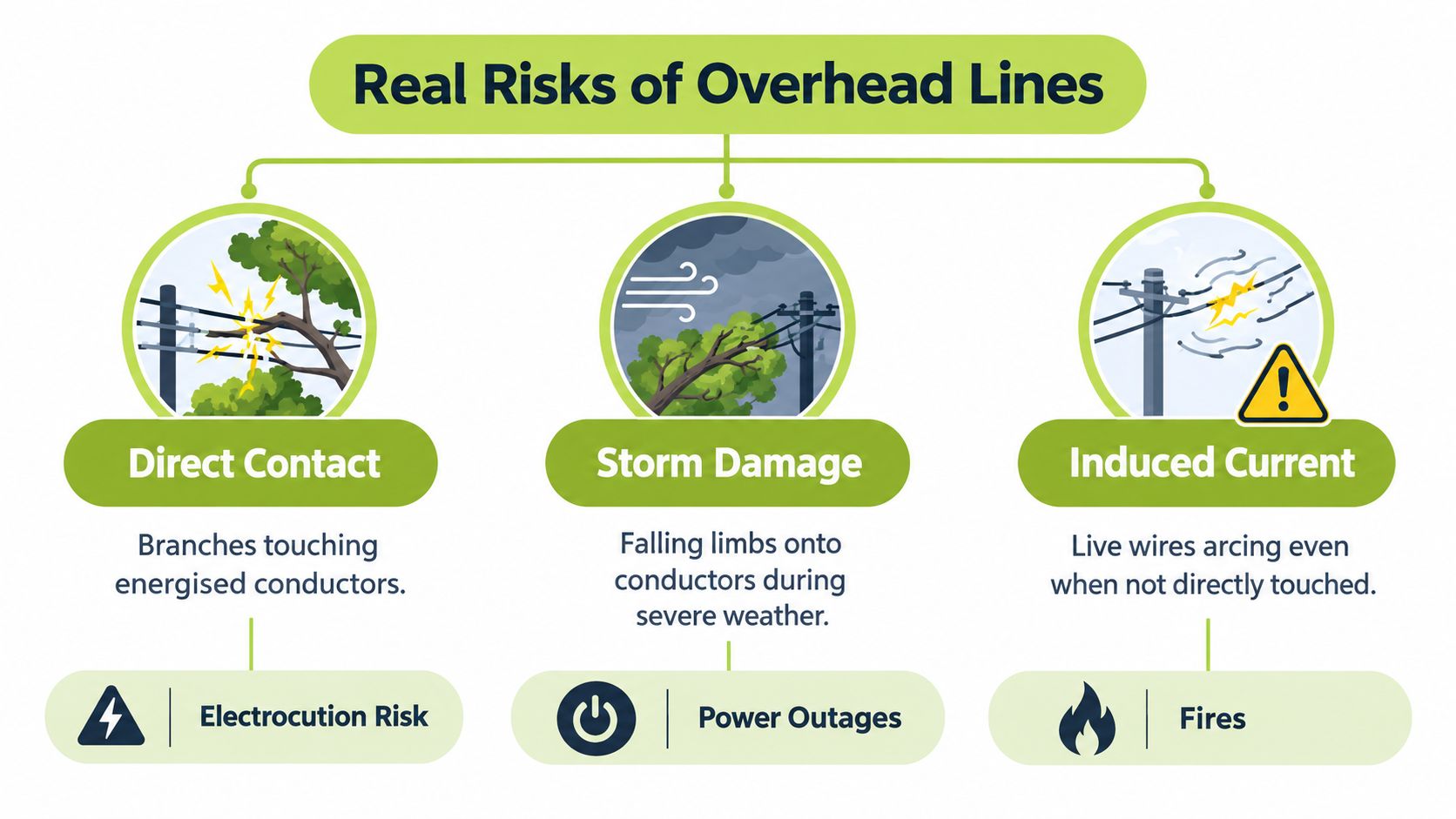
Vegetation near a conductor creates several different hazards, and each one can develop without the obvious sign of a branch touching a wire. A direct contact fault may occur when a limb reaches an energised line. Storm damage can place a heavy branch across conductors, while wind-driven foliage can move in and out of the clearance zone and create faults.
The bushfire consequences explain why network vegetation management matters. Energy Networks Australia reports that electricity was identified as the ignition source for 2.7% of bushfires, yet those fires accounted for 14% of the total area burned. That means electricity-related ignition is statistically uncommon, but the fires associated with it have been disproportionately consequential.
Why the visible gap can mislead
A line doesn't stay in one perfectly fixed position. Conductors sag between poles and swing in wind. Trees also move, branches flex under cutting pressure and a falling limb can travel in an unexpected direction. A line that looks safely distant from a stationary branch may not remain distant once the job begins.
The risk also depends on the line itself. Low-voltage service wires, bare mains, covered conductors and high-voltage lines don't all have the same approach requirements. Voltage and construction affect the potential hazard, while span length and bushfire classification can alter the clearance that must be maintained.
For homeowners, strata managers and facility operators, a tree-risk assessment should record the line position, likely movement, access points and fall paths rather than just stating that the foliage is “close”. A useful tree risk assessment service should also consider deadwood, cavities, storm damage and the likelihood of regrowth pushing the canopy back towards the conductors.
This is why clearance is a risk-control measure, not a cosmetic target. The practical solution may be selective pruning, staged dismantling, distributor coordination or removal. The correct choice depends on the tree and the electrical asset together.
Clearance Distances and What Determines Them
There isn't one universal safe gap for every overhead line in Australia. The required separation changes with voltage, conductor construction, span length, bushfire-risk classification, conductor movement, tree movement and future regrowth. Energy Safe Victoria's vegetation-management guidance illustrates why a generic measurement can give homeowners false confidence.
For example, a bare low-voltage line with a span up to 45 metres in a low-bushfire-risk area has a typical clearance requirement of 1,000 millimetres. In a hazardous-bushfire-risk setting, the example becomes 1,500 millimetres plus an allowance for movement. Those figures describe a specific example, not a universal rule for every Central Coast, Newcastle or Lake Macquarie property.
| Conductor type | Low bushfire risk | High bushfire risk | Notes |
|---|---|---|---|
| Bare low-voltage line | 1,000 mm in the cited example | 1,500 mm plus movement allowance in the cited example | Span, movement and local requirements still need checking. |
| Bare low-voltage mains in NSW council guidance | At least 1.5 m in the cited guidance | Can vary under the applicable network and bushfire requirements | The distributor undertakes work within the relevant network clearance. |
| Low-voltage aerial-bundled cable | 0.5 m in the cited council example | Must be confirmed for the asset and location | Bundled cable isn't treated the same as bare conductors. |
| Insulated service line | Schedule pruning before growth reaches 1 m | Confirm the applicable local requirement | Early pruning helps avoid cutting or wind movement into the line. |
| Bare service line | Schedule pruning before growth reaches 2 m | Confirm the applicable local requirement | The trigger is planning distance, not permission to work without assessment. |
The table's examples come from Energy Safe Victoria's electrical vegetation rules and the cited NSW guidance. They shouldn't be used as a do-it-yourself measuring guide.
Plan for movement, not today's photograph
A clearance envelope is more like an invisible buffer around the line than a ruler laid against the current foliage. It needs to allow for conductor sag, wind swing, branch flex, tree movement and regrowth after pruning. A gum tree beside a house in Terrigal may need a different treatment from a tree near a line in inland Lake Macquarie.
NSW's ISSC3 guideline adds 0.5 metres where bare overhead conductors are in bushfire-prone areas, and Ausgrid describes overall clearance requirements ranging approximately from 0.5 to 6 metres, depending on the asset and circumstances. The ISSC3 guideline and the distributor's requirements should be checked before a quote becomes a work plan.
If the line type isn't clear, don't guess. Photograph the arrangement from the ground without approaching the wires, identify the distributor and ask what clearance and authorisation apply. Early, planned pruning is usually easier to control than waiting until branches are already pressing into the conductors.
Who Is Actually Authorised to Work Near Live Lines
The threshold changes as soon as cutting, climbing, rigging or equipment movement could enter the prescribed approach distance. At that point, the job isn't ordinary garden pruning. It becomes controlled electrical-risk work, and the person arranging the job needs to verify who is authorised to perform it.
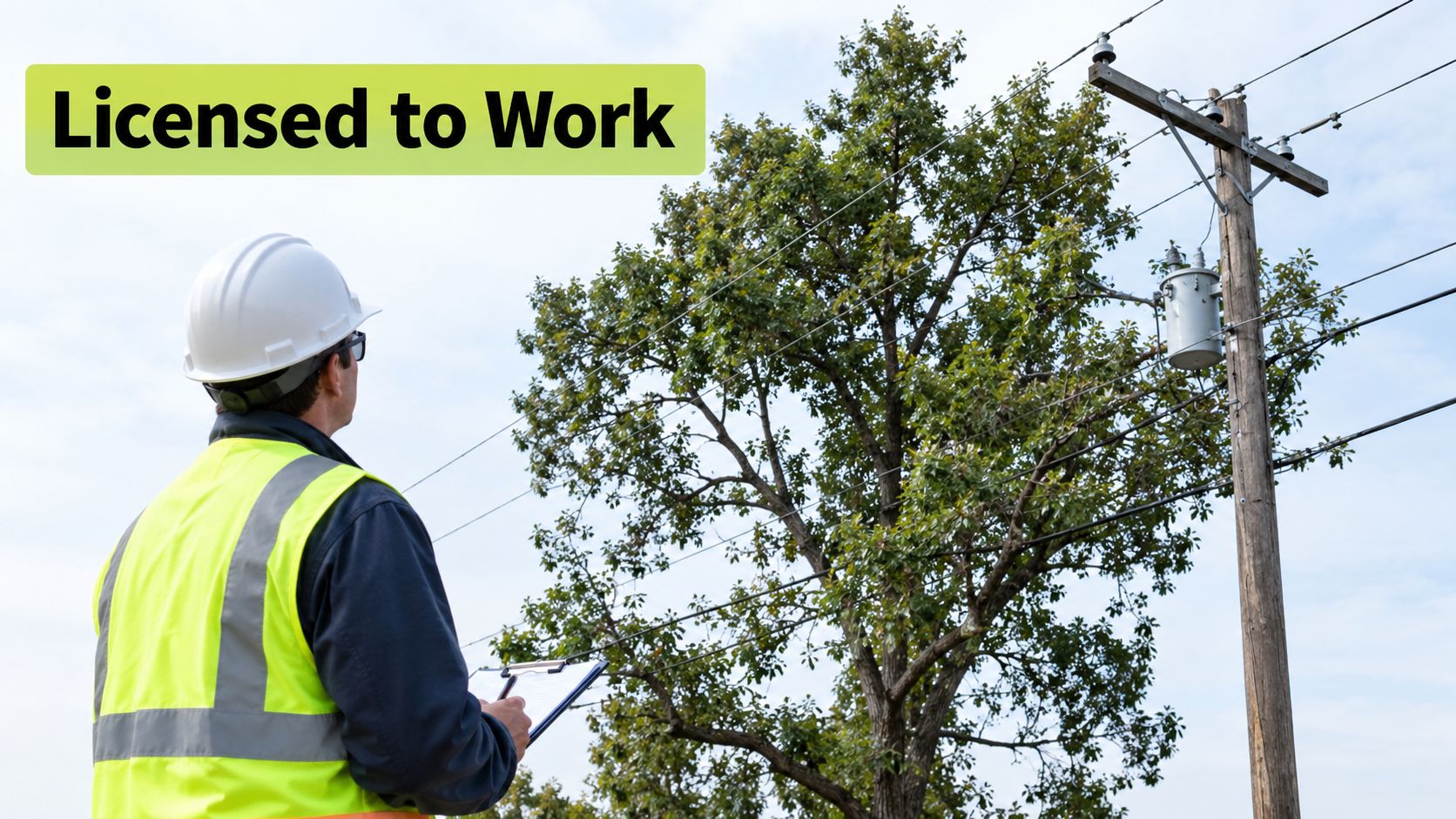
SafeWork NSW states that lines should be de-energised if cutting or felling could bring vegetation within the prescribed approach distances. Work inside the no-go zone must be done only by authorised people approved by the electricity supply authority. A general arborist qualification by itself doesn't answer that question.
Ask these questions before accepting a quote
Start with the distributor, not the saw. Ask whether the crew is authorised for the relevant electrical zone and whether the distributor must arrange isolation, a network crew or another control before work can proceed.
Your pre-quote checklist should include:
- Line identification: Can the contractor identify the conductor type and likely voltage without approaching it?
- Authorisation: Is the crew authorised for the relevant electrical approach zone?
- Risk documents: Will they provide a site-specific risk assessment and safe system of work?
- Training: Can they show evidence of suitable electrical-line vegetation training and supervision?
- Insurance: Do they carry workers compensation and appropriate public liability cover? For high-risk residential work, ask whether the policy provides $20 million public liability insurance.
- Coordination: Who will contact the distributor, and who confirms that isolation or other controls are in place?
- Equipment: How will the crew position ropes, ladders, chainsaws, work platforms and cut branches?
Distance alone isn't a reliable safety test. A branch can swing, a rope can become conductive when wet, a bucket can extend beyond the operator's initial position and a cut limb can fall towards the line. A qualified certified arborist service should explain those changing conditions before proposing a method.
The video below provides useful visual context for controlled work around electrical infrastructure.
A careful contractor won't pressure you to proceed because the job appears small. A single branch can still involve a fall zone, conductive equipment and a line that must be treated as live until the distributor formally confirms otherwise.
Navigating Permits, Strata and Legal Responsibilities
Electrical clearance and council approval are separate responsibilities. A council tree permit may control whether pruning or removal is allowed, but it doesn't authorise anyone to work inside an electrical exclusion zone. An easement, distributor requirement or network approval may apply as well.
Under the NSW Electricity Supply Act 1995, landowners have an ongoing responsibility to keep vegetation on their property a safe distance from powerlines throughout the year. A distributor may notify you when branches are too close, but you shouldn't wait for a notice before raising a concern. NSW Rural Fire Service vegetation-clearing guidance directs landowners to their network provider for safety and environmental approval options.
Council approval is only one layer
Council rules differ across the Central Coast, Lake Macquarie and Newcastle. Newcastle's heritage tree protections may affect a property with an established or significant tree, while a different council may apply its own permit, exempt-species or development-control process. Check the relevant council before pruning or removal, particularly for native trees, trees in heritage areas or trees affected by development work.
The applicable framework also includes ISSC3, the distributor's network rules and AS 4373, Pruning of Amenity Trees. Ausgrid identifies those standards and guidance as relevant to clearance and pruning around its network. Its stated approach is to cut back to the nearest suitable growth point or branch collar, rather than leaving blunt stubs or making indiscriminate cuts. Council approval for tree removal is worth checking early, before a storm-damage decision turns into an unauthorised removal.
Strata committees need a paper trail
A tree in a shared courtyard, driveway or visitor parking area usually affects more than one lot. The strata manager or owners corporation should record the inspection, approval, contractor insurance, risk assessment, distributor communications and final work area. That documentation helps clarify responsibility if a branch damages common property or a resident later questions why pruning or removal was necessary.
For commercial sites in Cardiff, Belmont, Tuggerah or Wyong, schedule work around pedestrians, deliveries and vehicle access. Coastal salt damage can weaken exposed branches around Terrigal and Wamberal, while drought stress inland can affect tree soundness. The permit process, network control and tree-health decision should be considered together.
Emergency Response When a Tree Contacts a Power Line
A storm-felled tree near a wire is an electrical emergency until the distributor confirms otherwise. NSW emergency guidance says fallen lines must be treated as live, and everyone should stay at least 8 metres away. Nobody should touch the tree, branches, debris or line.
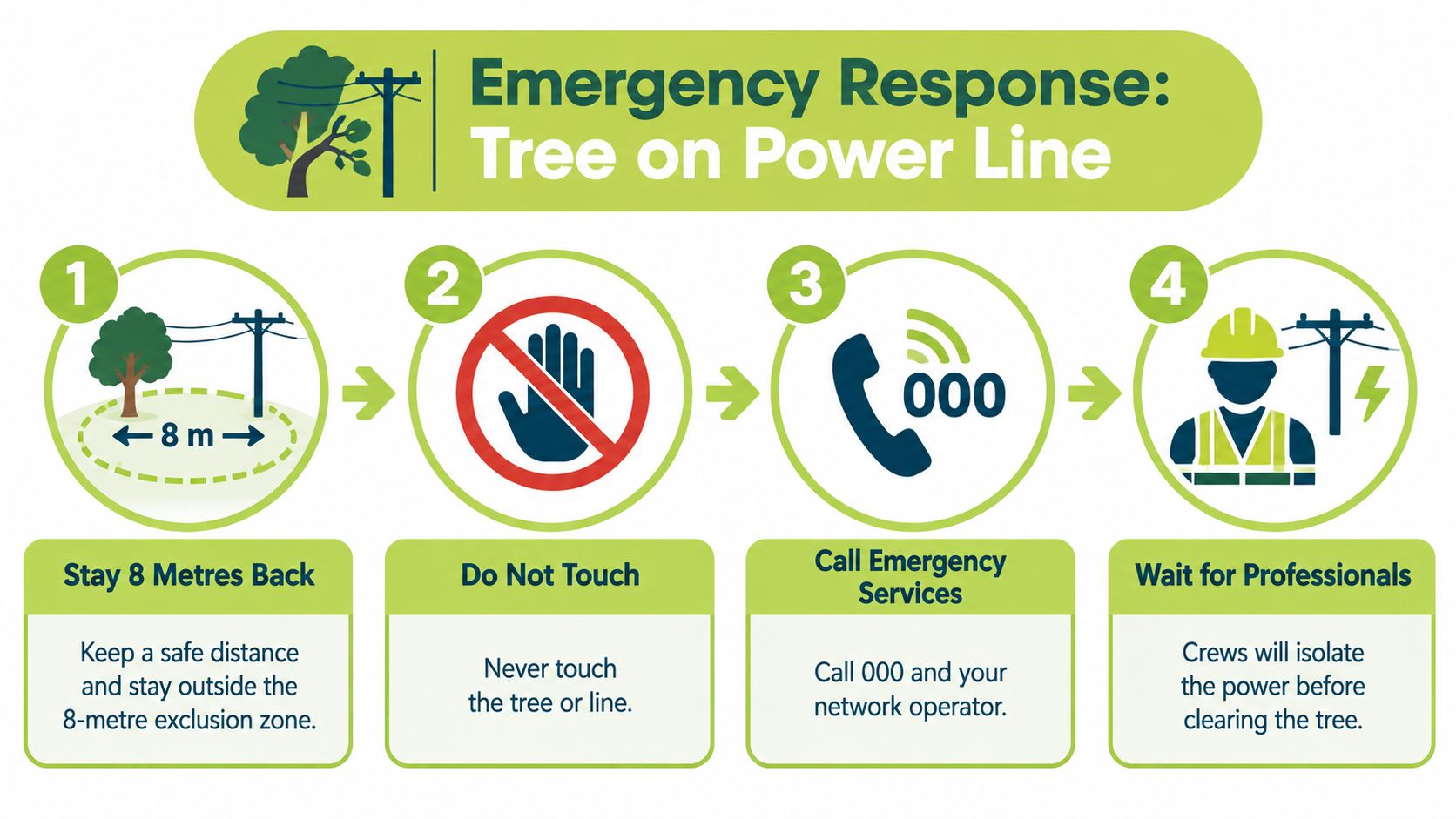
Use this decision sequence
- Stop and isolate the area. Keep household members, neighbours, pedestrians and vehicles away. Don't walk through branches or wet ground near the suspected line.
- Assume the line is live. Don't move a limb with a rake, ladder, vehicle, rope or gloved hand. A wire may be hidden beneath foliage or debris.
- Call for urgent help. Contact the electricity distributor, and call 000 when there is immediate danger to life, fire, traffic or nearby structures.
- Wait for electrical control. Only after the network operator has made the situation safe should an arborist assess accessible sections away from the electrical hazard.
The response differs depending on what you can see. A tree approaching street wires needs distributor advice before planned pruning. A branch physically touching a conductor requires isolation and exclusion. A storm-damaged tree lying in debris may hide an energised line, so treat the entire area as unsafe.
Give the distributor the property address, nearest intersection, line location, visible damage, fallen-tree direction and whether anyone is trapped or injured. Don't send someone closer to take a better photograph. For broader storm planning, emergency response procedures can help households and site managers prepare their contact sequence.
Electrical isolation must come before tree clearing. Resources about storm damage electrician Brisbane Northside also reinforce the wider principle that storm scenes need electrical assessment before cleanup begins, even though local distributor arrangements differ.
Choosing the Right Arborist for High-Risk Tree Work
DIY pruning is reasonable only where there is no electrical infrastructure, no climbing, no high-reaching equipment and no meaningful risk to people or property. Near overhead lines, a homeowner with a pole saw or ladder can create a dangerous reach problem before realising the branch is moving towards the conductor. A neighbour with a chainsaw isn't a substitute for authorisation, risk assessment or distributor coordination.
For high-risk work, compare contractors on their method, not just the quoted scope. A responsible arborist should explain whether pruning can retain the tree, whether staged dismantling is needed, how cut branches will be controlled and what happens if the distributor requires isolation.
What a sound proposal should include
Look for a documented site risk assessment, a safe system of work, evidence of electrical-line training, suitable supervision and insurance. Ask who will manage the network contact, how the crew will establish the exclusion zone and whether a raised work platform or rigging system is appropriate.
A contractor should also discuss the local tree and the reason for the work. A Norfolk Island pine in Wamberal, a blue gum in Gosford or a mature street tree in Newcastle may need different pruning decisions. Coastal salt exposure, drought stress, deadwood, disease, heritage controls and future regrowth all affect the recommendation.
You don't need a contractor who automatically recommends removal. Strategic pruning may solve a clearance problem while keeping shade and habitat, but removal may be justified where the tree is structurally unsound, repeatedly conflicts with the line or can't be managed safely. The right Level 5 arborist should be able to explain that trade-off in plain language.
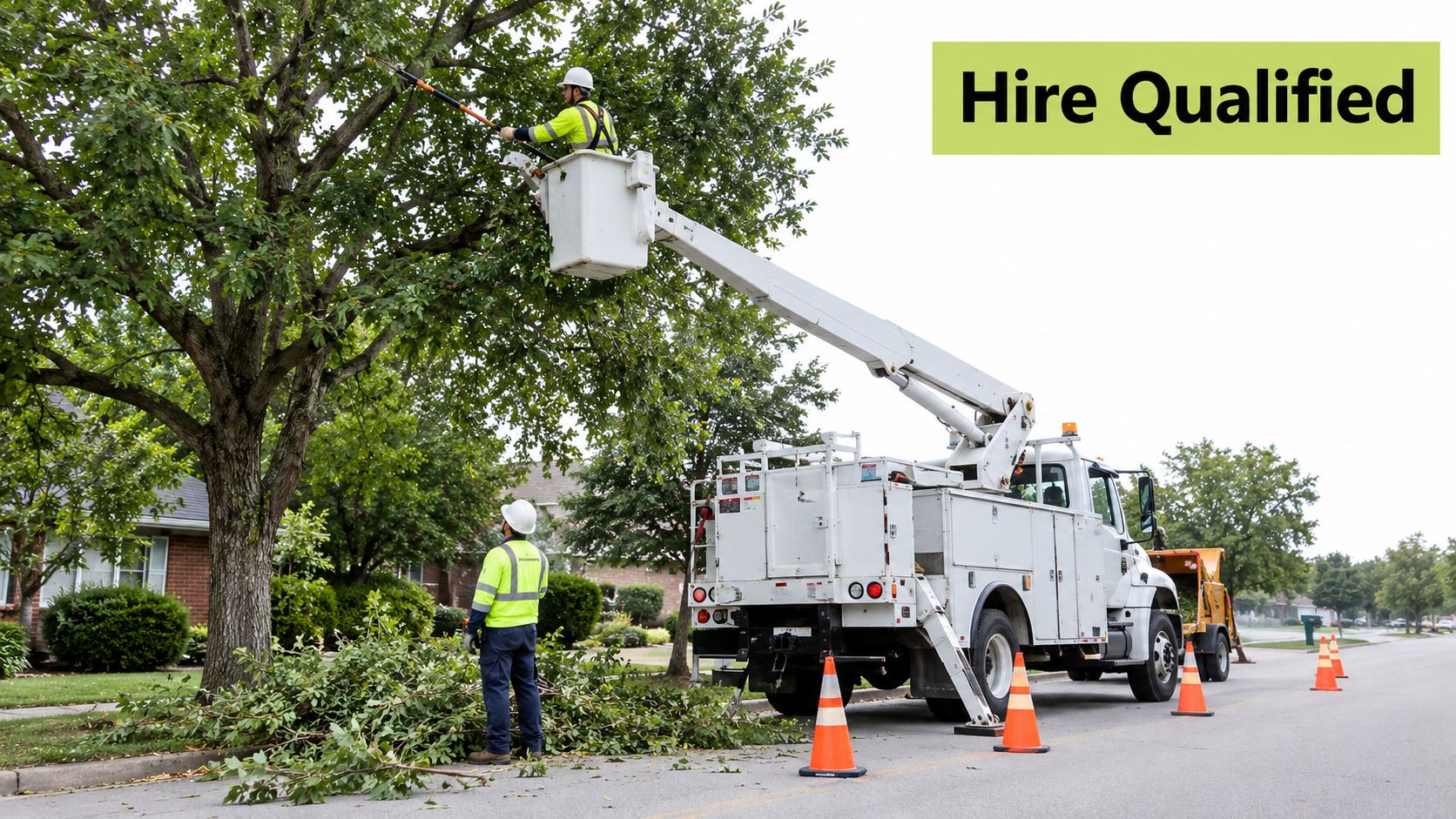
Across the Central Coast, Lake Macquarie and Newcastle, our crews approach these jobs with more than 25 years of local experience, careful site planning and an “On Time, Every Time” focus. We work around homes, strata common areas and commercial properties, while allowing for council approvals, distributor requirements, public access and a clean handover.
If you've noticed branches near a line in Terrigal, Erina, Wyong, Cardiff, Belmont, Charlestown or Mayfield, start with a safe ground-level assessment. Don't cut first and ask questions later.
Treecorp Solutions provides safety-focused tree assessments, clearance pruning, removals and storm-damage support for homes, strata and businesses across the Central Coast, Lake Macquarie and Newcastle. Request a free property assessment by visiting Treecorp Solutions, and contact the team for guidance before any branch, tool or equipment moves near a power line.


