
You can clear trees within 10 metres of a home and underlying vegetation within 50 metres in designated bushfire-prone areas under NSW's 10/50 entitlement, but strict rules still apply. The entitlement only covers eligible land and lawful work, and slopes, waterways, ownership, strata approvals and local controls can change what you're allowed to do.
A storm has pushed a large gum towards your driveway in Terrigal. Dense scrub sits behind the house, the ground falls away towards a creek, and a neighbour's fence runs along the boundary. You may be looking at 10/50 vegetation clearing, but reaching for a chainsaw before checking the site could create a safety problem, an environmental breach or a dispute with your strata committee.
For homeowners across the Central Coast, Newcastle and Lake Macquarie, the practical answer is to treat 10/50 as a bushfire-risk clearance framework, not a general permission to remove trees. The following guide explains what works, what doesn't and where professional assessment makes sense. For related advice about protecting native vegetation during tree work, see our guide to environmental considerations.
What Is the 10/50 Vegetation Clearing Entitlement?
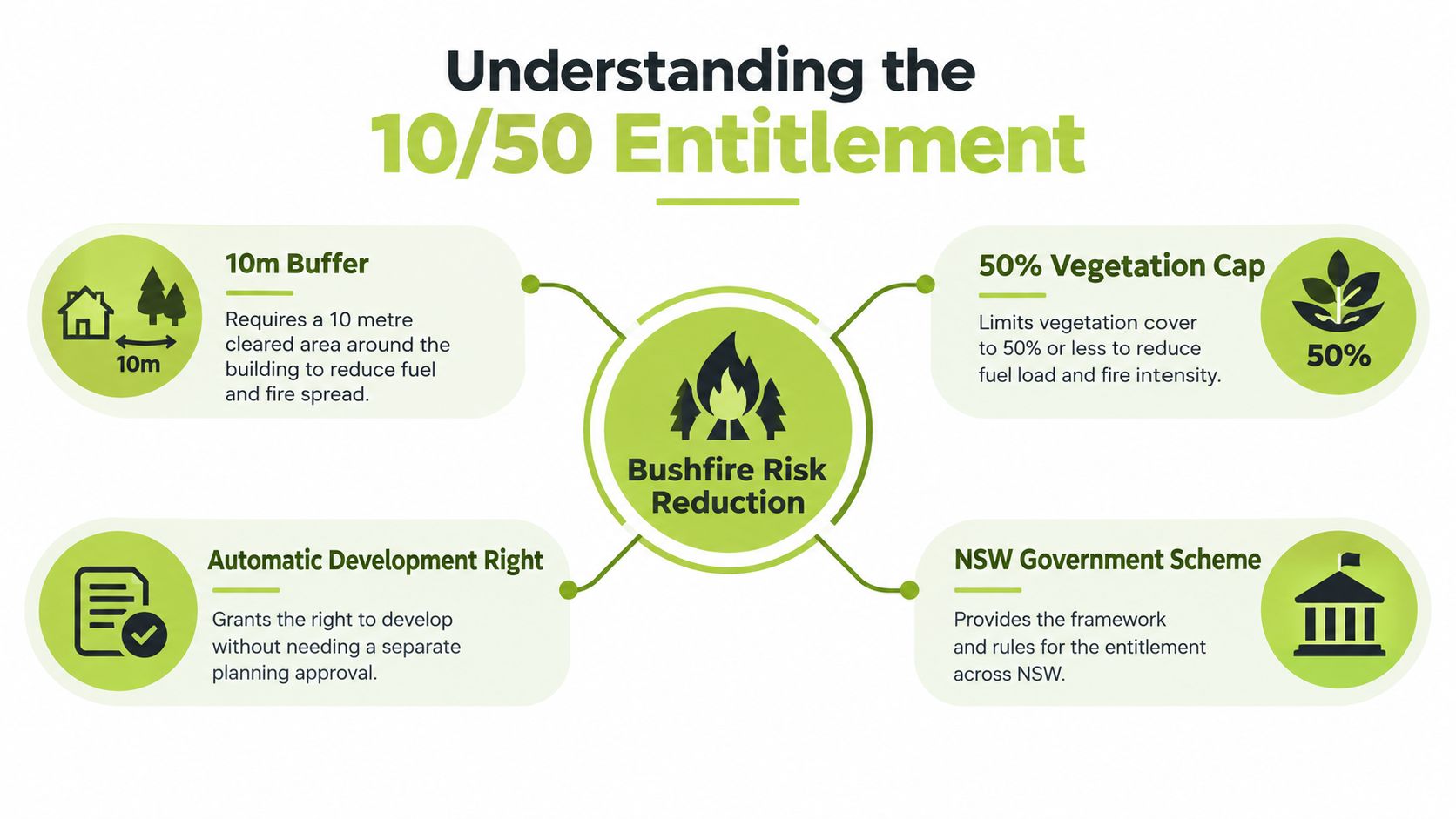
A home on a steep Wamberal block may sit close to dense bush, with a creek below and shared property boundaries nearby. If the address is within a mapped entitlement area, the NSW scheme may allow the owner to clear eligible trees within 10 metres of the home and underlying vegetation within 50 metres, without separate approval for that clearing under the entitlement. The work must still comply with the 10/50 Code and other applicable restrictions, as explained by the NSW Rural Fire Service 10/50 guidance.
The measurement starts at the relevant home or structure, not the front boundary. On sloping land, the horizontal distance can be difficult to judge, particularly where a retaining wall, waterway or access track changes the ground level. The entitlement applies to your own land, so it does not authorise clearing across a boundary or in a neighbour's yard. Strata owners also need to confirm whether the tree or vegetation is part of common property before work begins.
Why the rule exists
The scheme followed the catastrophic 2013 bushfires. NSW Rural Fire Service material says the reduced entitlement area of 100 metres from higher-risk vegetation was retained because it covers 85% of properties historically destroyed in a bushfire. The rule targets bushfire exposure around homes, rather than routine garden maintenance. See the RFS 10/50 vegetation clearing tool for the scheme's risk-based purpose.
A storm-damaged tree, heavy fuel load or obstructed access may justify an assessment. A healthy tree may need pruning, while a hazardous tree may require controlled dismantling to protect the roof, driveway, power assets and people nearby. Treecorp Solutions can assess these site conditions, including slope, waterways and strata boundaries, before work starts. For related guidance, see our environmental considerations for tree work.
Who Is Eligible and Where Does It Apply?
Eligibility starts with the official NSW Rural Fire Service map. A property must be identified as entitlement land on the day you plan to clear. Maps and bushfire conditions can change, so don't rely on an old screenshot, a neighbour's advice or a previous contractor's assessment. Check the NSW RFS 10/50 vegetation clearing area on the day of clearing.
The entitlement belongs to the land and is intended for work on that land. An owner can't use it to remove a tree growing on adjoining land, even if branches hang over a roof. If you're a tenant, builder, property manager or contractor, you also need the landowner's permission before any clearing starts.
Practical rule: A map result answers the eligibility question. It doesn't answer every approval, ownership or safety question.
Different property arrangements need extra care
A freestanding homeowner usually has control over the lot, subject to the Code and other restrictions. A tenant may need written consent under the lease. A builder may need the owner's authority and a clear scope showing which vegetation sits inside the approved work area.
Strata properties are more complicated. A tree beside a shared driveway, common lawn or external wall may be controlled by the owners corporation, even where the unit itself sits inside the relevant distance. The strata manager should check the scheme's by-laws, obtain body corporate approval where required and document who authorised the work.
Local tree controls can also operate separately. Councils may have preservation rules, heritage controls, biodiversity requirements or planning instruments that need checking. A useful starting point is this guide to council approval for tree removal, alongside a broader site safety compliance guide. The key point is simple: 10/50 eligibility doesn't automatically cancel every other rule affecting the block.
Critical Exclusions and Restrictions You Must Know
The most serious mistakes happen when people measure the distance to the house but ignore the rest of the site. Water, slope and ground stability can limit the work even when the property appears on the entitlement map.
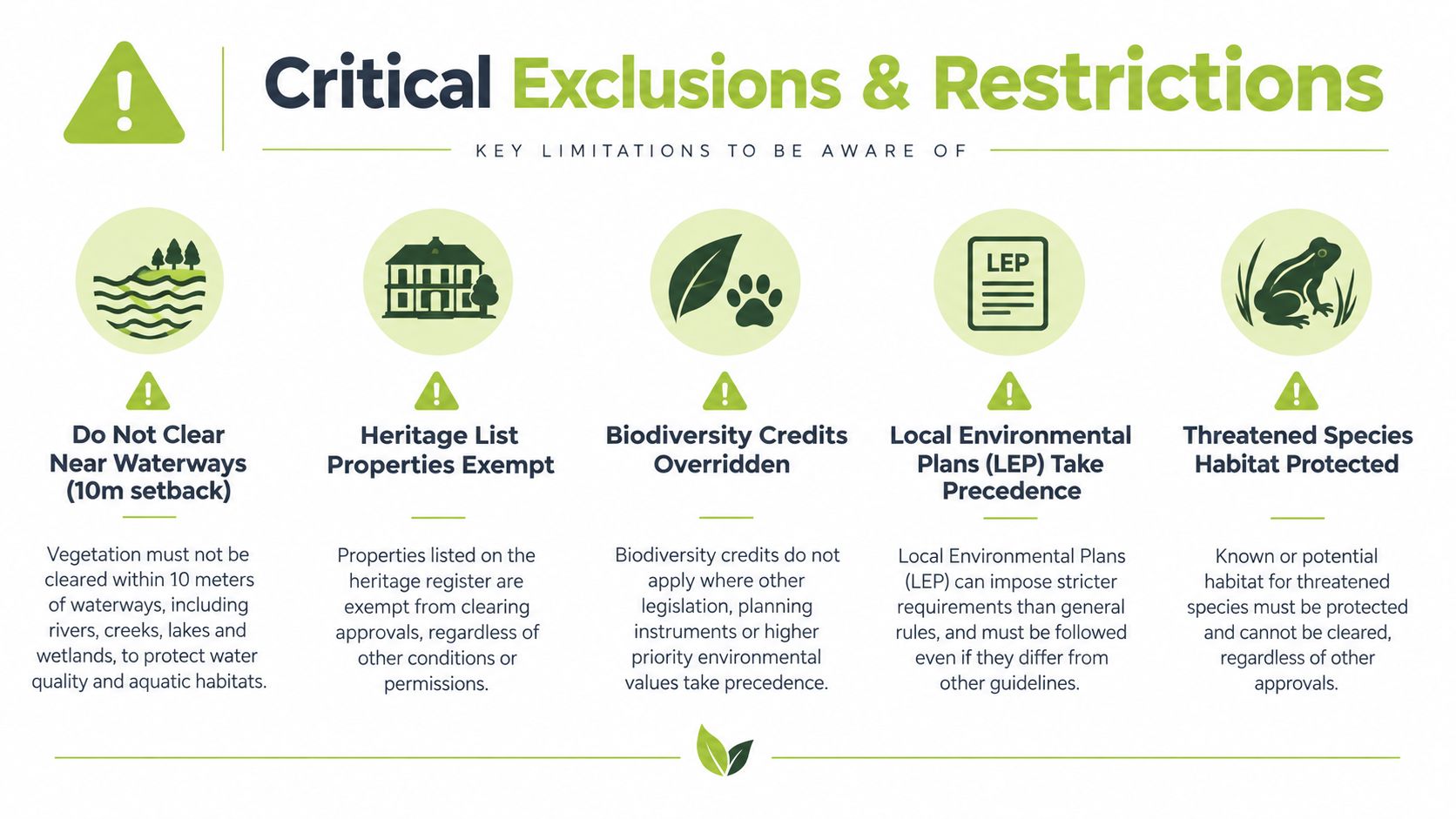
Trees can't be cleared within 10 metres of a lake or within 10 metres of a river that is at least 2 metres wide between the highest opposite banks. The waterway measurement is not something to guess from a dry channel or a narrow section upstream. If the proposed work is near water, pause the job and obtain a proper site assessment. The NSW 10/50 technical tool sets out these waterway constraints.
Slopes change the method
On slopes steeper than 18 degrees, trees can't be removed or pruned by more than 25% of the original canopy unless a geotechnical engineer's assessment specifically supports the work. This is about more than the tree itself. Removing roots and canopy can affect soil stability, water movement and the safety of workers operating above or below the cutting area.
On the Central Coast, a block in Matcham or Killcare can combine steep ground, sandy soils and coastal wind exposure. Around Newcastle and Lake Macquarie, a property may have a narrow access route, a drainage line or a steep fall behind the dwelling. Those conditions affect rigging, machinery access, retreat paths and where cut material can safely land.
Before approving a cutting plan, check three things:
- Slope: Establish whether the work area exceeds the relevant slope limit.
- Waterway: Identify lakes and qualifying rivers, including the setback from the bank.
- Canopy: Assess the original canopy before planning any pruning on steep ground.
The restrictions exist to reduce erosion, instability and off-site impacts. They also protect waterways from sediment and prevent a rushed clearance job from turning into a retaining-wall or neighbour's-land problem. For environmentally sensitive work, our guide to eco land clearing provides useful context.
How to Apply or Notify for Vegetation Clearing
Start with the map, not the equipment. Enter the property details into the NSW RFS tool, confirm that the land is mapped as entitlement land and save a record of the result. Then walk the proposed clearing area and mark the dwelling, the 10-metre tree zone, the 50-metre underlying vegetation zone, boundaries, waterways and steep sections.
Next, contact your local council. The 10/50 entitlement may remove the need for a full development application for eligible clearing, but council tree controls, heritage provisions, environmental requirements and site-specific planning rules can still matter. A council conversation is especially important in Newcastle, where heritage-listed streetscapes and established trees can create additional considerations, and in coastal suburbs where sensitive vegetation is common.

Consent matters on shared or rented land
A strata manager should obtain the owners corporation's approval before arranging work in common areas. A tenant should check the lease and obtain the owner's written consent. A builder or insurer shouldn't assume that a 10/50 map result provides authority to remove vegetation without the landowner's direction.
Keep the map result, photographs, written permissions, council correspondence and arborist report with the job file. An arborist report for tree work can document the tree condition, proposed method, site hazards and reasons for pruning or removal.
Once the scope is clear, the contractor should establish exclusion zones, confirm access and identify overhead services before work begins. Notification requirements depend on the circumstances and the applicable NSW process, so ask the RFS or council what applies to your property rather than assuming no notice is needed.
DIY Clearing vs Hiring a Professional Arborist
A small shrub with clear access is very different from a mature gum leaning over a home. Tree work near buildings involves stored energy, falling timber, ropes, saws, uneven ground and changing weather. A branch can swing into a roof, roll down a slope or land outside the area you thought you controlled.
DIY clearing also makes it easy to miss the compliance details. People measure from the wrong structure, prune too much canopy on a steep slope or clear across a boundary. If an injury or property-damage event occurs, your home insurance may not respond in the way you expect, particularly where the work was unauthorised or carried out without suitable controls.
What professional planning adds
A qualified arborist assesses tree structure, lean, decay, access, drop zones and retention options before deciding whether pruning or removal is appropriate. The crew can use staged dismantling, rigging and controlled lowering where a straight fell isn't safe. They should also work under relevant Australian Standards and WHS obligations, with documented controls for workers, residents, pedestrians and nearby assets.
Ask prospective contractors for evidence of qualifications, current insurance, a written scope and a clear clean-up plan. For public-facing work, confirm $20 million public liability insurance before the crew starts. That cover doesn't make unsafe work acceptable, but it is an important part of managing risk to your property and third parties.
Don't compare a professional tree-work quote with a DIY chainsaw purchase as if they deliver the same result. The real comparison includes planning, controls, equipment, waste handling and responsibility for the site.
Coastal salt, strong winds and storm-damaged limbs call for different precautions from drought-stressed trees inland. Facility managers can also use these practical facility landscaping tips when planning routine grounds work. For qualifications and competency, review this guide to arborist qualifications.
Costs, Insurance, and Timeframes
The entitlement itself may be available once the property and proposed work are verified, but the job still has practical costs. Tree size, species, lean, access, slope, proximity to buildings, traffic management, machinery requirements, pruning complexity and green-waste removal all affect the scope.
A tree beside a driveway may be straightforward to dismantle but difficult to move through a narrow side passage. A block in Erina may have easier vehicle access than a steep property in Cardiff or Swansea. Coastal conditions can also make storm-damaged trees unpredictable, while drought-stressed trees may have brittle limbs and reduced structural reliability.
Ask for a written quotation that explains what will be removed, what will remain, how the work will be staged, whether waste is chipped or removed, and what clean-up is included. If an engineer, traffic controller or council process is needed, the quote should identify that rather than leaving you with an unclear total.
Weather can delay work involving wind, rain, lightning or unstable ground. Emergency hazards may need immediate isolation, followed by planned dismantling once conditions are safe. A fully insured contractor can also provide useful documentation for an insurance claim, including photographs, a work description and an invoice that separates emergency make-safe work from later vegetation management.
Final Checklist for Homeowners and Strata Managers
Before any branch is cut, put the job through a short compliance and safety check. The aim isn't to create paperwork for its own sake. It's to make sure the person authorising the work, the contractor doing it and the neighbours affected by it all understand the same boundaries.
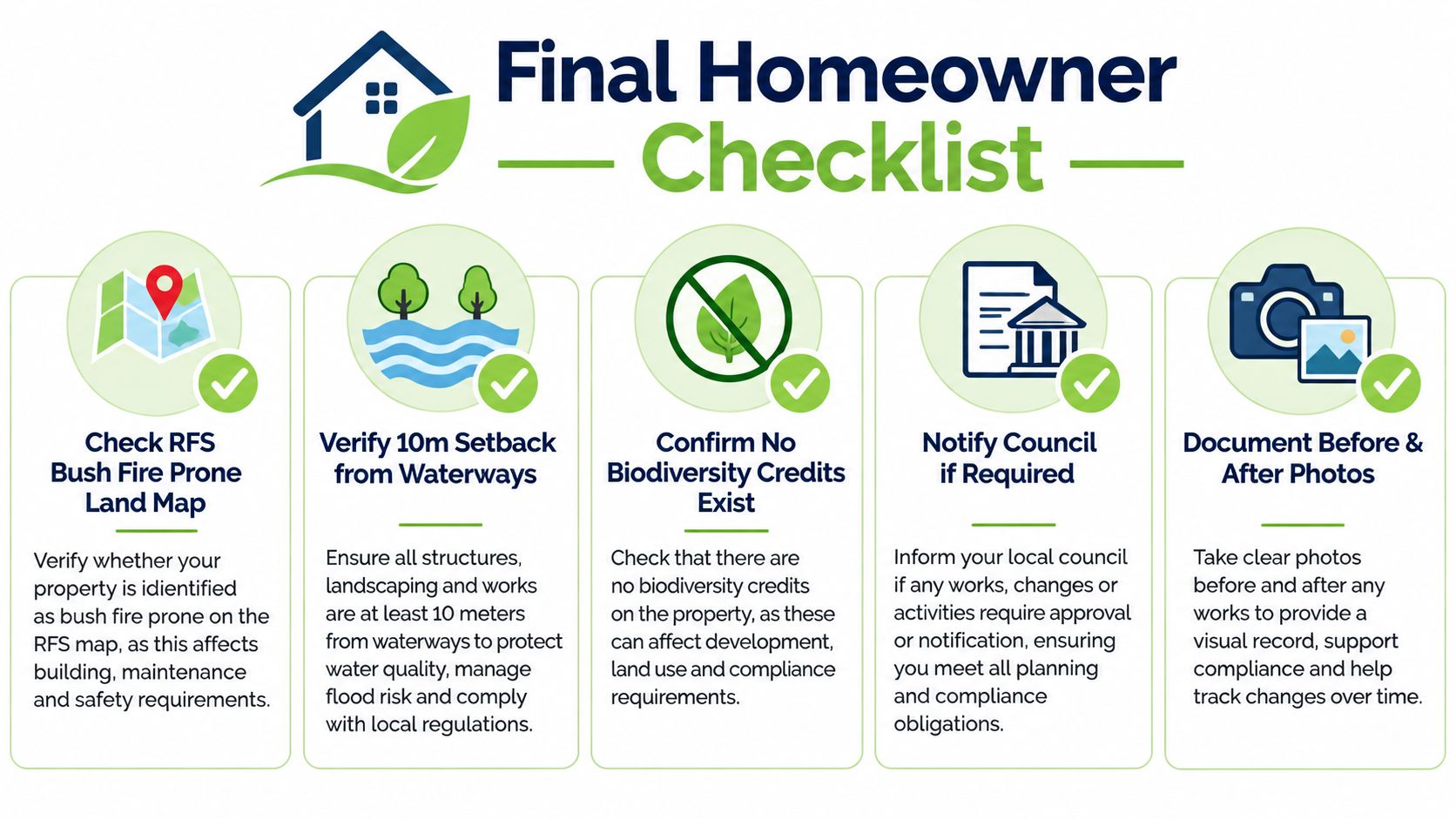
Use this order on site:
- Check the RFS map: Confirm the property is in entitlement land on the day of the proposed clearing.
- Mark the work area: Identify the dwelling, distances, property boundaries and vegetation that belongs to someone else.
- Inspect waterways: Verify the 10-metre setback from lakes and qualifying rivers before planning removal.
- Assess the slope: Check whether steep ground affects removal or canopy reduction, and seek geotechnical advice where required.
- Check local rules: Ask council about tree preservation, heritage, biodiversity and planning controls.
- Confirm authority: Obtain landowner, lease, strata or owners corporation consent where relevant.
- Choose a qualified arborist: Request evidence of competency, WHS planning, insurance and a written scope.
- Record the condition: Take before-and-after photographs and keep the map result, approvals and job documents.
If you're preparing several properties or managing a strata site, a downloadable fire inspection checklist can help organise broader fire-safety records, although it doesn't replace NSW 10/50 or council checks.
For Central Coast, Lake Macquarie and Newcastle properties, Treecorp Solutions can assess the proposed work, identify site constraints and coordinate safe pruning, removal or vegetation clearing. With more than 25 years of local experience, fully insured crews and an “On Time, Every Time” approach, we can help you request a free property assessment through Treecorp Solutions, and urgent storm hazards can be discussed through the company's emergency service.


