Starting a construction project is an exciting time, but the real success of your build depends entirely on the groundwork. Site preparation for construction isn't just about clearing dirt; it’s the critical first step that creates a safe, compliant, and stable foundation for everything that follows. Think of it as setting the stage properly before the main performance begins. With over 25 years of local experience on the Central Coast, we’ve seen how proper prep work prevents costly headaches down the track.
Your Guide to Central Coast Site Preparation
So, you've bought a block of land in a leafy suburb like Terrigal or Adamstown. You can't just fire up a bulldozer and start clearing. The first thing we always do is a careful site walk-through. We’re looking for challenges like significant trees, sloping land, or tricky access points that could cause headaches later.
Getting a handle on these factors upfront helps us shape a realistic budget and timeline for you. It’s all about preventing those costly, unexpected surprises down the road. We’ll walk you through the entire process, from that initial look-see to the final safety checks, making sure your Central Coast project starts on solid ground.
This is even more critical for rural or semi-rural properties, where zoning laws and environmental factors are a much bigger deal. If you're building outside the main hubs, this guide to building on rural land in NSW is a fantastic resource that covers approvals and other key considerations.
Below is a simple flowchart that shows the three-phase process we follow on every single job.

It’s a clear visual of how we move from understanding what makes your site unique, to drawing up a detailed plan, and finally, getting our hands dirty with the physical prep work.
A huge part of this is managing whatever is already growing on your land. Here on the Central Coast and in Newcastle, that almost always means dealing with trees. This process starts with a professional assessment by a qualified arborist, which is essential for both safety and council compliance.
To give you a clearer picture, the table below breaks down the key stages of site preparation.
Key Stages of Site Preparation
This table offers a quick snapshot of the essential phases, what happens during each, and why they're so important for a successful build.
| Stage | Key Activities | Why It Matters |
|---|---|---|
| 1. Assessment & Planning | Site survey, arborist reports, council permit applications, utility location. | Prevents costly mistakes, ensures legal compliance, and establishes a safe work environment. |
| 2. Physical Preparation | Tree removal, stump grinding, bulk earthworks, site levelling. | Creates a clean, stable, and accessible area for construction to begin. |
| 3. Finalisation & Safety | Erosion control setup, site security (fencing), final cleanup, waste removal. | Protects the site and neighbouring properties, and ensures a safe handover to the builders. |
Each stage builds on the last, creating a seamless transition from a raw block of land to a build-ready site.
With over 25 years of local experience, we’ve seen it all—from complex strata projects in The Entrance to large-scale block clearing near Lake Macquarie. Our key takeaway is this: a detailed, professional site assessment isn't an expense; it's an investment that saves you time, money, and stress throughout your build.
Assessing Trees and Vegetation on Your Property
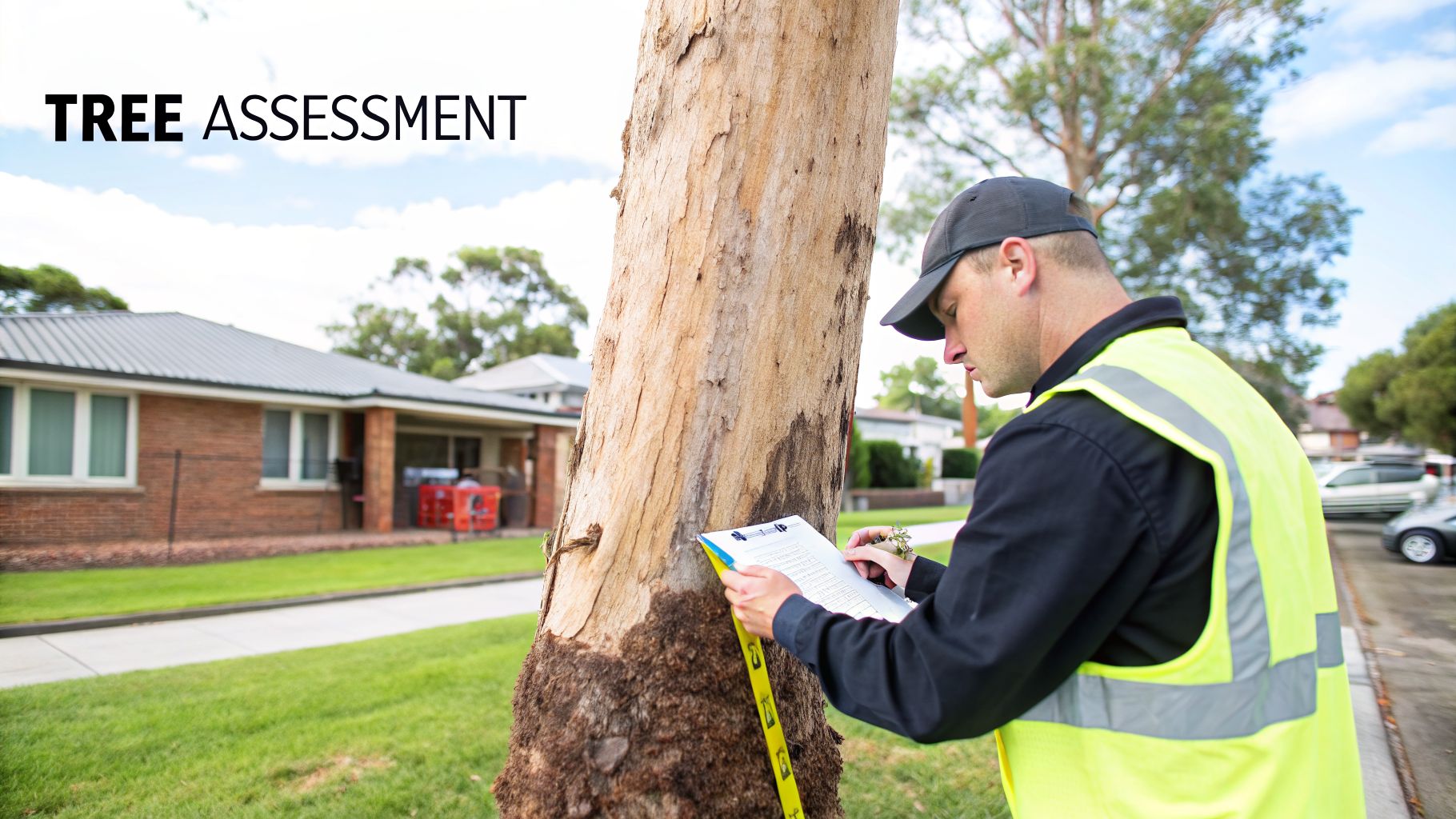
On the leafy Central Coast and in established Newcastle suburbs, dealing with trees is a massive part of any site preparation for construction. It’s a step that demands more than just a quick glance around the block. To get it right and sidestep major headaches down the track, a professional assessment from a qualified arborist isn't just a good idea—it's essential.
This isn’t simply about finding which trees are sitting squarely on your building footprint. We carry out a detailed evaluation of every significant tree, looking closely at its health, species, and structural integrity. Imagine you’ve got a large gum tree in Terrigal dropping branches. A qualified arborist can spot the subtle clues of internal decay or weakness that could turn it into a safety hazard once the ground starts vibrating from construction.
Why a Professional Assessment Matters
A proper arborist assessment provides a clear, actionable plan. It’s the difference between guessing and knowing, and it becomes your roadmap for managing the vegetation on your site safely and legally. The report we provide will identify trees with structural flaws that are invisible to the untrained eye, like a compromised root system that could become a liability during your build.
It also helps protect valuable assets. Not every tree has to go. Sometimes, strategic pruning is all that’s needed to get the clearance you require while saving a beautiful, healthy tree that adds real value to your property. We help you make informed decisions about what to keep and what to remove.
Most importantly, it ensures council compliance. We identify protected or significant native species that councils like Central Coast or Lake Macquarie City Council have strict rules about. Trying to remove one without a permit can lead to hefty fines and stop-work orders. Understanding what a qualified arborist does is key to appreciating this crucial step.
From Assessment to Action Plan
Once we've completed the assessment, we hand you a comprehensive report. This document clearly lays out which trees must be removed, which can be safely kept with some expert pruning, and the safest methods to get the work done. It's all about finding that balance between your building plans, council rules, and environmental responsibility.
We’ve been serving the Central Coast, Newcastle, and Lake Macquarie for over 25 years. In that time, we've learned that a proper tree assessment is non-negotiable for any construction project. It provides the certainty you need, backed by our $20M public liability insurance for your complete peace of mind.
This methodical approach is even more critical for strata properties, like a block of units in The Entrance or Toukley. The process here involves not just council approval but also navigating the body corporate's rules, especially for trees in common areas. We have extensive experience working with strata managers to make sure every approval is sorted before work begins, keeping things smooth for everyone involved.
Navigating Council Permits and Local Approvals
Before a single shovel hits the dirt or any trees come down for your build, there’s one hurdle you absolutely can't ignore: council permits. Many property owners on the Central Coast are surprised when they learn they need official approval to remove a tree on their own land. This is exactly where getting professional guidance for your site preparation for construction becomes so important.
The rules for land clearing and tree removal can change dramatically depending on whether your property is under the Central Coast Council, City of Newcastle, or Lake Macquarie City Council. A tree you could remove without fuss in one suburb might be strictly protected just a few kilometres away, reflecting regional variations in heritage and environmental protection.
Decoding Local Council Rules
You’ve got to get a handle on your local council's specific requirements right from the get-go. The paperwork can look daunting, but after helping clients with this for over 25 years, we know precisely what each council looks for. We can help you pull together all the necessary documents, including a formal arborist report, and manage the entire application process for you.
Let's take a real-world example. Imagine you're looking to remove a large, native Angophora on a block in a heritage pocket of Hamilton. That situation will almost certainly demand a much more detailed assessment and face tougher conditions than removing a declared pest species in Woy Woy. Getting this wrong can lead to project-halting stop-work orders and some pretty hefty fines.
Our Pro Tip: When it comes to council rules, never assume. It is always safer, and in the long run, faster to check the requirements first. A quick call to us for a site assessment can clear up what’s needed and save you from expensive delays before you’ve even started lodging paperwork.
We can walk you through the common factors that trigger the need for a permit, making sure you’re fully prepared.
Common Permit Triggers to Watch For
Several key factors will determine whether you need to lodge a Development Application (DA) or a specific tree permit. These are the most common ones we see every day: tree size (height or trunk diameter), species (especially protected natives), and its location on the property relative to boundaries or conservation zones.
If you're in a strata complex in a place like Umina Beach or Warners Bay, council approval is just one part of the puzzle. You'll also need to get the green light from the body corporate, especially for any trees in common areas. We frequently work with strata managers to coordinate these dual approvals, ensuring a smooth process.
Trying to figure all this out on your own can be a real headache, but it’s a critical step. For a more detailed look, you might find our guide on everything you need to know about council approval for tree removal really helpful. Having an experienced arborist in your corner ensures every box is ticked, keeping your project compliant and moving forward without a hitch.
Clearing the Land: The Physical Work Begins
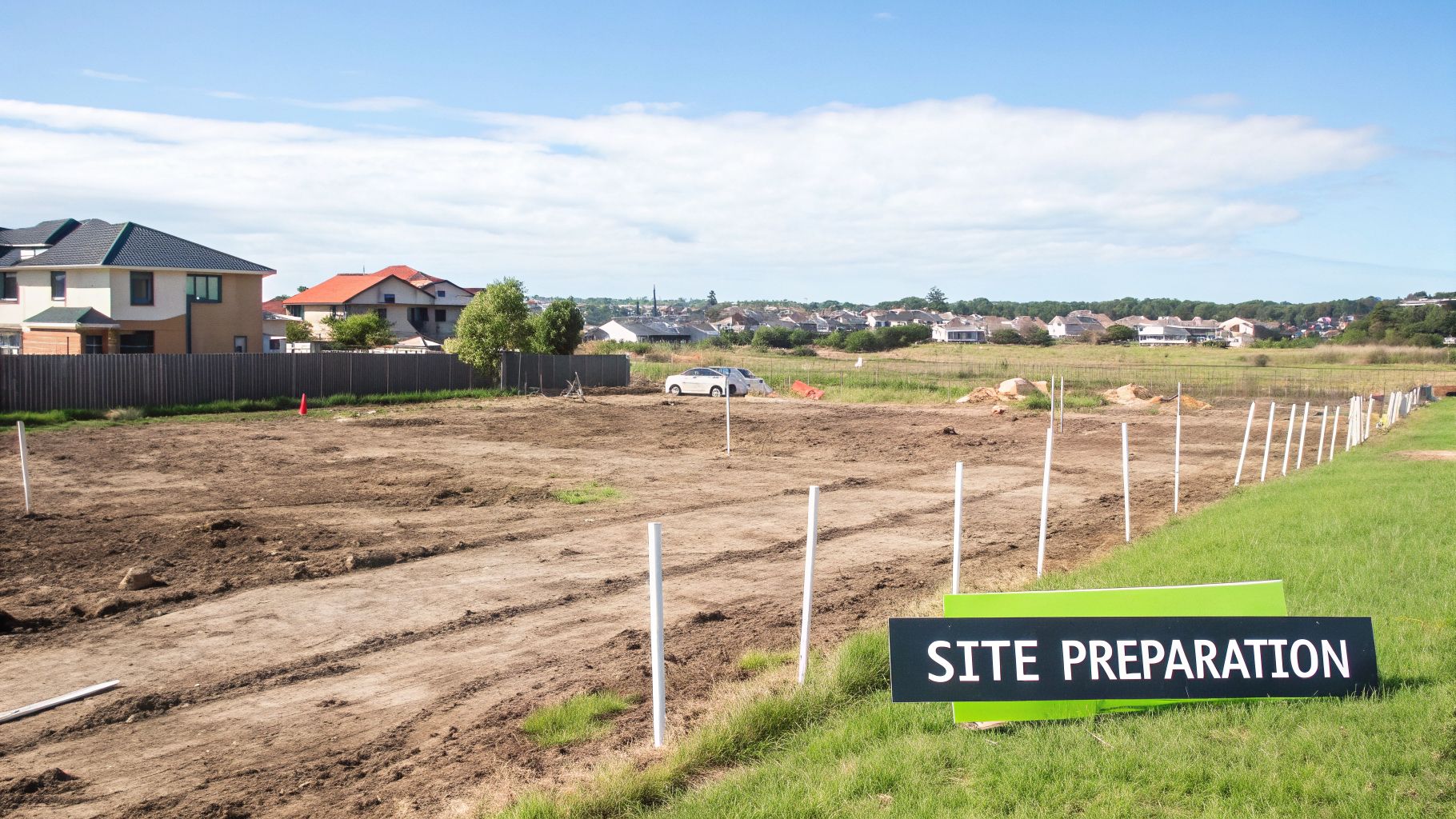
With all the site surveys done and the council permits in hand, it’s time for us to get our hands dirty and start clearing your block. This is where our team’s skill and unwavering focus on safety truly shine, transforming an overgrown site into a clean, build-ready canvas. The very first thing we do is establish a secure worksite to protect your property, your neighbours, and the general public.
When it comes to tree removal, our qualified arborists use precise rigging techniques and modern equipment. This lets us safely dismantle trees piece by piece, which is crucial for the tight, confined spaces we often work in across suburbs like Belmont, or for trees that tower over existing homes. It’s a careful, controlled process, not just a matter of felling trees indiscriminately.
From Tree Felling to Stump Grinding
Once a tree is safely on the ground, the next step is to tackle the stump. We move right onto stump grinding, a process that is absolutely vital for preventing a whole raft of future headaches. If you leave a stump behind, it can become a magnet for termites, encourage fungal growth that spreads to other plants, and even cause problems for your new home's foundations later on.
We bring in powerful stump grinders to chew the stump and its main root ball well below ground level. This doesn’t just get rid of an eyesore; it creates a completely clear surface that’s ready for the builders. On larger blocks, like the ones you might find out towards Wyong or Morisset, this stage can also involve clearing away dense undergrowth and scrub. This process is sometimes called grubbing, and you can learn more about it in our detailed guide on what grubbing and clearing involves.
A Crucial Reminder on Safety: All our work is performed under the strictest Work Health and Safety (WHS) legislation. Our meticulous approach, backed by our comprehensive $20M public liability insurance, gives you and your builders complete peace of mind that the site is not just clear, but professionally and safely prepared.
Managing Waste and Leaving Your Site Tidy
A huge part of doing the job right is what happens after everything is down. We pride ourselves on leaving a site impeccably tidy and ready for the next tradie. This means all green waste, from the smallest branches to the biggest logs, is managed responsibly. We have chippers to process foliage and small branches on-site, which you can even keep as garden mulch if you like.
We remove all the larger logs from the site, making sure nothing is left behind to get in the way of your builders. This commitment to a full clean-up is a core part of our 'On Time, Every Time' promise. We don't just get the job done; we finish it to the highest standard, ensuring a smooth handover for the next phase of your build. This methodical process ensures that the site preparation for construction is thorough, safe, and sets your project up for success right from the start.
Final Site Prep and Safety: Getting Builder-Ready
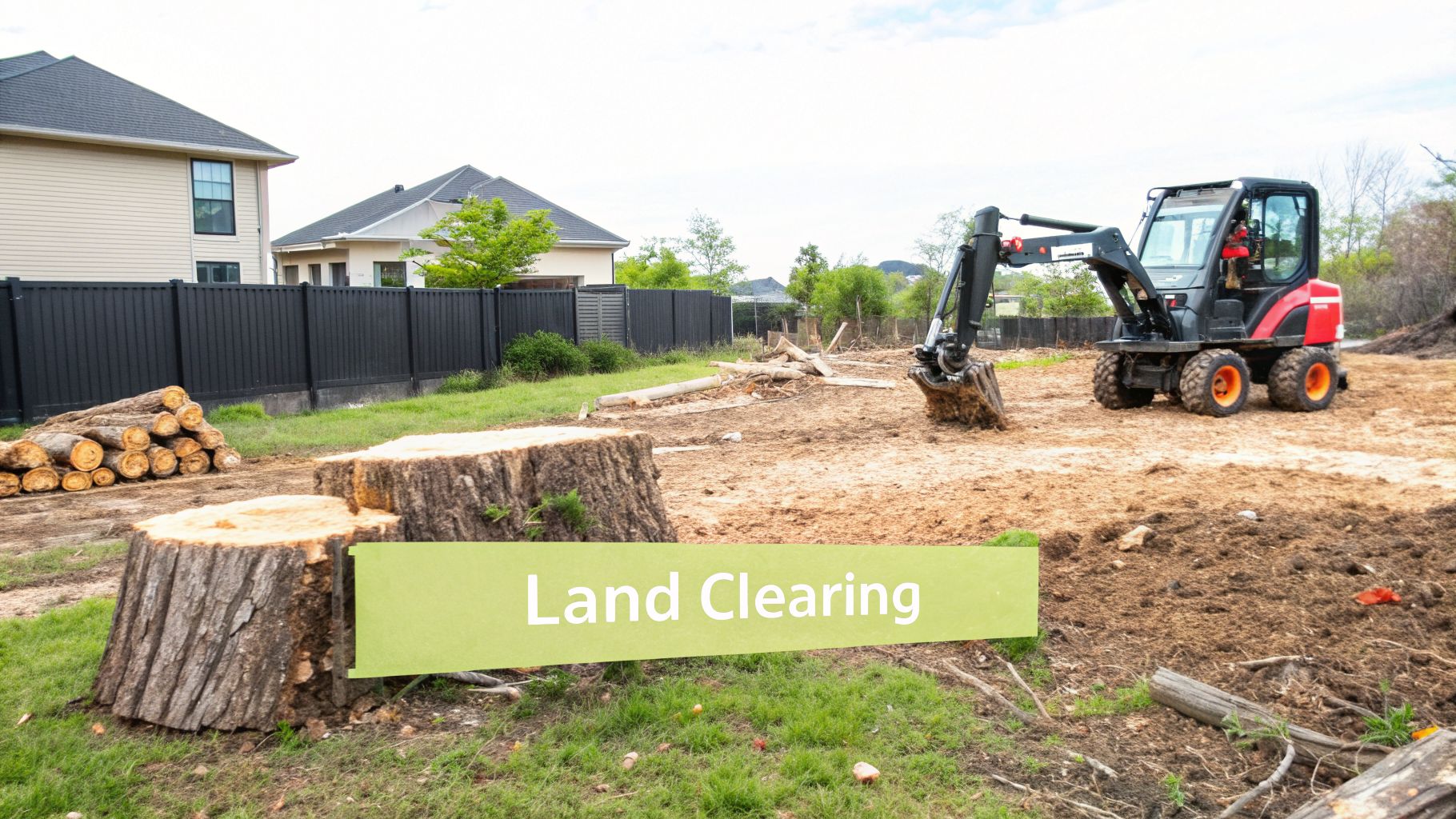
So, the big machines have done their job. The trees are gone, the stumps have been ground out, and you can finally see the true shape of your block. But we're not quite done yet.
Now, our focus for your site preparation for construction shifts from heavy clearing to the finer details. This is where we transition the site from a cleared block into a safe, compliant, and genuinely builder-ready worksite. It's about looking beneath the surface and getting everything in place for the next stage.
One of the first and most critical jobs is finding out what lies underground. A "Dial Before You Dig" enquiry is non-negotiable before any more digging happens. Striking a hidden water main, gas line, or fibre-optic cable is a disaster you don't need—it's incredibly dangerous and brings a project to a screeching, expensive halt.
Taming the Terrain: Erosion and Sediment Controls
Here on the Central Coast and around Lake Macquarie, flat blocks are a rarity. Most sites have some kind of slope, which makes erosion and sediment control absolutely essential. After clearing, your site is vulnerable. One good downpour can wash loose soil onto your neighbour’s property or into our local waterways, leading to council fines and environmental harm.
We've seen the chaos a sudden coastal storm can cause on an unsecured site versus one we've properly prepared—the difference is night and day. To stop this from happening, we install controls like sediment fences to filter runoff, soil stabilisation mats for steeper slopes, and gravel access points to stop mud being tracked onto the road. These measures are about being a good neighbour and looking after the local environment we all love, from Warners Bay to Forresters Beach.
Creating Safe and Solid Site Access
Soon, your site will be bustling with builders, concreters, and all sorts of delivery trucks. They need clear, stable access. This is more than just clearing a path; it's about creating an entryway that can handle heavy machinery without turning into a bog or damaging public infrastructure, especially after the rain we often get on the coast.
Imagine a tight residential street in a suburb like Adamstown. We meticulously plan access to minimise disruption to traffic and neighbours. This could mean laying down temporary road plates or building up a solid gravel driveway to protect the footpath. A well-built access track is crucial for keeping your build on schedule—a key part of our "On Time, Every Time" commitment.
As the first major contractors on your property, we set the standard for Work Health and Safety (WHS) compliance. A tidy, well-organised, and secure site sends a clear message of professionalism that carries through the entire build.
The Paperwork That Keeps Everyone Safe
Managing high-risk activities like operating heavy machinery requires more than just experience—it demands a formal process. That's why we develop a comprehensive Safe Work Method Statement (SWMS) for every project. This document breaks down each task, identifies hazards, and details the control measures we put in place to manage risks, protecting our crew, you, your property, and the public.
With over 25 years of experience and our $20M public liability insurance, you can be confident that every part of your site preparation is handled with the highest level of professional care. Once these final preparations are locked in, your site is officially ready for the builders to break ground. And if you’ve just had trees and stumps cleared, you might find our guide on what to expect from a professional tree stump grinding service helpful.
Your Site Preparation Questions Answered
When you're getting ready to build, you've got questions. We get it. Having worked with property owners all over the Central Coast, Newcastle, and Lake Macquarie, we've heard them all. Here are some straightforward answers to the questions we're asked most often, helping you plan your site preparation for construction with total confidence.
How long does site preparation for construction usually take?
Honestly, it depends. The timeline for clearing a block can shift quite a bit based on its size and what we're dealing with. A pretty standard residential lot in a place like Tuggerah might only need a week or two for clearing and stump grinding. But if you're on a larger, steeply sloped, or heavily treed block, you could be looking at several weeks of work.
The biggest wildcard is often waiting on council permits. This part of the process can take anywhere from a few weeks to over a month, depending on how complex your project is and your local council's current workload. Once we've done a full site assessment, we can give you a much more realistic schedule that takes everything into account.
What are the main factors that influence land clearing costs?
The final price for clearing your land is driven by a handful of key factors. The biggest one is usually the number, size, and species of trees that need to go. Site accessibility is another major one. If we’re navigating a tight spot in a suburb like Merewether, we might need specialised machinery, which can influence the cost.
Other things that come into play are the steepness of your land and how much stump grinding is involved. You’ll also need to factor in any council permit fees and the cost of an arborist report if your project requires one. While it's impossible to give a price without seeing your site, we always provide a detailed, itemised quote so you know exactly where your money is going.
Our 'On Time, Every Time' promise means we stick to the agreed budget and schedule, giving you clarity and peace of mind from the very start.
Can I do some of the site clearing myself to save money?
We know it's tempting to try and save a few dollars by tackling smaller shrubs or trees on your own. But we strongly, strongly advise against it. DIY tree removal or trying to operate heavy machinery without the right training, tickets, and qualifications is incredibly dangerous. The risk of serious personal injury or causing major damage to your property is just too high.
Beyond the safety risks, there's the insurance. A professional crew like ours is fully insured. Our $20 million public liability insurance means you're completely protected from any liability if something goes wrong. A single mistake could end up costing you far more in repairs or medical bills than you'd save. It’s always safer, faster, and more efficient to let an insured, qualified team manage the process correctly and in line with WHS legislation.
When you're ready to get your project started on the right foot, trust the local team with over 25 years of hands-on experience. At Treecorp Solutions, we make sure your site is prepared safely, efficiently, and in full compliance with all local regulations.
Request a free quote online or give us a call on our phone number for emergency assistance.