So, you're thinking about clearing a block on the Central Coast or in Newcastle? It’s a pretty big job, and it’s about a lot more than just getting rid of some trees. Professional residential land clearing is the essential first step that gets your property ready for a new build, a garden expansion, or even for reducing bushfire risk. It's all about creating a safe, stable foundation for whatever you have planned next. As arborists with over 25 years of local experience, we help you navigate the process from initial assessment to a build-ready site, making sure it's done safely and correctly.
Preparing for Your Land Clearing Project
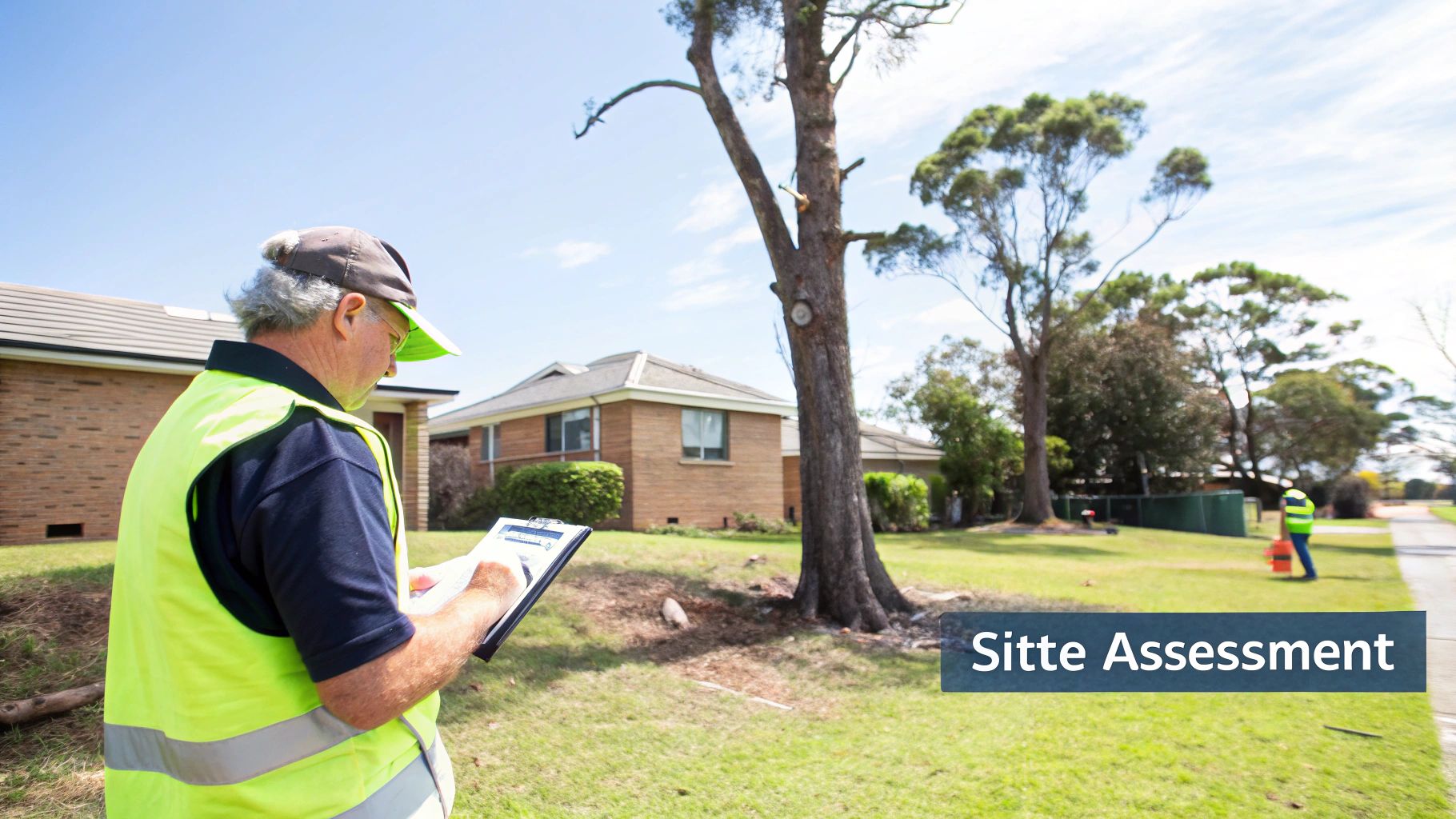
The success of any land clearing project really comes down to the prep work. Before a single branch is pruned, a qualified arborist needs to do a thorough assessment of your property. This isn't just a quick walk-around to see what needs to go; it’s a deep dive into the entire ecosystem of your block.
Imagine you’ve just bought a sloping block in Terrigal, covered in thick scrub and a few big old gum trees. A proper assessment would look at the trees, sure, but it would also check the soil type, the gradient of the land, and where we can safely bring in machinery. Getting this planning stage right from the start is absolutely vital to avoid costly mistakes, council headaches, and needless damage to your site.
Assessing Your Site's Potential
A proper site evaluation is all about the big picture. We need to know what you’re planning—where the house will sit, where the driveway will go—so we can make smart decisions about what stays and what goes. Some trees might be perfect to keep for shade or just because they look great, while others could be a future nightmare for foundations or plumbing.
It's also important to know exactly what kind of vegetation we're dealing with. For a closer look at what's common in our area, you can check out our guide to the most common trees on the Central Coast. This whole process ensures the clearing work lines up perfectly with your building or landscaping plans from day one.
This flow diagram gives you a clear idea of how we move from that first look to a solid, finalised plan.
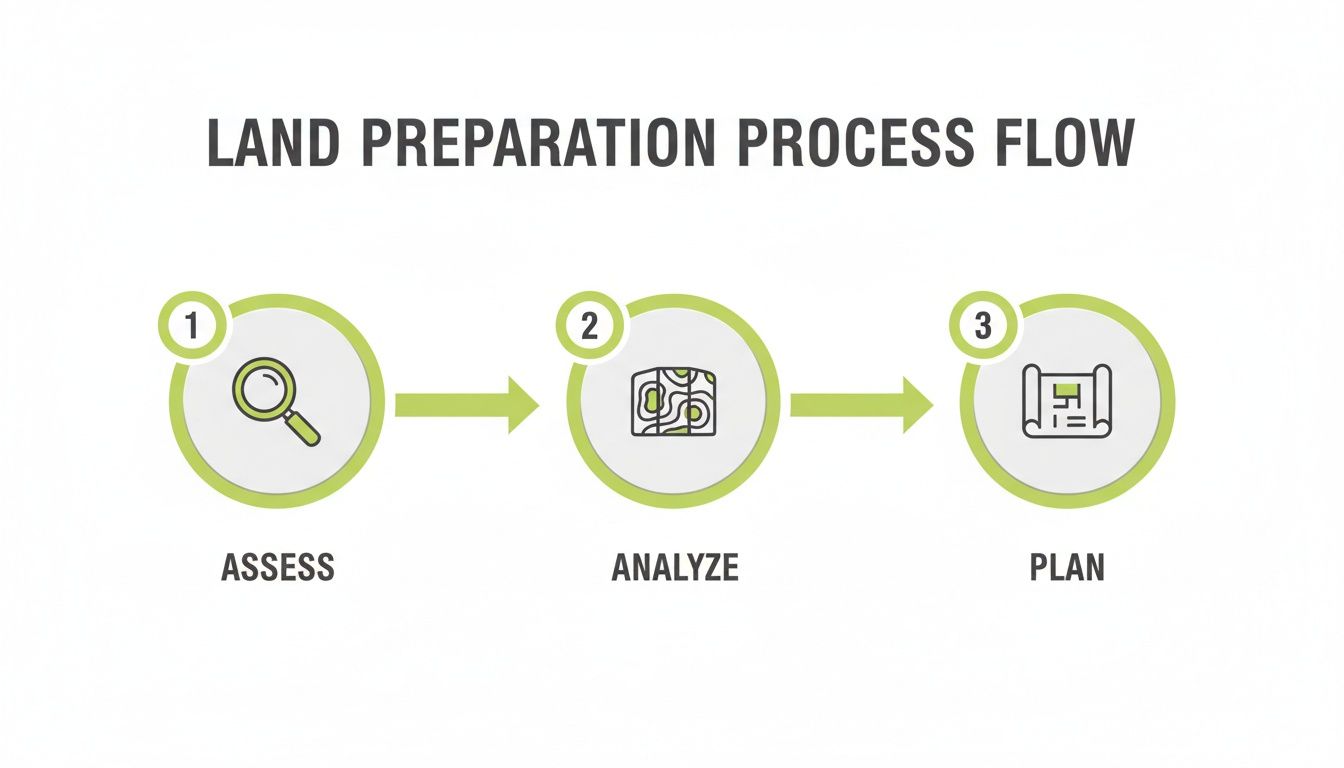
As you can see, taking a methodical approach like this is the best way to prevent expensive oversights and make sure everything flows smoothly into the construction phase.
Proper residential land clearing is the groundwork for any new build or major landscaping project. It's the first and most important part of any good site preparation for construction. Think about it: a block in a coastal spot like Toowoon Bay will need a completely different soil management strategy compared to an inland property in Warners Bay, thanks to the sandy soil and salt spray.
Initial Land Clearing Checklist
Here are some of the key things we consider before we even start. For instance, a family in Matcham wanting a new pool and entertaining area will require selective clearing and grading, not a full block scrape. This is why defining your project goal is the first step.
Next, we look at site access. Can heavy machinery get in and out safely without damaging kerbs or neighbouring properties? A battle-axe block in Woy Woy might need smaller equipment or a temporary driveway to avoid damaging the front property's garden.
Tree identification is also crucial, as some trees are protected by council regulations and can’t be removed without specific permits. Removing a large Sydney Red Gum in Gosford could lead to a significant fine if you don't have the required arborist report and council approval. Finally, we assess the slope and drainage, because clearing on a slope can cause erosion and water runoff issues if not managed properly. On a steep block in Kincumber, we’d need to plan for silt fences and stage the clearing to prevent soil washing into the street during rain.
With over 25+ years of local experience, we’ve seen it all and understand these nuances inside and out. Our "On Time, Every Time" promise means we manage this crucial planning phase with the efficiency it deserves. We set the stage for a project that’s safe, compliant, and successful—one that respects both your vision and our local environment.
Navigating Council Permits and Environmental Rules
Let's be honest, dealing with council rules is often the most confusing part of any land clearing project. Each local council—whether you're under Central Coast Council, Newcastle City Council, or Lake Macquarie City Council—has its own unique set of regulations.
These rules are there for a good reason. They exist to protect our local environment, preserve significant trees, and make sure any development is done responsibly. But trying to figure out which rules apply to your block can feel like wading through a mountain of paperwork.
This is exactly where our 25+ years of local experience makes a difference. We’ve managed projects in suburbs all across the region, from Gosford to Warners Bay, so we know the local laws and what council officers are looking for. This insight lets us guide you through the process smoothly, ensuring your project is compliant right from the get-go.
Do You Need a Council Permit to Clear Land?
The first question we always tackle is whether a permit is even needed. The answer isn't as simple as counting the number of trees you want to remove. Councils look at a range of factors, including the size and species of the trees, the zoning of your land, and if the area is subject to any special environmental protections, often called overlays.
For instance, your property might fall under a Tree Preservation Order (TPO) or a Vegetation Management Plan. These are legal tools councils use to protect important trees and native vegetation. A tree might be protected because of its age, species, or role in the local ecosystem, which is common in areas with Newcastle's heritage tree protection overlays.
Attempting to remove a protected tree without the right approval can lead to heavy fines, sometimes running into thousands of dollars. We can help you determine if any of these orders apply to your property, whether you're in Wyong, The Entrance, or anywhere in between.
Key Takeaway: Never assume you can clear land without checking with the council first. The regulations are complex and vary wildly between areas, and the penalties for getting it wrong are severe. It’s a risk that just isn’t worth taking.
Understanding the specific permit requirements is our specialty. For more detailed information, you can check out our guide on council tree removal permits.
Protecting Our Local Environment Is Key
Beyond just ticking the boxes on a permit application, responsible residential land clearing requires a genuine respect for the local environment. We’re not just clearing a block of land; we're altering an ecosystem.
This means we have a duty to protect native flora and fauna wherever possible. This is particularly important for properties near sensitive areas, like the waterways around Lake Macquarie or the coastal bushland in suburbs like Wamberal.
Before any work starts, we carry out an ecological assessment to identify significant habitats, native animal corridors, or protected plant species. From there, we put controls in place to minimise our impact. This might involve establishing clear work zones to avoid disturbing surrounding vegetation, using sediment controls to stop soil runoff into local drains and creeks, or carefully relocating any native wildlife found on site.
A crucial part of any clearing project is navigating these local requirements. Gaining a deeper understanding from a BIM for Land Use Regulations ultimate guide can be incredibly helpful for planning and approvals. By building these environmental safeguards into every job, we ensure your land is cleared not just efficiently, but ethically, preserving the natural beauty that makes our region so special.
The Right Methods for Safe and Efficient Clearing
When it comes to residential land clearing, there’s no one-size-fits-all solution. The best approach depends entirely on your block’s size, the type of vegetation we’re dealing with, the slope of the land, and what you’re ultimately planning to build. We tailor our methods to your specific site to get the job done safely and efficiently.
For a smaller, more delicate project—say, clearing an overgrown backyard in a tight suburban spot like Terrigal—we often rely on manual clearing. This involves our skilled crew using chainsaws, brush cutters, and hand tools to selectively remove unwanted growth while carefully preserving the trees and plants you want to keep. It’s a precision approach that minimises soil disturbance and protects the surrounding landscape.
On the other hand, for larger blocks like a new home site in Wyong or a commercial development in Tuggerah, heavy machinery is a must. Excavators, bulldozers, and forestry mulchers allow us to clear dense bush and large trees quickly, creating a completely clean slate for construction.
From Tree Removal to a Build-Ready Site
Clearing land is far more than just knocking things over. It’s a systematic process designed to prepare a stable, safe foundation for whatever comes next. After felling the required trees, the next critical step is dealing with what’s left in the ground.
Stump grinding mechanically grinds down tree stumps to below the soil level, which is essential for preventing regrowth and getting rid of trip hazards. But for areas where foundations will be poured, we go a step further with full root ball extraction, using an excavator to pull the entire root system out.
Why It Matters: Leaving large roots in the ground under a future concrete slab or driveway can cause serious problems down the line. As those roots decay, they create voids in the soil, leading to subsidence and cracking in the structure above. Complete removal is non-negotiable for build areas.
Once the vegetation and stumps are gone, the final step is site grading. We use machinery to level and contour the land, ensuring it has the correct slope for proper water drainage. A well-graded site directs rainwater away from your future home's foundation, preventing a world of costly water damage issues.
Our Commitment to Safety and Compliance
On any worksite, safety is our first priority. Land clearing involves significant risks, and we take our responsibility to protect your property, your neighbours, the public, and our own crew very seriously. We operate under strict Work Health and Safety (WHS) legislation and follow Australian Standards for all our work.
This commitment to safety is backed by our comprehensive $20M public liability insurance. While we meticulously plan every job to prevent accidents, this level of insurance gives you complete peace of mind that you're fully protected. Before we even start, we establish clear exclusion zones, use professional signage, and ensure our crew has all the required personal protective equipment (PPE).
Heavy machinery is a huge part of clearing land efficiently. If you want to understand more about how these powerful tools are used, you can learn about the versatile uses of an excavator by a qualified arborist in our detailed article. With over 25+ years of local experience across the Central Coast and Newcastle, our "On Time, Every Time" guarantee ensures your project is completed safely and to the highest professional standard.
Understanding the Costs and Timelines for Your Project
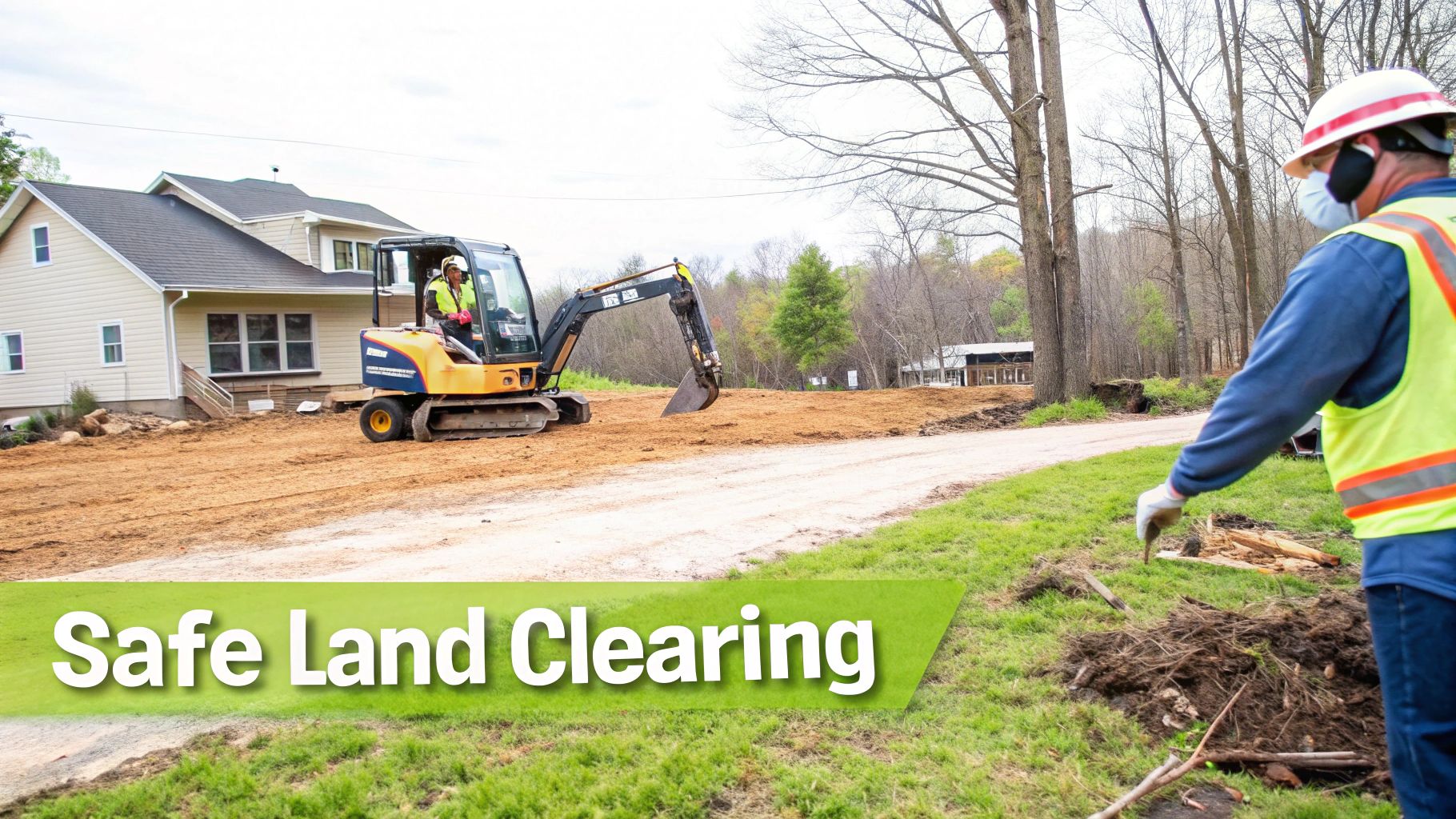
When it comes to residential land clearing, two questions always pop up first: "How much is this going to cost?" and "How long will it take?" The straight-up answer is that every single site has its own story. No two blocks of land are identical, so no two clearing jobs will ever have the same price tag or schedule.
The only way to get a firm, reliable figure is with a detailed, on-site assessment. That said, getting a handle on the main factors that drive the final cost and timeline will help you budget properly and keep your construction schedule on track. It really boils down to a few core elements that define how complex the job will be.
Key Factors Influencing Project Costs
A few key variables always come into play when we're putting together a quote for you. The more challenging and labour-intensive these elements are, the more it will be reflected in the final cost.
- Vegetation Density: A block that's lightly dotted with shrubs and a few small trees is a world away from one that’s covered in dense, established bushland. The sheer volume of green waste we need to process and haul away is a massive cost factor.
- Tree Size and Type: Popping out a few small saplings is one thing. But felling and processing a huge, mature tree like a Sydney Blue Gum? That’s a whole different ball game. It demands specialised gear, a bigger crew, and much stricter risk management, all of which influences the price.
- Site Accessibility: Can we get our machinery right up to the work area without a fuss? A flat, open block in Wyong with wide street access is a dream run compared to a steep, battle-axe block in Woy Woy where everything has to be navigated through a tight passage.
- Terrain and Slope: Working on a steep or rocky slope isn't just tricky; it introduces significant safety challenges and calls for more time and specialised techniques. Naturally, this complexity adds to the labour costs.
Our Approach: When we give you a quote, it's a comprehensive, fixed price. It covers the lot—labour, machinery, waste disposal, and a final site tidy-up. You won't find any hidden fees or surprise charges. What we quote is what you pay.
Estimating a Realistic Timeline
How long it takes to clear your block is completely tied to the scope of work.
A small-scale job for a backyard extension in a suburb like Toukley might only take a day or two. That usually involves removing a handful of trees, grinding the stumps, and giving the area a good clean-up.
On the other hand, clearing an entire residential block for a brand-new home in a place like Gosford is a far more involved process. A project of that scale could take anywhere from several days to over a week, depending on all those factors we just talked about. This timeline covers felling all the required trees, pulling out every stump and root ball, grading the site, and clearing all the debris.
We get it—your builders are often lined up and waiting for us to finish. That’s why our "On Time, Every Time" commitment is more than just a slogan. We work efficiently and professionally to get your site ready, so the next phase of your project can kick off without a single delay.
For a deeper dive into pricing, our article on the cost factors of Central Coast tree removal offers more detailed insights.
How to Choose a Qualified Arborist for Your Project
Hiring the right contractor is easily the most critical decision you'll make for your residential land clearing project. It's the difference between a safe, successful outcome and a potential disaster of property damage, legal headaches, and shoddy work. An unqualified operator can leave your land in a mess and you holding some serious liability.
With over 25+ years of experience clearing blocks across the Central Coast, Newcastle, and Lake Macquarie, we've seen it all—the good, the bad, and the outright dangerous. To help you choose with confidence, we’ve put together a practical guide on what to look for and the essential questions you need to ask. This isn't just about finding someone with a chainsaw; it's about partnering with a professional who gets the local landscape and respects your property.
Verifying Qualifications and Insurance
First things first: check their qualifications. Don't be shy about asking for proof. A legitimate arborist will be proud to show you their credentials, which should include a minimum of a Certificate III in Arboriculture. This is your assurance that they have the proper training in tree biology, safe work practices, and current industry standards.
Just as important is their insurance. Any company doing a high-risk job like land clearing must have current Public Liability Insurance, and you should always ask to see the certificate. We carry $20M in public liability coverage because it provides a crucial safety net, protecting you and your property from any unforeseen accidents. If a contractor gets cagey about providing these documents, take it as a major red flag.
The Arborist vs. The 'Tree Lopper' Distinction
You'll often hear "arborist" and "tree lopper" used interchangeably, but they represent a world of difference in skill, knowledge, and approach. A "tree lopper" is typically someone who just cuts down trees, often without formal training or a deep understanding of tree health. Their focus is purely on removal, sometimes using aggressive techniques that can damage the surrounding environment.
A qualified arborist, on the other hand, is a trained specialist. We understand the entire ecosystem, know how to assess tree health, and work within Australian Standards (like AS 4373-2007, Pruning of Amenity Trees). Our work preserves the long-term value of your property. For a deeper dive into what sets a professional apart, you can learn more about our Central Coast arborist services. Choosing an arborist is an investment in quality and safety from the get-go.
Asking the Right Questions
When you have a potential contractor on-site for a quote, use it as a chance to suss out their professionalism and expertise. Here are a few key questions that will tell you a lot:
- Can you provide local references? A reputable company will happily share contacts from recent jobs in areas like Gosford, Warners Bay, or Belmont.
- How will you protect my property? Ask them to walk you through their process for preventing damage to driveways, fences, and neighbouring properties.
- What's your process for waste removal? Make sure their quote includes the complete removal and disposal of all green waste, leaving your site tidy.
- Are you familiar with local council regulations? They should be able to speak confidently about the specific requirements of Central Coast, Newcastle, or Lake Macquarie councils.
Our Promise: With Treecorp Solutions, you're not just hiring a crew; you're partnering with a team that has a long-standing reputation in the community. We are committed to responsible land management, always mindful that our work impacts the local environment.
Unfortunately, Australia has seen significant vegetation loss since European settlement, a trend that highlights the need for responsible land management today. To understand the broader context, you can explore the history and data of vegetation clearing trends in Australia on Wikipedia. By choosing a qualified arborist who respects these environmental responsibilities, you ensure your project is completed ethically and sustainably.
Your Land Clearing Questions Answered
After 25+ years of working with homeowners, strata managers, and builders across the Central Coast, Newcastle, and Lake Macquarie, we’ve heard just about every question there is about residential land clearing. It’s a big undertaking, and it's only natural to want clear, straightforward answers before you commit.
We’ve pulled together some of the most common queries we get to help you make the right call for your property.
What's the Difference Between Land Clearing and Tree Removal?
This one comes up a lot, and it's a great question. The two services sound similar but are worlds apart in scope and purpose.
Standard tree removal is surgical. It’s a targeted job focused on a single tree or a small group, usually for safety, health or aesthetic reasons—like dealing with a diseased gum tree in your Belmont backyard.
Residential land clearing, on the other hand, is a large-scale operation. It’s about preparing an entire section of land for something new, whether that’s a new home build, a granny flat, or a commercial project. It's a comprehensive process that goes far beyond just cutting down a few trees.
Key Takeaway: Think of it like this: tree removal is like taking a single item out of a room. Land clearing is like completely gutting the room to prepare it for a total renovation. One is selective, the other is transformative.
The goal of clearing is to create a totally clean slate. That means removing trees, shrubs, stumps, rocks, and any other obstacles to give you a safe, buildable surface.
How Do You Protect the Environment During Clearing?
Protecting our local environment is at the heart of everything we do. It’s a responsibility we take seriously on every job, whether we’re working near the coastal lagoons of The Entrance or the bushland reserves around Warners Bay.
Before a single machine starts up, we do a thorough site assessment. We’re looking for sensitive areas, significant native trees, and potential wildlife habitats.
From there, we implement strict environmental controls:
- Erosion and Sediment Control: We use silt fences and other barriers to stop soil and debris from washing into stormwater drains or nearby waterways. This is absolutely critical on sloped sites.
- Minimising Soil Disturbance: We match the machinery to the job to avoid unnecessary soil compaction, which can suffocate the root systems of trees you want to keep.
- Protecting Retained Trees: If you’re keeping some trees, we fence off clear protection zones around them to prevent damage to their trunks and roots during the project.
Unfortunately, our state has seen a major increase in land clearing. In 2023, New South Wales witnessed a staggering 47% surge, with 66,498 hectares of native bush destroyed. This alarming jump highlights why responsible, professional practices are more critical than ever. You can discover more insights about these land clearing statistics from The Nature Conservation Council of NSW.
What Happens to All the Green Waste?
A professional land clearing job always includes the complete removal and responsible disposal of all green waste. Leaving piles of logs, branches, and mulch on site is simply not how professionals operate. Our process guarantees your block is left completely tidy and ready for the next stage.
Depending on the type and volume of material, we use a few different methods. High-quality timber can sometimes be milled for firewood or other uses. The vast majority of branches, leaves, and smaller vegetation goes through a high-capacity wood chipper, creating mulch. This is then trucked off-site for recycling or reuse in landscaping and soil improvement projects. It's an efficient system that minimises landfill and puts green waste to good use.
Can I Do Any of the Clearing Myself to Save Money?
It's tempting to think about saving some cash by tackling parts of the job yourself, but we strongly advise against it for anything beyond light gardening work. Residential land clearing is a high-risk activity that demands specialised training, professional-grade equipment, and a deep understanding of safety protocols.
Trying to fell trees or operate heavy machinery without the right qualifications is incredibly dangerous. It can lead to serious injury, property damage, or worse. You could also accidentally breach council regulations by removing a protected tree, leading to hefty fines. Honestly, it's a job where the risks massively outweigh any potential savings.
Hiring a professional team with full insurance, including $20M public liability coverage, is the only way to ensure the job is done safely, compliantly, and efficiently. It gives you complete peace of mind, knowing that you and your property are fully protected from start to finish.
Ready to take the next step with your project? The team at Treecorp Solutions is here to help. With over 25 years of local experience, we provide safe, compliant, and reliable residential land clearing services across the Central Coast, Newcastle, and Lake Macquarie.
Request a free quote online or give us a call to discuss your needs with one of our qualified arborists.