When a severe storm barrels through the Central Coast, the aftermath can be confronting. Seeing a massive tree sprawled across your property is a shock, and the first instinct for many is to rush outside. But hold on. Safety has to come first. Hidden dangers like downed powerlines or unstable branches can turn a bad situation into a tragic one. With over 25 years of experience helping homeowners and strata managers across the Central Coast and Newcastle, we've seen it all. This guide will walk you through the essential steps, from the first moments after the fall to the final clean-up.
What to Do Immediately After a Tree Falls
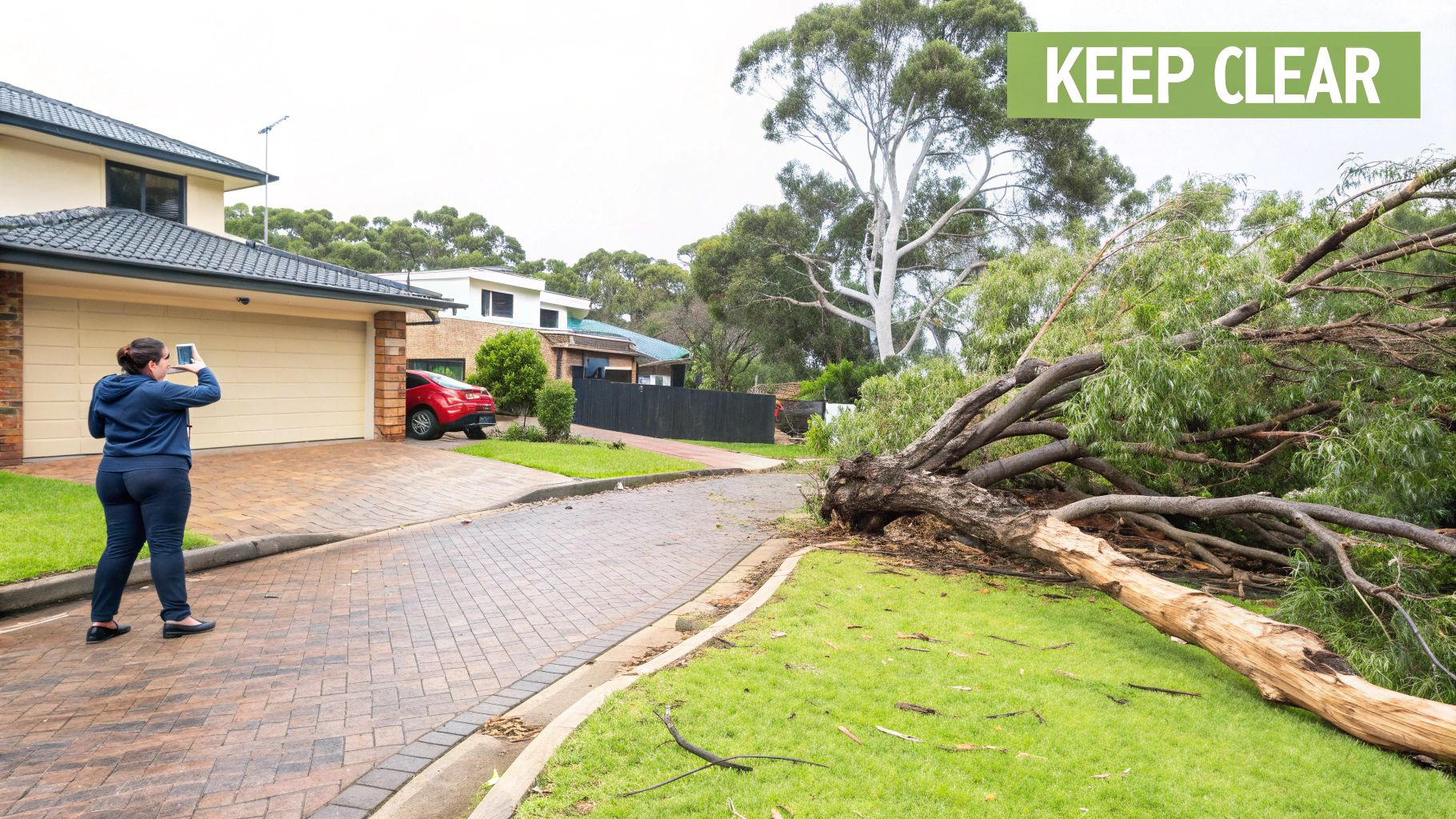
Discovering a fallen tree, especially after one of the fierce coastal storms we get from Newcastle down to the Central Coast, is incredibly stressful. The most important thing you can do is take a deep breath and assess everything from a safe distance—well clear of the fall zone. Stay inside or on a secure verandah and look carefully.
Let's imagine a large gum tree has come down across your driveway in a suburb like Erina or Umina Beach. Before you even think about moving it, you need to play detective. The absolute number one hazard to check for is downed powerlines. If you see any wires tangled in the branches or lying on the ground, assume they are live and extremely dangerous.
Securing the Area and Making the Right Calls
Your immediate priority is making sure everyone is safe. Keep children and pets indoors and well away from the fallen tree until the area has been professionally declared safe. The tree itself could be unstable, with branches under immense tension that could snap or shift without warning.
Once you have a clear view from a distance, it’s time to call the right people. Your response depends entirely on what you see.
- Downed Powerlines: Your first and only call should be to Ausgrid's emergency line. Do not go near the area or touch anything—not even a damp fence.
- Immediate Public Danger: If the tree is blocking a public road or has fallen in a way that endangers others, call the State Emergency Service (SES).
- Damage to Your Home: Has the tree hit your roof or another part of your house? Your next calls will be to your insurer and a professional arborist. Knowing the immediate steps is crucial; for more detail, it’s worth reading a guide on what to do if a tree falls on your roof.
- The Tree Itself: For the actual removal, especially in complex situations, you'll need a qualified and insured arborist. Our team is fully equipped for emergency tree removal and can make the site safe fast.
Remember, property can be fixed, but personal safety is irreplaceable. Never attempt to cut or move a large fallen tree yourself, especially if it's near powerlines or resting on a building. The risks are just too high.
Assessing the Full Scope of the Damage
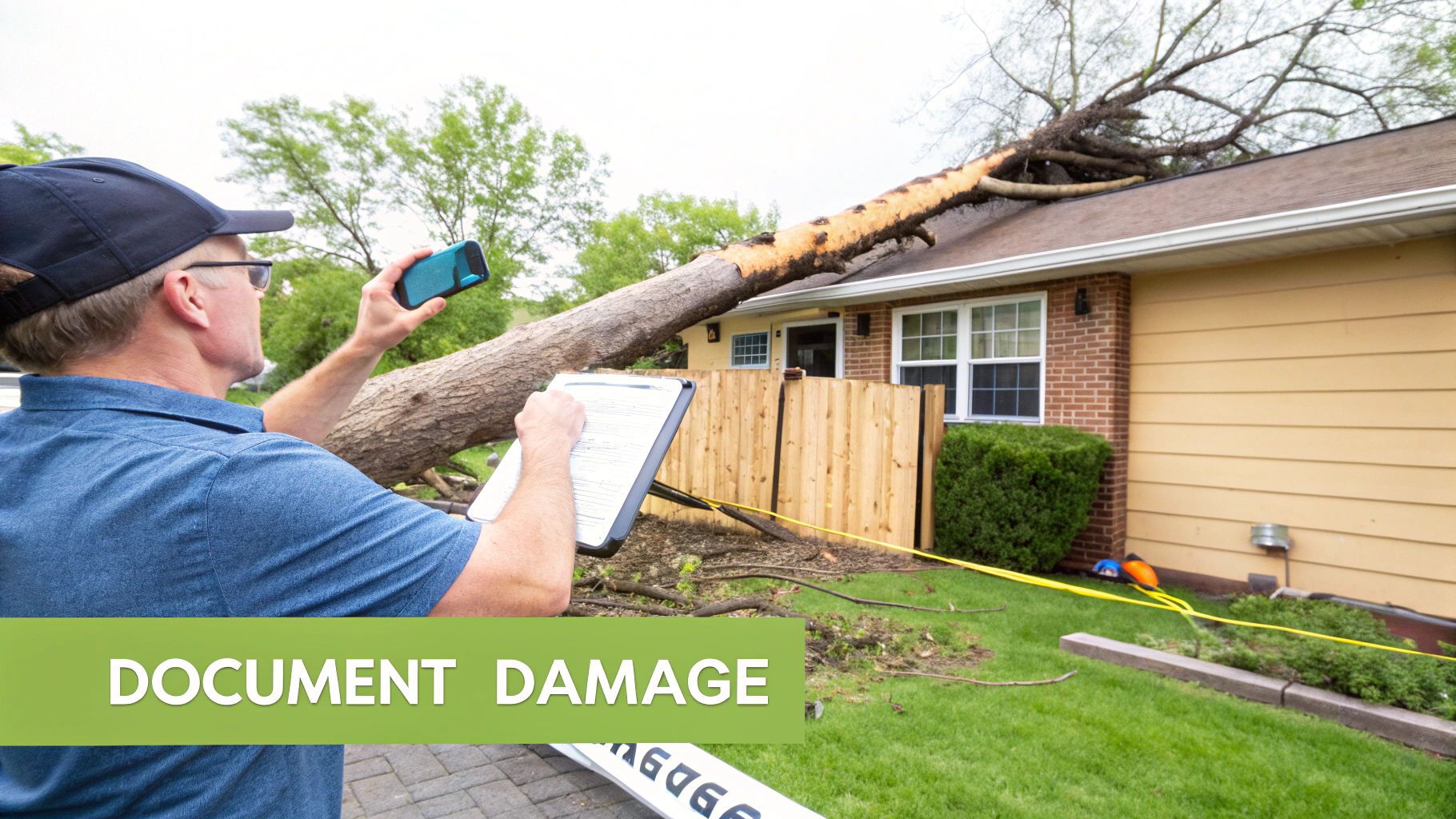
Once you're certain the immediate area is safe, it’s time to take a deep breath and figure out exactly what you're up against. The difference between a small wattle down in a Gosford backyard and a massive Blackbutt smashing a roof in Terrigal is night and day. Your next steps hinge entirely on this initial assessment.
This is a critical moment, especially if you’re planning to make an insurance claim. The first thing we always tell clients is to grab their phone and start documenting everything. Before a single branch is moved, take photos and videos from every angle. It's easy to forget this in the heat of the moment, but that evidence is gold when you're on the phone with your insurer.
Documenting for Insurance and Safety
Start with wide shots to capture the whole scene, then get up close to show the specific points of impact. Is it the fence? The car? The corner of the house? Make sure you get clear photos of the damage. Note the date and time, too—this creates a clean timeline for your claim and can save a lot of headaches later on.
Once you’ve got your photos, shift your focus to how the tree is lying. This isn't just about where it landed; it’s about the physics of the situation. A qualified arborist is trained to spot the hidden dangers created by the fall.
Crucial Safety Check: Look for signs of tension and compression. Is the trunk bent awkwardly over a retaining wall or your car? A bend like that creates enormous stored energy, like a loaded spring. Making the wrong cut can cause the trunk to snap upwards or sideways with deadly force.
Understanding the Tree's Position and Potential Energy
A tree that's twisted or propped up against a structure is infinitely more dangerous than one lying flat on the lawn. For example, imagine a large Tallowwood has come down and is now resting precariously on your garage roof in a tight Belmont street. Its entire weight is balanced on a few points. Attempting to cut it up without the right rigging and expertise could cause it to shift, roll, or bring the rest of the garage down with it.
These complex scenarios are exactly why you call a professional. With over 25+ years of experience, we know how to read these situations, understand the forces at play, and plan a sequence of cuts that safely releases that stored energy. Trying this yourself is a massive gamble.
While the risks are rare, they are severe. Data from John Hunter Hospital, which serves the Newcastle region, showed that out of nearly 14,000 trauma cases, 16 were directly related to tree felling or pruning. Nationally, about four people die each year from accidental tree failures. This is why a proper assessment is the most important part of removing a fallen tree safely. You can learn more about the local risks from storm-damaged trees in this detailed study.
Checking Council Regulations Before You Cut
Finally, there’s the matter of local council rules. Just because a tree has fallen doesn't automatically give you a green light to chop it into firewood. Councils across the Central Coast, Newcastle, and Lake Macquarie have specific regulations, especially for protected native species. A fallen angophora in a Charlestown backyard might still be covered by local tree preservation orders that dictate how it can be disposed of.
Before starting any major work, it’s always smart to check with your local council. This is another area where our local knowledge comes in handy. We deal with these councils every day and can help you navigate the paperwork, ensuring everything is handled by the book. It’s a small step that can save you from a potential fine, especially if you live in a heritage conservation area or a suburb with a strict vegetation management plan.
DIY Removal vs Calling a Professional Arborist
After a storm rolls through, seeing a tree down in your yard can bring out the inner lumberjack in anyone. It's tempting to grab the chainsaw and start cutting it up. For a small branch lying clear on the lawn, that’s probably fine. But when you're dealing with anything bigger, that impulse decision can go sideways, fast.
The biggest danger most people don't see is stored energy. A fallen tree isn't just a dead log; it’s a complex structure under incredible tension and compression. Picture a big tree trunk bent over a retaining wall—it's essentially a giant, loaded spring. One wrong cut can release that energy in a split second, causing the trunk to roll, kick back, or whip sideways with terrifying force.
When to Immediately Stop and Call an Expert
With over 25+ years of working on storm-damaged trees across the Central Coast and Newcastle, we've seen firsthand what happens when DIY jobs go wrong. There are some non-negotiable red flags that mean you absolutely must put the tools down and call in a professional arborist.
These situations are clear signs the job is too dangerous for a DIY approach:
- Size and Weight: If the trunk is thicker than your leg or far too heavy for two people to shift, you simply don't have the gear to handle it safely.
- Near Powerlines: Never, ever work anywhere near overhead wires. Even if they look undamaged, you have to assume they are live. The risk is just too high.
- Resting on Structures: Is the tree on your roof, car, shed, or fence? It's supporting a heavy, unstable load. Trying to remove it without the right technique will almost certainly cause more damage.
- Entangled Trees: When a fallen tree gets hung up in the branches of another, it creates an extremely unpredictable and dangerous situation known as a "hanger." These are widow-makers.
A small chainsaw from Bunnings is designed for light pruning, not for sectioning a mature Eucalypt. It’s like trying to knock down a brick wall with a tack hammer—you don't have the power, the safety features, or the specialised rigging needed to control the situation.
The Professional Advantage: Peace of Mind and Protection
Calling in a qualified team isn't just about bringing bigger saws. It's about getting a crew with the training to read the forces in the tree, understand the physics involved, and dismantle it methodically and safely. This is the key difference between a handyman and a certified arborist. You can learn more about what arborists do in our detailed article.
A professional team brings peace of mind backed by proven safety protocols and, critically, proper insurance. Our $20M public liability insurance means that in the unlikely event something goes wrong, you, your home, and your neighbours are completely protected. That's a level of security a DIY job or a casual handyman can never offer.
The risks involved in tree work are immense. In New South Wales, tree-related incidents are a stark reminder of why expertise matters. SafeWork Australia data shows that around 65% of fatalities in the arboriculture industry happen during the initial tree felling, and another 7% occur while cutting up trees that are already on the ground. The danger doesn't stop just because the tree has fallen.
If you do decide to hire help, the principles for selecting the best landscaper apply here too—look for qualifications, insurance, and experience.
Ultimately, the choice comes down to a simple risk assessment. The few hundred dollars you might save doing it yourself are nothing compared to the potential cost of a serious accident, thousands in property damage, or a trip to the emergency room.
The Professional Tree Removal Process Explained
So, you’ve decided against the DIY route and made the wise choice to call in the professionals. Good move. But what actually happens next? When you call Treecorp Solutions, you’re not just getting a couple of blokes with a chainsaw; you’re engaging a team of qualified arborists with a systematic process designed for safety and efficiency, honed over 25+ years of service.
The entire process kicks off the moment we arrive at your property. Whether it's a tight-access block in Woy Woy or a sprawling commercial site in Tuggerah, our first step is always a thorough on-site assessment. We don't just glance at the tree; we analyse the entire scene to create a safe, effective removal plan.
Creating a Safe and Methodical Removal Plan
Our lead arborist will walk the site with you, listening to your concerns and explaining what they see from a technical standpoint. We're looking for hazards like hidden services, property risks, and the specific physics of the fallen tree. Is the trunk under tension? Are there large, detached branches caught in the canopy just waiting to fall? This detailed inspection is crucial for planning the safest sequence of cuts.
Based on this assessment, we map out a tailored plan that puts the safety of everyone—your family, the public, and our crew—first. This includes setting up clear exclusion zones and making sure all work complies with Australian Standards and WHS legislation. It's this methodical approach that prevents further damage and ensures a smooth operation.
Our commitment is simple: On Time, Every Time. When we schedule your job, you can count on our crew arriving prepared and ready to work. We understand that after a storm, the last thing you need is a tradie who doesn't show up.
The Techniques of Safe Tree Dismantling
For most fallen trees, especially large ones, we don't just start hacking away. We use a technique called sectional dismantling. Think of it like carefully deconstructing something piece by piece, rather than just demolishing it. We strategically remove the tree in manageable sections, which is the key to preventing the trunk from rolling or shifting unexpectedly.
Imagine a large Ironbark has crashed across your sloping driveway in a Lake Macquarie suburb like Warners Bay. Using specialised rigging and cutting techniques, we secure sections of the trunk before cutting them free. This ensures each heavy piece is controlled, preventing it from careening down the slope and causing more damage. If access is tricky or the tree is a monster, we can bring in cranes and other heavy machinery to lift sections clear of your property. For a deeper dive, our guide on the complete tree removal process from the root offers more detail.
This quick decision guide helps visualise when to make the call for professional help.
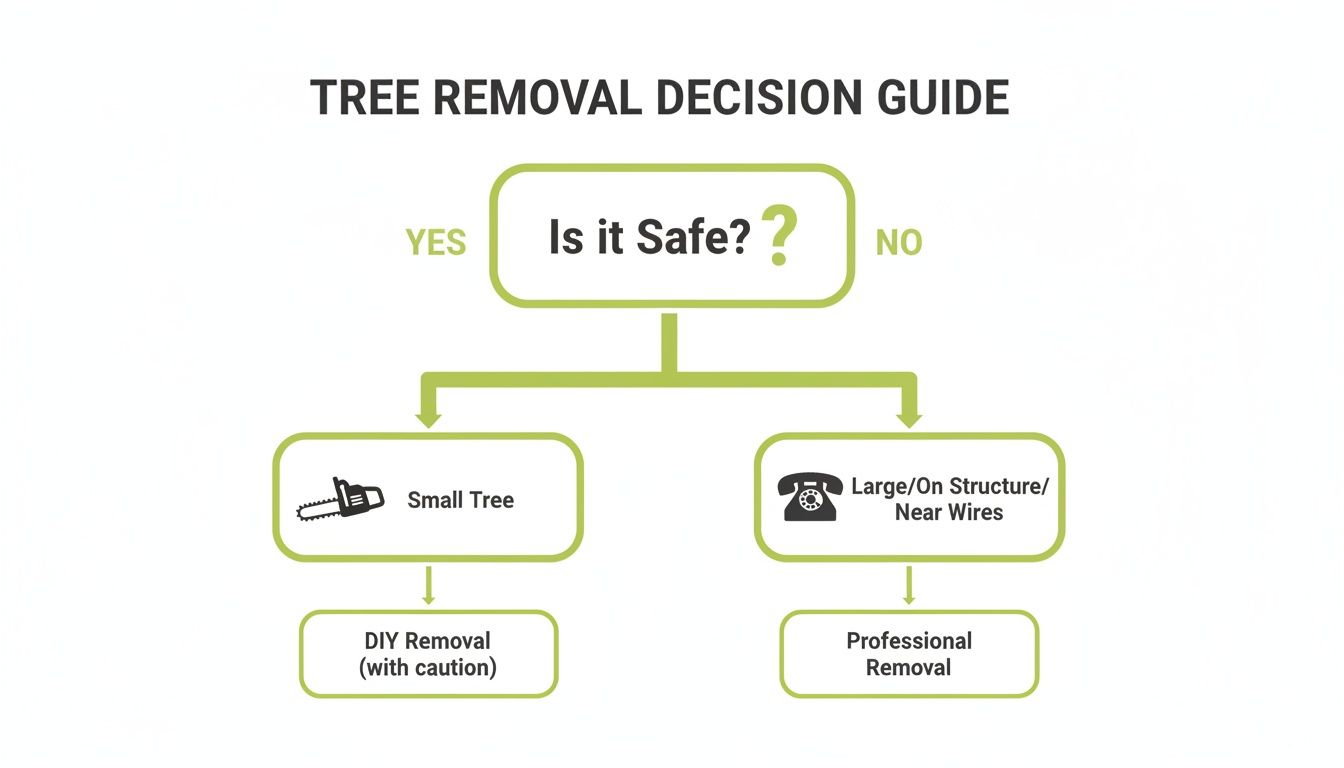
As the flowchart shows, any real complication—like the tree's size, its location on a structure, or proximity to powerlines—means professional removal is the only safe choice.
Final Clean-Up and Leaving Your Property Tidy
Our job isn’t done once the last piece of the trunk is on the truck. A core part of our professional service is the final, comprehensive clean-up. We use powerful wood chippers to process smaller branches and foliage into mulch, and our crews rake, sweep, and blow down the entire work area.
This is especially important for our strata clients managing body corporate expectations in shared spaces, from apartment complexes in Gosford to townhouses in Newcastle. We make sure driveways, paths, and common gardens are left clear and tidy, minimising disruption for all residents.
Our goal is simple: leave your property looking as good as, if not better than, it did before we arrived—minus the fallen tree, of course. This whole process is backed by our full $20M public liability insurance, giving you complete peace of mind from the initial call to the final sweep-up.
After the Tree Is Gone: Stump and Debris Management
Getting the main trunk and branches of a fallen tree cleared is a massive relief, but the job's not quite done. You’re often left with a stubborn stump and a mountain of green waste, and tackling these is the final step in getting your property back to normal.
For homeowners anywhere from Forresters Beach to Caves Beach, reclaiming the yard quickly is usually the top priority. This is where having a smart plan for the leftover stump and debris really pays off. When it comes to the stump, you've got a couple of options, and the right choice really boils down to what you plan to do with that space next.
Stump Grinding vs. Complete Stump Removal
The two main approaches here are stump grinding and a full stump removal, and they couldn't be more different. A complete removal means digging out the entire root ball. It’s a serious earthmoving job that tears up your lawn and garden beds in a big way. Frankly, it's rarely necessary unless you're about to lay a foundation or pour a new driveway right over that spot.
For pretty much every other scenario, stump grinding is the smarter solution. It’s quicker, way less invasive, and much easier on the wallet. We bring in a powerful stump grinder that literally chews the stump and its main surface roots into small wood chips, taking it down well below ground level. The process effectively erases the stump without destroying your yard. You can get the full rundown on how it works in our guide to our professional tree stump grinding service.
One of the best things about stump grinding is what you get at the end. The mix of wood chips and soil it creates is a fantastic organic mulch. We can either haul it away for you or leave it piled up, ready for you to spread on your garden beds to help keep moisture in and weeds out.
Responsible Debris and Green Waste Disposal
So, what about all that timber, foliage, and branch wood? With over 25+ years in the game, we’ve perfected a responsible and efficient disposal system. Our goal is to recycle as much of every tree as possible, making sure very little actually goes to waste.
Our high-powered wood chippers turn all the smaller branches and leaves into quality mulch right there on-site. The bigger logs from the trunk and main branches can often find a second life.
- Firewood: If the tree was a good hardwood like an Ironbark or Spotted Gum, we can cut the logs into manageable rounds for you. All you have to do is split and season them for your fireplace. Just give us a heads-up beforehand!
- Milling: Sometimes, a high-quality log is perfect for milling into slabs for furniture making or other unique woodworking projects.
- Recycling: Anything left over is taken to a dedicated green waste facility where it’s processed into commercial-grade mulch or compost.
This focus on a thorough clean-up is especially vital in strata complexes. For a body corporate managing a property in a busy suburb like Adamstown or The Entrance, keeping disruption to a minimum is key. Our crews work methodically to clear shared driveways and common areas, leaving the site safe and tidy for all residents. It's all part of our promise to leave every property looking better than when we arrived.
Navigating Insurance Claims and Council Permits
When a tree comes down on your property, dealing with the aftermath can feel overwhelming. The physical cleanup is one thing, but the paperwork that follows—from insurance claims to council rules—can be just as stressful. We've seen countless homeowners in this exact spot, but a little bit of know-how can make the whole process much less of a headache.
For most people, the first call is to their insurance company. It’s crucial to understand what your policy is actually likely to cover. Generally, if a tree falls and damages an insured structure like your house, garage, or even a fence, your home insurance should cover the cost of removing the part of the tree that’s on the structure, as well as the necessary repairs.
But here’s a detail that often catches people out: if a tree simply falls into your yard without hitting anything, the removal costs are usually not covered. It's a frustrating but common clause. Our best advice is always the same: before anything is moved, take plenty of photos from every angle. Then, get a detailed quote from a professional arborist to submit with your claim.
Understanding Your Insurance Policy
When you lodge a claim, your insurer will want clear, documented evidence of the damage. A professional quote from a team like ours, which breaks down the specific work needed to make the area safe and remove the tree from the damaged structure, really helps to streamline the process. We provide all the necessary documentation to give your claim the best chance of a smooth approval.
It’s also worth knowing that if your neighbour's tree falls on your property during a storm or other natural event, your neighbour generally isn't held responsible. In these "act of God" scenarios, you'll typically need to claim on your own policy. We always recommend digging out your policy documents or calling your provider directly to confirm the specifics.
Key Takeaway: Document everything with photos before any work starts. A detailed arborist's report and quote are your most powerful tools for a successful insurance claim, especially when a tree has caused property damage.
Dealing with Local Council Requirements
Just when you think you're over the hurdles, you have to consider council permits. A fallen tree doesn’t automatically give you a green light to dispose of it however you see fit. Councils across the Central Coast, Newcastle, and Lake Macquarie all have their own specific tree preservation orders.
Believe it or not, these rules can sometimes apply even to fallen trees, especially if they are a significant native species. For example, getting rid of a large, fallen angophora in a Charlestown backyard might still need a permit or have specific disposal instructions. The risks are real, too. A WorkSafe alert highlighted the hidden dangers of storm-damaged trees after a partially cut tree dislodged and caused a serious injury—a scenario all too possible in our wet and windy local conditions.
This is where local experience really counts. Having worked for over 25+ years in suburbs from Wyong to Warners Bay, we know the regional variations in council regulations inside and out. We can help you figure out if a permit is needed, taking that compliance stress right off your shoulders. For a more detailed guide, check out our post on navigating council approval for tree removal. Our aim is to make the entire process, from the first assessment to the final paperwork, as simple as it can possibly be for you.
Your Fallen Tree Questions, Answered
When a tree comes down on your property, a million questions race through your mind. With over 25+ years of experience helping folks clean up after storms across the Central Coast, Newcastle, and Lake Macquarie, we’ve pretty much heard them all. Here are the answers to the most common ones we get.
How Much Does Fallen Tree Removal Cost?
This really depends on the situation on the ground. The cost can vary quite a bit. A small tree that’s fallen cleanly into an open yard is a straightforward job. It's a completely different story for a massive old gum tree that's tangled in powerlines or has crashed onto your roof in a tight suburban street in Belmont.
The final price comes down to a few key things: the sheer size of the tree, its location and how easily we can get our heavy equipment in, and the complexity of the job. We also factor in things like stump grinding if you need it. To make sure there are no surprises, we always come out for a proper site assessment and give you a detailed, obligation-free quote.
Will My Home Insurance Cover the Removal?
This is the big one for most people. Generally, your insurance policy will cover the cost of removing a tree if it has fallen on and damaged an insured structure. This includes your house, garage, or even a fence in a suburb like Adamstown.
However, if a tree simply falls in your yard without hitting anything, the clean-up cost is often not covered by a standard policy. It's always best to pull out your PDS or call your insurer to check your specific coverage. When there is damage, we can provide all the professional documentation you need to support your claim.
Can I Keep the Wood for Firewood?
Absolutely! Just let us know you want to keep it. For good hardwoods, we can cut the main trunk and larger branches into manageable rounds for you. All you'll need to do is split and season them later. It's a fantastic way to make use of the timber.
We can then chip all the smaller branches and leaves, either taking the mulch away or leaving it for you to use in your garden beds—it's brilliant for suppressing weeds and retaining moisture.
For a fast, safe, and professional response when a tree falls, you can trust the team at Treecorp Solutions. We offer a 24/7 emergency service to make your property safe again. Request a free quote online or give us a call for immediate help.